
Agentic AI for Customer Support: Smarter Support That Actually Works
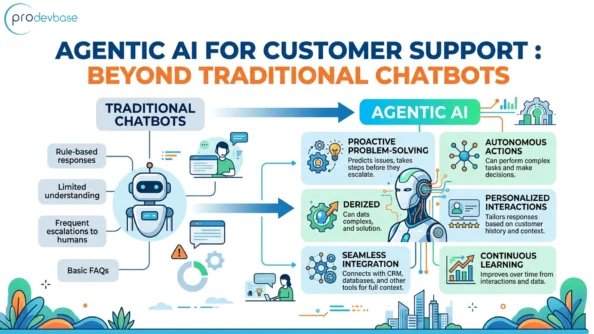
Agentic AI for Customer Support: Beyond Traditional Chatbots
Customer support is often the first place where a business feels the gap between what technology promises and what it actually delivers. While many organizations rely on chatbots to greet visitors or answer basic FAQs, these tools often fail the moment a customer has a real problem. Whether it is a delayed order, a billing discrepancy, or a complex product replacement, a traditional bot typically hits a wall and sends the customer to a human queue. So let’s have a look at Agentic AI for Customer Support.
Agentic AI for customer support changes this dynamic by moving from scripted replies to autonomous, end-to-end problem solving. These systems are not built on rigid decision trees. Instead, they understand context, access internal systems, and resolve issues with the same level of capability as a trained support agent.
Why Traditional Chatbots Fail the Resolution Test
Traditional chatbots operate primarily on intent matching. When a customer types a message, the bot attempts to match it to a pre-defined category and returns a scripted answer. This is effective for a narrow set of predictable questions:
- Operating hours and physical locations
- General return and refund policies
- Basic product availability checks
The limitation arises because modern support interactions are rarely one-dimensional. They involve account histories, live order details, and payment records. Traditional chatbots cannot typically update a record in your CRM or carry out a multi-step process across different tools. When a conversation moves beyond the script, the bot either provides an incorrect answer or forces an escalation to a human. This creates friction rather than efficiency.
The Core Limitation: Traditional bots are designed to respond. Agentic AI is designed to act.
How Agentic AI Handles Support Differently
An agentic AI system does not just provide a link to a help article. It reasons about the customer’s specific needs, identifies the necessary steps to solve the problem, and executes those tasks within your existing business software.
A Practical Comparison:
If a customer reports that an order arrived damaged, a traditional chatbot might offer a link to a returns form. In contrast, an agentic AI system looks up the order in your database, verifies the purchase date, initiates a replacement shipment, and sends a confirmation email. It then automatically logs the entire interaction in your CRM.
This shift transforms the technology from a simple communication interface into a digital support agent capable of independent work.
Three Pillars of Agentic AI Capability
To be a true alternative to traditional chatbots, agentic AI relies on three core operational strengths:
- Cross-System Integration: It connects directly to your helpdesk, order management system, and payment gateway. It pulls real-time data and writes updates back to the tools your human team uses.
- Multi-Step Reasoning: Most customer issues require a sequence of actions. Agentic AI can plan these steps, handle conditional logic, and adapt if a customer provides new information mid-conversation.
- Contextual Escalation: When a situation requires human empathy or complex judgment, the AI hands off the case intelligently. It provides the human agent with a full summary so the customer never has to repeat their story.
The Business Case: Resolution Rate over Deflection Rate
In the current market, the value of support technology is no longer measured by how many people it prevents from calling (deflection). It is measured by how many problems it actually solves (resolution).
As customer expectations for instant results continue to grow, a bot that merely acts as a gatekeeper is seen as a barrier to service. Agentic AI addresses this by resolving a significant percentage of tickets entirely on its own, which directly improves customer satisfaction and reduces the operational cost per ticket.
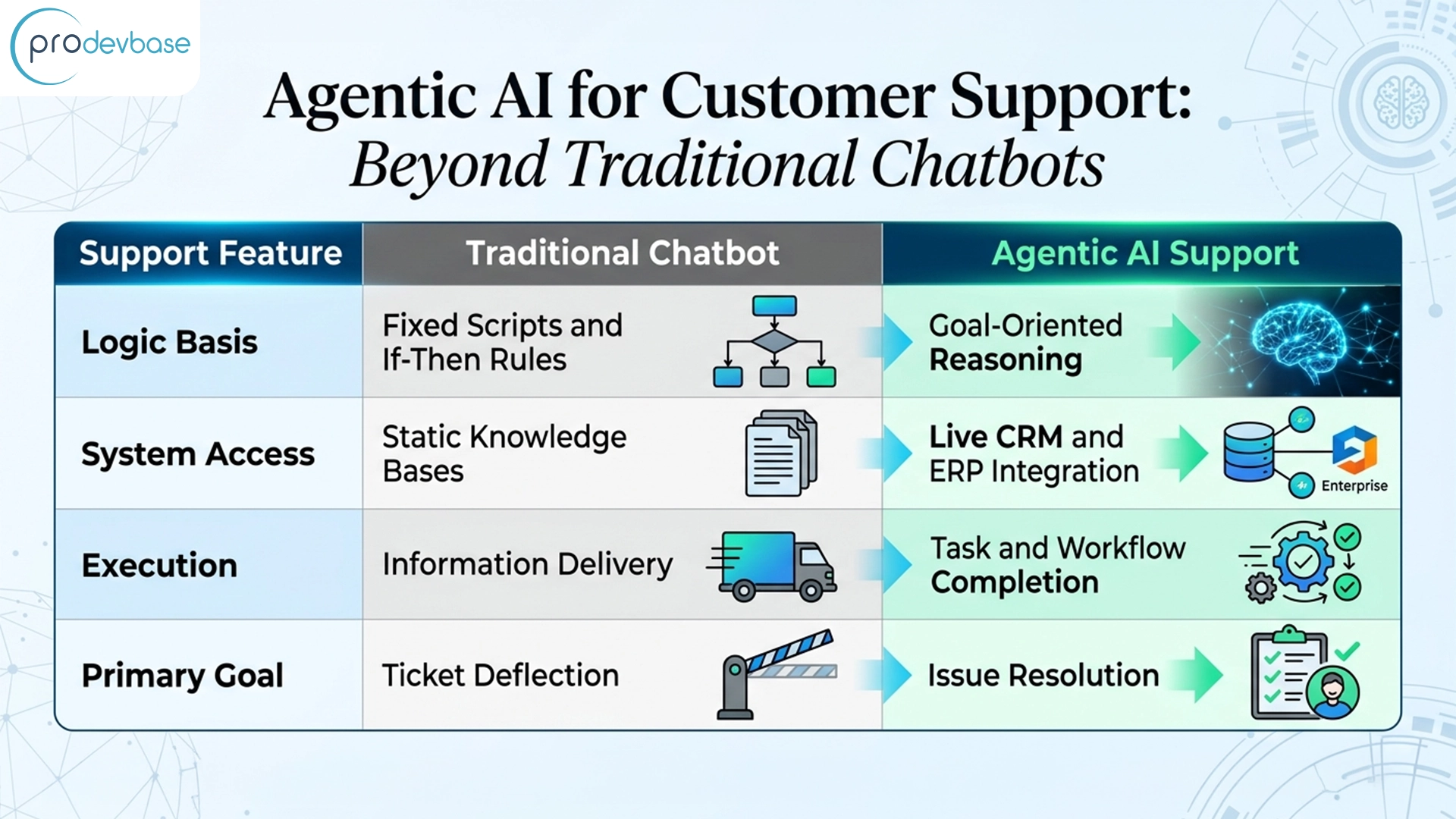
| Support Feature | Traditional Chatbot | Agentic AI Support |
|---|---|---|
| Logic Basis | Fixed Scripts and If-Then Rules | Goal-Oriented Reasoning |
| System Access | Static Knowledge Bases | Live CRM and ERP Integration |
| Execution | Information Delivery | Task and Workflow Completion |
| Primary Goal | Ticket Deflection | Issue Resolution |
Also read: Agentic AI vs Generative AI: What Should Your Business Invest in First?
Practical Applications for AI Support Automation
- Retail and E-commerce: Fully managing returns, exchanges, and stock inquiries by accessing live logistics data.
- Financial Services: Navigating transaction disputes and account updates while strictly following compliance protocols.
- SaaS and Tech Support: Performing account diagnostics, resetting user credentials, and adjusting subscription levels instantly.
- Healthcare Administration: Automating appointment scheduling and insurance verification without adding to the administrative workload.
Evaluating an Agentic AI Solution
When moving away from traditional chatbots, it is essential to ask the right questions about potential solutions:
- Does it have “write” access? If the tool can only read data but cannot update a system, it is not a true agent.
- Can it handle ambiguity? A sophisticated system should ask clarifying questions instead of failing when a prompt is not perfectly clear.
- Is performance measured by resolution? Ensure the focus is on how many tasks the AI completes from start to finish.
Frequently Asked Questions
How does agentic AI interact with human teams?
It acts as a first-line responder that handles high-volume, routine tasks. This allows human agents to focus their energy on complex, high-value, or sensitive customer relationships.
Is this technology accessible for smaller businesses?
Yes. Agentic AI is a force multiplier for small teams, allowing them to provide 24/7, high-quality support without the need for a massive headcount.
What systems can it integrate with?
Most platforms use secure APIs to connect with standard business tools like Salesforce, HubSpot, Zendesk, and Shopify to ensure data consistency.
Move Beyond Simple Responses
Agentic AI for customer support allows your business to resolve customer needs at scale. If you are ready to transition from bots that talk to agents that work, the next step is a strategic conversation about your automation goals.