
Agentic AI vs Generative AI: What Should Your Business Invest in First?
Which is better Agentic AI or Generative AI for business Growth?
Every week, a new AI product claims it will transform business operations. Yet two categories continue to lead the conversation: Generative AI and Agentic AI. They are not the same, and choosing where to invest first can shape your competitive position for years to come. So let’s have a deep look into which is better Agentic AI or Generative AI for business Growth?
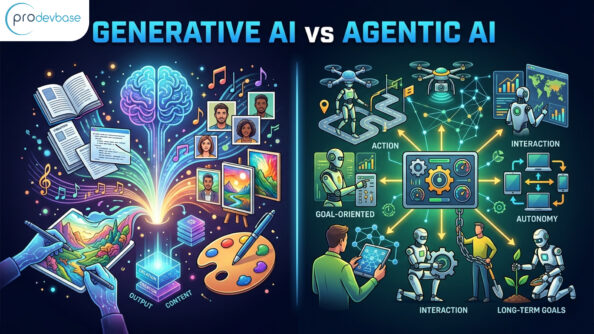
Many businesses have already experimented with Generative AI. They use tools like ChatGPT to draft emails, Midjourney to create visuals, or GitHub Copilot to speed up development. In simple terms, Generative AI takes a prompt and produces an output such as text, code, images, or audio within seconds.
Agentic AI is different. It does not only respond. It can take action. An Agentic AI system can set goals, break tasks into steps, use tools, and complete work with limited human direction. For example, it may review emails, decide which need replies, draft responses, and send them automatically.
So, which one should your business invest in first?
The answer is not about choosing one winner. Instead, it depends on where your business stands today and what outcomes you want tomorrow.
What Generative AI Actually Does for a Business
Generative AI is strongest when businesses need to create content at scale.
It can:
- Write hundreds of product descriptions quickly
- Summarise long reports into short briefs
- Create multiple sales email versions for testing
- Assist developers with code suggestions
- Speed up customer support responses
The key word is produce.
Generative AI acts like a creative engine. You provide a topic, brief, or dataset, and it returns finished output. Because of this, it is especially valuable in:
- Marketing
- Content operations
- Customer service
- Software development
- Internal communications
However, Generative AI does not take initiative. It waits for a prompt. It will not monitor your business, identify a problem, and solve it on its own.
That is not necessarily a weakness. It keeps humans in control. Still, it means businesses need teams that know how to use these tools effectively.
Key Insight
Generative AI multiplies human output. It does not replace human judgement.
The companies seeing the best results use it as a productivity tool, not as a replacement for people.
What Agentic AI Actually Does for a Business
Agentic AI goes further than content generation.
Instead of waiting for prompts, it works toward goals.
For example:
- Book the cheapest flight next Tuesday
- Identify overdue invoices and send reminders
- Route support tickets to the right department
- Reconcile data across multiple systems
- Manage onboarding workflows
An Agentic AI system can reason through a plan, choose the right tools, check progress, and adapt if something changes.
Think of it this way:
- Generative AI is a powerful tool
- Agentic AI behaves more like a capable teammate
This creates major business potential. Many repetitive and multi-step workflows can be automated through Agentic AI, especially in:
- Finance
- Logistics
- Healthcare
- Operations
- IT support
Also don’t miss to know What is AI Strategy and Advisory with Examples?
However, Agentic AI is more complex to deploy. It also carries more risk if not properly governed.
A Generative AI mistake may create a poor draft email. An Agentic AI mistake could send that email automatically.
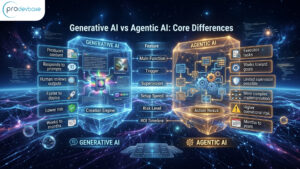
Generative AI vs Agentic AI: Core Differences
| Feature | Generative AI | Agentic AI |
|---|---|---|
| Main Function | Produces content | Executes tasks |
| Trigger | Responds to prompts | Works toward goals |
| Supervision | Human reviews outputs | Limited supervision possible |
| Setup Speed | Faster to deploy | More complex implementation |
| Risk Level | Lower risk | Higher operational risk |
| ROI Timeline | Weeks to months | Months to years |
Both technologies are growing quickly. However, their maturity levels are different.
Generative AI tools are more accessible today. Vendor options are stronger, pricing is competitive, and use cases are clearer.
Agentic AI is still evolving. Best practices, infrastructure, and enterprise-grade reliability are improving but not yet universal.
Which Should You Invest in First?
For most organisations, the practical answer is clear:
Start with Generative AI, then build toward Agentic AI.
Why?
Because Generative AI helps build the internal foundation needed for Agentic AI success.
When teams learn how to:
- Write effective prompts
- Evaluate AI output
- Integrate AI into workflows
- Measure performance
- Use AI responsibly
…they are building the skills needed for more advanced Agentic AI systems later.
In addition, Generative AI often delivers faster and more measurable returns.
For example:
If content production time drops by 50%, the impact is easy to track.
Agentic AI can create bigger long-term value, but ROI usually takes longer to measure.
When to Prioritise Agentic AI Instead
There are cases where Agentic AI deserves earlier investment.
1. Highly Repetitive Multi-Step Workflows
If your business depends on processes such as:
- Insurance claims handling
- Helpdesk ticket routing
- Order tracking
- Invoice processing
…then Agentic AI can deliver strong value quickly.
2. Speed Is a Competitive Advantage
In industries like logistics or financial services, speed matters.
Businesses already using Agentic AI workflows may operate faster than companies relying only on human-reviewed Generative AI systems.
A Practical AI Investment Roadmap
Step 1: Audit Workflows
Identify repetitive, time-consuming, and rules-based tasks.
Step 2: Deploy Generative AI First
Use it in low-risk areas where humans review outputs.
Step 3: Build AI Literacy
Train teams in prompting, review processes, and responsible use.
Step 4: Launch One Agentic AI Pilot
Choose one workflow such as:
- Expense approvals
- Lead qualification
- IT ticket triage
Keep human oversight in place.
Step 5: Measure and Expand
Track:
- Accuracy
- Time saved
- Error rates
- ROI
Then scale what works.
The Risk of Waiting
Some leaders still prefer a wait-and-see approach.
That may have made sense earlier. It is harder to justify now.
The businesses moving ahead are not always the ones with the largest budgets. Instead, they are the ones that started early, learned quickly, and improved over time.
The learning curve matters.
Especially with Agentic AI, real advantage comes from knowing how to:
- Scope the right use cases
- Create guardrails
- Integrate with existing systems
- Manage risks responsibly
That knowledge comes through experience.
The Bottom Line
For most organisations, Generative AI is the right first investment. It is accessible, measurable, and useful immediately.
At the same time, smart businesses are not choosing between Generative AI and Agentic AI forever. They are sequencing both technologies strategically.
Start with Generative AI. Learn quickly. Run one focused Agentic AI pilot. Then scale what proves valuable.
The real question is no longer whether AI will change business.
It already is.
The question now is whether your business is building the expertise to lead that change or waiting for competitors to move first.