
Top 10 Real-World Agentic AI Use Cases Transforming Industries
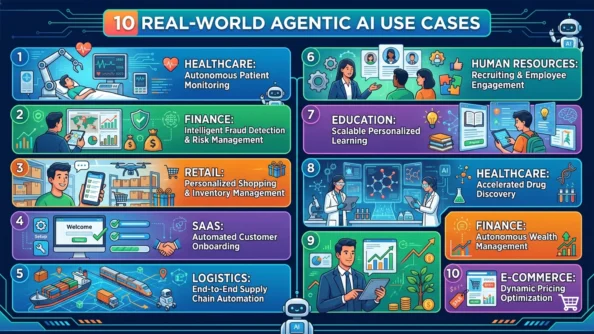
10 Real-World Agentic AI Use Cases
Agentic AI is no longer a concept locked inside research labs or tech conferences. It is actively reshaping how industries operate, make decisions, and deliver value to customers. From hospitals to warehouses, and classrooms to boardrooms, agentic AI is performing complex functions that traditional software cannot handle. So let’s have a look at Agentic AI Use Cases in Real World.
But what does this look like in practice? In this blog, we explore the top 10 real-world use cases of agentic AI across major industries. Each example demonstrates how autonomous agents adapt to changing conditions and complete multi-step tasks without constant human intervention.
What Makes Agentic AI Different in Real-World Applications?
Before diving into the use cases, it helps to understand what sets agentic AI apart from other AI tools. Unlike standard bots, agentic AI systems do not just respond to a prompt; they pursue goals.
These agents plan steps, access external tools, analyze real-time data, and course-correct when variables change. This goal-driven, autonomous behavior is the engine behind its rapid adoption across the globe.
1. Healthcare: Autonomous Patient Monitoring
Industry: Healthcare
Agentic AI systems are being deployed to continuously monitor patient vitals and coordinate care. Instead of medical staff manually tracking every chart, an AI agent monitors data streams in real-time. If a patient’s vitals fluctuate, the agent alerts the specific care team, logs the event, and suggests immediate next steps based on the patient’s medical history.
- Real Impact: Faster response times reduced human error and improved patient outcomes.
2. Finance: Intelligent Fraud Detection & Risk Management
Industry: Finance
Financial institutions process millions of transactions daily. Agentic AI agents analyze these patterns in milliseconds. When a suspicious transaction occurs, the agent doesn’t just flag but investigates. It checks related accounts and recent activities to decide whether to block the transaction or escalate it to a human analyst.
- Real Impact: Lower fraud losses and smarter risk decisions with minimal manual oversight.
3. Retail: Personalized Shopping & Inventory Management
Industry: Retail
On the customer side, agentic AI tracks browsing behavior and current trends to guide shoppers toward products they actually need. Behind the scenes, these agents handle inventory forecasting. Rather than waiting for a manager to notice low stock, the agent predicts demand based on seasonal trends and automatically places orders with suppliers.
- Real Impact: Higher conversion rates and significantly reduced overstock waste.
4. SaaS: Automated Customer Onboarding
Industry: Software as a Service (SaaS)
Agentic AI is transforming the onboarding phase by guiding users through setup entirely on autopilot. If a user gets stuck in a workflow, the agent proactively offers help or triggers a relevant tutorial. On the support side, it diagnoses technical issues and applies fixes without requiring a human ticket response.
- Real Impact: Reduced churn and lower support costs.
5. Logistics: End-to-End Supply Chain Automation
Industry: Logistics
Supply chains involve hundreds of moving parts. Agentic AI agents track shipments, reroute deliveries during delays, and communicate with vendors autonomously. If a port closes or weather shifts, the agent assesses alternative routes and recalculates timelines instantly.
- Real Impact: Fewer delivery delays and more resilient supply chains.
6. Human Resources: Recruiting & Employee Engagement
Industry: HR
Agentic AI agents screen thousands of resumes, score candidates against specific role requirements, and even schedule interviews. Beyond hiring, they monitor engagement signals like communication patterns to recommend targeted interventions for managers before a high-performing employee decides to leave.
- Real Impact: Faster hiring cycles and lower employee turnover.
7. Education: Scalable Personalized Learning
Industry: Education
Agentic AI platforms analyze how individual students learn. Based on this data, the agent continuously adjusts the learning path, providing targeted practice where the student struggles. For educators, these agents handle administrative tasks like grading routine assignments and generating progress reports.
- Real Impact: Better learning outcomes and more time for teachers to focus on mentorship.
8. Healthcare: Accelerated Drug Discovery
Industry: Pharma/Healthcare
Agentic AI agents analyze vast datasets of molecular structures to identify promising drug candidates faster than human researchers. These agents run simulations, evaluate results, and generate new hypotheses autonomously, significantly cutting down the time it takes to bring life-saving medicine to market.
- Real Impact: Lower research costs and faster drug development.
9. Finance: Autonomous Wealth Management
Industry: Finance
Agentic AI is democratizing high-quality financial advice. These agents build personalized financial plans and adjust investment strategies based on life events (like a change in income or a market shift). They don’t just follow rules; they reassess the user’s entire portfolio in real-time.
- Real Impact: Broader access to expert financial guidance for everyday users.
10. E-Commerce: Dynamic Pricing Optimization
Industry: Retail/E-Commerce
Setting the right price is a delicate balance. Agentic AI agents monitor competitor pricing, inventory levels, and market demand to adjust prices across thousands of products instantly. When demand spikes, the agent responds to maximize margin without losing the customer.
- Real Impact: Higher profit margins and a massive competitive advantage.
Also read: Agentic AI vs Generative AI: What Should Your Business Invest in First?
Why These Use Cases Matter Right Now
The significance of these examples lies in the adaptability of technology. Agentic AI agents do not follow a rigid script; they solve problems and learn from results. For organizations evaluating their digital transformation, these real-world applications provide a clear signal: the technology is mature, flexible, and ready to deliver measurable ROI.
Conclusion
Agentic AI is not a future technology here. Whether it is managing a supply chain or the discovery of a new drug, the core principle remains that when AI can act autonomously and plan strategically, it doesn’t just support human work; it transforms it.
The question for your business is no longer if you should adopt these services, but where you will start.