
From Business Problem to AI Solution: How Custom AI and ML Development Creates Industry-Specific Applications
How Do Custom AI and ML Development Services Drive Growth?
AI gets talked about like it’s magic. It isn’t. A model is only as good as the problem it was built to solve, and that’s usually where off-the-shelf tools fall apart. They’re built for everyone, which in practice means built for no one in particular. Custom AI and ML development works the other way around. It starts with a real business problem and builds outward from there. So let’s know about Custom AI and ML Development Services.
The Problem Comes Before the Code
Someone has to sit with the actual pain point before anything gets built. A hospital losing money to no-shows and a warehouse losing time to inventory delays aren’t the same problem. Yet both often get lumped under “we need AI” by someone in a hurry. So the real work starts with questions:
- What outcome actually needs to move?
- Where does the current process actually break down?
- What data already exists, and what’s missing?
- Who’s going to use this once it’s built?
Skip that step, and teams end up automating the wrong process. Just faster.
Why Generic Tools Rarely Fit
Off-the-shelf AI is built for scale, not specificity. A support chatbot handles “where’s my order” fine. Hand it pharmacy compliance language, though, and it stumbles.
Healthcare, manufacturing, logistics, and finance each run on their own rules and vocabulary. Add legacy systems nobody wants to touch, and a packaged tool rarely bends to fit any of it. A custom-built model trains on the language and constraints of the field it actually works in. That difference shows up fast once the tool sees daily use.
How a Business Problem Becomes an AI Application
The path from “we have a problem” to “we have a working system” tends to follow a familiar shape, even if the details shift by industry.
Discovery comes first. Stakeholders and developers map the problem together and agree on what success actually looks like, in numbers rather than vibes. Data review comes next. Teams clean and structure messy or scattered records, and this step almost always takes longer than expected. Skip it, though, and projects tend to fail quietly, six months in.
Model design follows: prediction, classification, language processing, whatever the task calls for. Developers train it specifically on data from that field. Testing gets serious before launch, since edge cases usually reveal where weaknesses hide. And the work doesn’t really stop at deployment. The system keeps learning as new data arrives, so it improves instead of going stale.
What This Looks Like Across Industries
Because every field has its own bottlenecks, the applications built through custom AI and ML development end up looking quite different from one another.
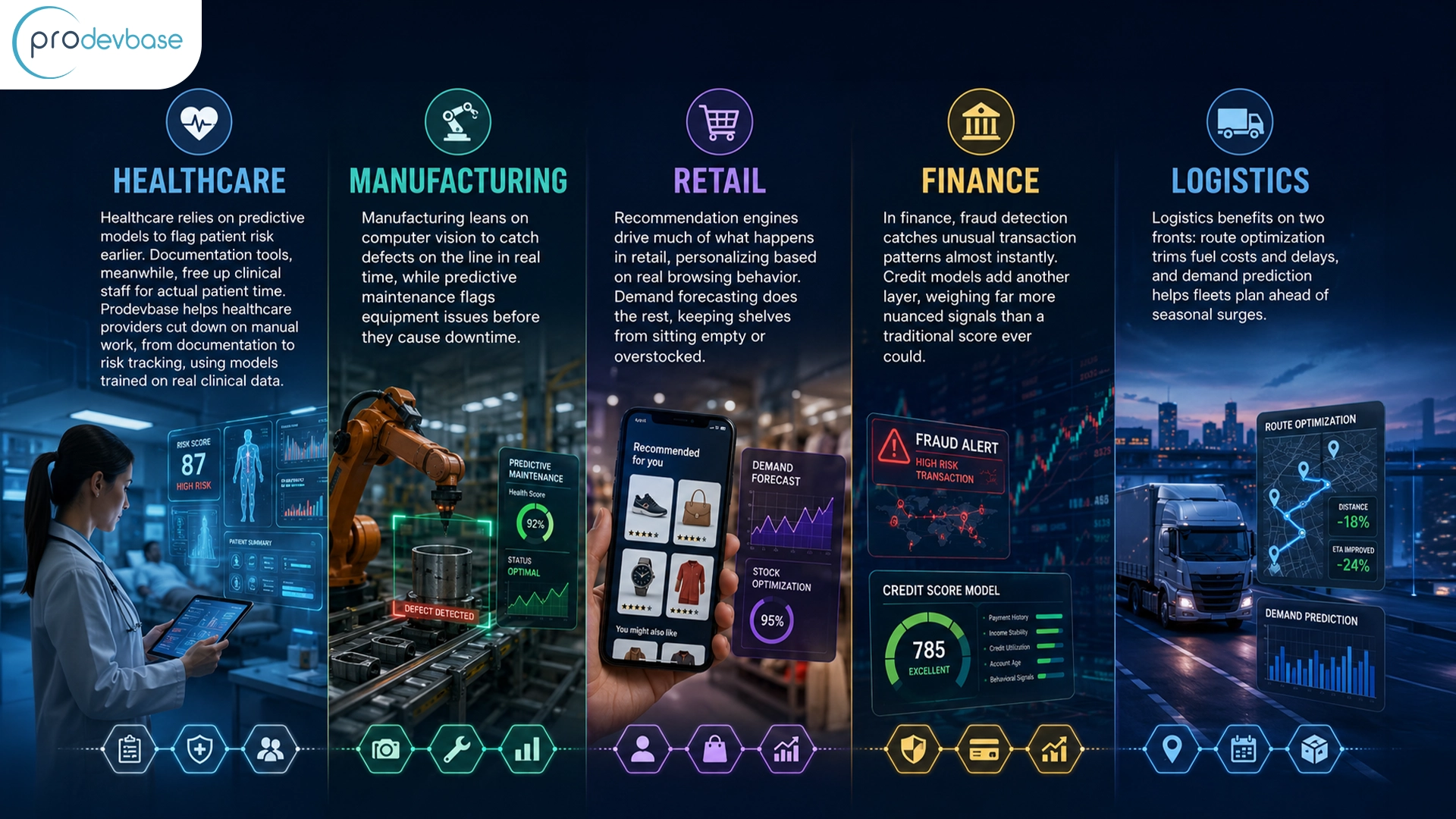
Healthcare relies on predictive models to flag patient risk earlier. Documentation tools, meanwhile, free up clinical staff for actual patient time. Prodevbase helps healthcare providers cut down on manual work, from documentation to risk tracking, using models trained on real clinical data.
Manufacturing leans on computer vision to catch defects on the line in real time, while predictive maintenance flags equipment issues before they cause downtime.
Recommendation engines drive much of what happens in retail, personalizing based on real browsing behavior. Demand forecasting does the rest, keeping shelves from sitting empty or overstocked.
In finance, fraud detection catches unusual transaction patterns almost instantly. Credit models add another layer, weighing far more nuanced signals than a traditional score ever could.
Logistics benefits on two fronts: route optimization trims fuel costs and delays, and demand prediction helps fleets plan ahead of seasonal surges.
The techniques overlap across all five. The finished applications don’t, because each one took shape around a specific problem rather than a shared template.
Also read: The Hidden Cost of Poor Data Engineering on AI Outcomes
Custom AI and ML Development Services: Where Prodevbase Fits In
Prodevbase works with businesses to turn operational headaches into working AI systems, starting with the actual problem instead of a pre-built package. The workflow gets mapped first. From there, the team evaluates the data, designs the model, and deploys a system that fits what’s already there, not the other way around.
Why the Tailored Approach Holds Up
Models trained on relevant, field-specific data tend to be more accurate. Plain and simple. Compliance and operational rules get built in from day one instead of bolted on later. Workflows follow how work actually happens, not some assumption of how it should. And because the system keeps learning, it tends to improve over time rather than aging out.
The Bottom Line
Good AI rarely starts with the algorithm. It starts with a clearly named problem, followed by the less glamorous work of data, design, and testing. Custom AI and ML development is really just a disciplined way of getting from one to the other. Prodevbase’s part in that is simple: take a real business problem and build something that actually fits it, instead of asking a business to bend around the software.