
Why AI Data Engineering Is Business-Critical in 2026?

Why Is AI Data Engineering Important for Businesses in 2026?
A company spends millions on AI. Six months later, the results are underwhelming. Sound familiar? This happens more often than business leaders admit. The AI model isn’t the problem. The data feeding it is. That’s exactly why AI data engineering matters so much right now. It’s the unglamorous work of collecting, cleaning, and connecting data so AI systems can actually deliver on their promise. Prodevbase has watched this space closely over the past year, and one thing is clear: the companies winning with AI aren’t the ones with the flashiest models. They’re the ones with the strongest data foundations. So let’s have a look into why is AI Data Engineering Important for Businesses.
In 2026, AI data engineering has moved out of the back office. It’s no longer just a technical function buried in IT. Instead, it has become a strategic pillar. It determines whether AI investments succeed or quietly fail.
So why does this shift matter so much this year? Let’s break it down.
What Exactly Changed in 2026?
For years, data engineering simply meant building pipelines and maintaining warehouses. That definition has expanded dramatically since. Data engineering now covers feature engineering, data quality automation, lineage tracking, and AI readiness, all at once.
Meanwhile, AI models are demanding much more from the data that feeds them. They need context, not just volume. Because of this, organizations that once measured success by how much data they collected are now judged by how usable that data actually is.
In short, AI Data Engineering has become the foundation everything else in the AI stack depends on.
Why AI Data Engineering Matters for Businesses Right Now
1. AI Is Only as Good as the Data Behind It
An AI model can be brilliant in theory. Without clean, well-governed, and contextualized data, though, it will still produce poor results in practice. Consequently, companies that invest in strong data foundations tend to see far better returns from their AI initiatives than those chasing flashy models alone.
2. Faster, More Confident Decisions
Real-time data pipelines are quickly becoming the norm rather than the exception. Organizations can now detect fraud, track inventory, and respond to customer behavior as it happens, instead of days later. This speed translates directly into competitive advantage.
3. Lower Costs and Fewer Surprises
Cloud spend has grown into one of the biggest budget concerns for modern enterprises. Disciplined AI Data Engineering practices, such as right-sized compute and smarter storage tiers, still help companies avoid runaway costs. Good data engineering isn’t just about performance, in other words; it also protects the bottom line.
4. Stronger Governance and Trust
Regulations are tightening across nearly every industry. At the same time, customers expect their data to be handled responsibly. Companies need governance built directly into their pipelines, not bolted on afterward, or trust and compliance both suffer.
5. A Genuine Competitive Edge
Organizations that treat data as a strategic asset consistently outperform those that treat it as an afterthought. Companies with mature AI Data Engineering practices, for example, are already reporting faster forecasting, quicker incident response, and lower operational overhead than their peers.
Also read: AI vs Human Intelligence: Are We Creating Our Own Dependency?
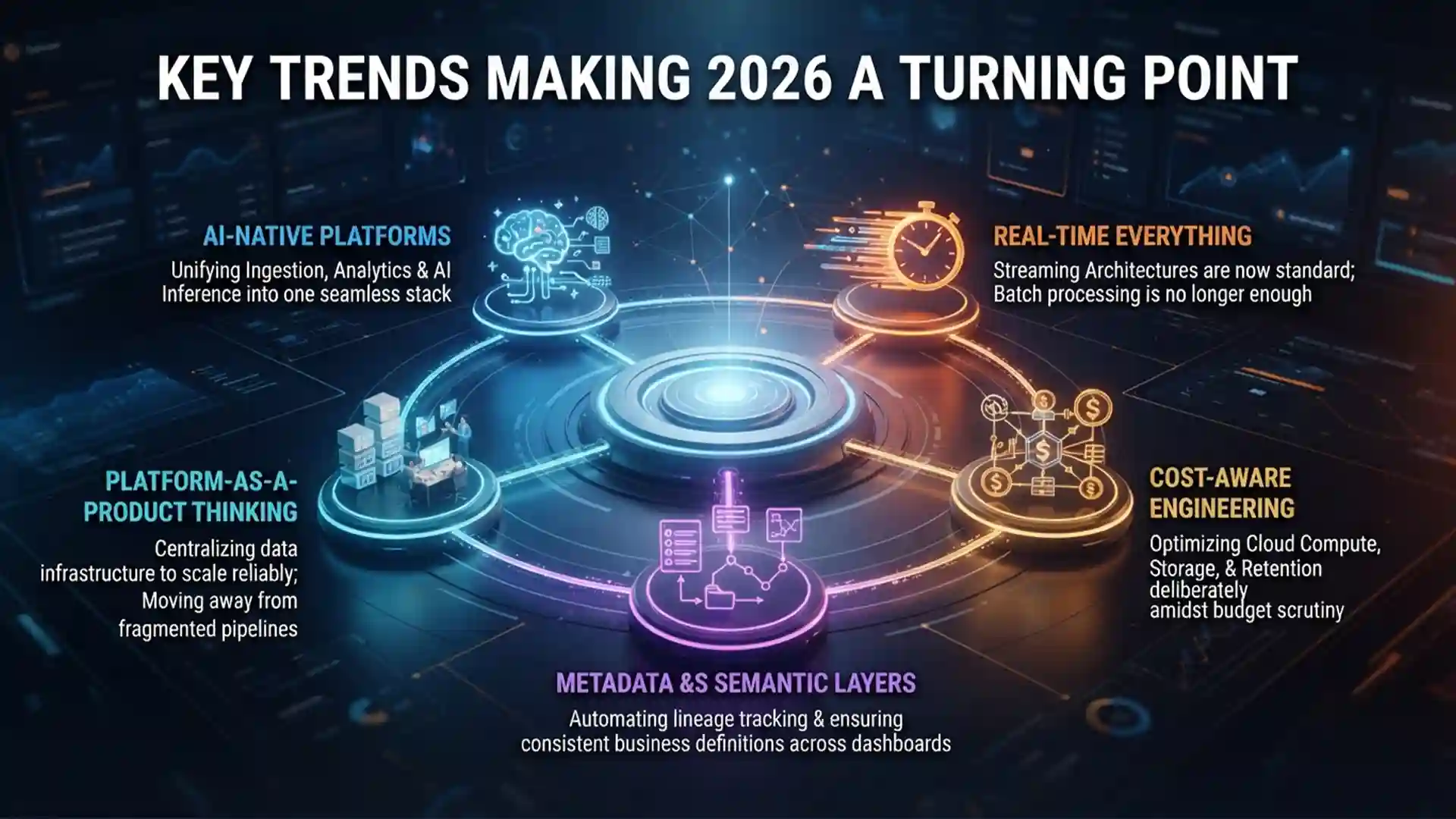
Key Trends Making 2026 a Turning Point
Several converging trends explain why this year feels different:
- AI-native platforms: Enterprises are moving away from separate analytics and AI stacks. Instead, they’re unifying ingestion, analytics, and AI inference into one platform.
- Real-time everything: Batch processing alone is no longer enough. Streaming architectures are becoming standard practice as a result.
- Cost-aware engineering: Cloud budgets are under scrutiny, so teams are optimizing storage, compute, and retention more deliberately.
- Metadata and semantic layers: These tools help teams automate lineage tracking and keep business definitions consistent across dashboards and models.
- Platform-as-a-product thinking: Rather than every team building its own pipelines, organizations are centralizing data infrastructure so it scales reliably.
Together, these trends show one clear pattern: production AI now demands fresh, accurate, always-available data with governance built into the pipelines, not added on afterward.
What Happens When Companies Ignore This?
Some organizations assume they can delay investing in their data foundations. That approach tends to backfire, unfortunately. Without solid data engineering, AI projects stall, costs spiral, and decisions slow down instead of speeding up.
Competitors who invest early gain a compounding advantage, too. The gap between AI leaders and AI laggards is widening every quarter as a result, not shrinking.
Getting Started: A Simple Way to Think About It
Most organizations benefit from starting small and scaling deliberately, rather than fixing everything at once. A good first step, in this case, is assessing current data maturity: Is the data clean? Is it accessible in real time? Is governance already built in, or is it an afterthought? This is the kind of assessment Prodevbase typically starts with before recommending next steps.
Priorities tend to fall into place naturally from there. First, fix data quality issues. Next, build governance into the pipeline itself. Finally, layer in automation and AI-readiness once the foundation is solid.
Final Thoughts
AI Data Engineering is no longer optional groundwork. It’s the strategic backbone that determines how far AI ambitions can actually go in 2026 and beyond. Companies that recognize this early move faster, spend smarter, and build far more trust with customers than those that don’t, a principle Prodevbase builds into every engagement.
In the end, the businesses that win with AI won’t be the ones with the flashiest models. They’ll be the ones with the strongest data foundations underneath them.