
AI vs Human Intelligence: Are We Creating Our Own Dependency?
AI Dependence and Human Intelligence: Are We Losing Our Edge?
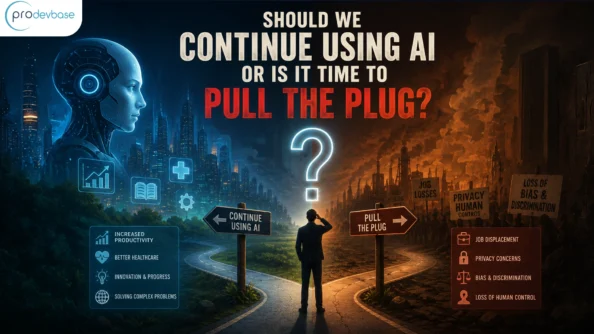
The rapid rise of artificial intelligence has sparked an intense global debate. As automated tools slip into daily workflows, a critical question arises: Should the use of AI be reduced, or should it be completely stopped? So let’s know about AI Dependence and Human Intelligence.
Recently, Google CEO Sundar Pichai added his voice to this conversation during a high-profile interview with the BBC. These insights, along with perspectives from independent experts, offer a realistic middle ground for anyone navigating the sudden shift toward total automation.
Why Stopping AI Completely Is Not the Answer
To understand the future of technology, it is necessary to accept that a complete boycott of AI is highly unrealistic. Generative platforms have already revolutionized industries by optimizing repetitive tasks. For example, these systems can instantly analyze vast data sets, draft emails, and handle complex coding.
Tech companies are moving quickly because consumer demand is incredibly high. In fact, Google recently launched the Gemini 3.0 model, which can process photo, audio, and video inputs with advanced reasoning capabilities. Completely removing these tools would disrupt global productivity. However, the real danger is not the technology itself. Instead, the risk lies in a growing, absolute dependence on it.
Also read: How Can AI Improve Healthcare Operations?
The Danger of Blindly Trusting the Machine
In his interview, Sundar Pichai highlighted a growing concern: users are becoming solely dependent on automated systems. When reliance shifts entirely to algorithms for critical thinking, human creativity begins to shrink.
Crucially, current state-of-the-art AI models are prone to errors. These systems have a known tendency to generate false information or confidently “make up” answers to please the user. Research shows that even top-tier AI assistants can misrepresent factual news stories up to 45% of the time.
“People have to learn to use these tools for what they’re good at, and not blindly trust everything they say.” – Sundar Pichai
If a user blindly trusts every answer an AI generates, especially regarding sensitive topics like health, science, or news, misinformation can spread quickly. Therefore, rather than stopping the technology, the solution lies in changing the interaction with it.
The Debate Over Corporate Responsibility
While tech companies place disclaimer labels on tools to warn users about potential mistakes, this approach has faced heavy criticism. Many responsible AI experts argue that the burden of accuracy should not be passed on to the consumer.
Critics point out that tech giants should focus on making systems fundamentally more reliable rather than asking users to constantly act as fact-checkers. For instance, early rollouts of AI-summarized search results faced widespread mockery for providing erratic and inaccurate responses.
To address these concerns, tech companies are forced to balance rapid development with safety mitigations. This includes investing heavily in AI security and open-sourcing detection tools that help identify AI-generated content and images.
Building a Rich Information Ecosystem
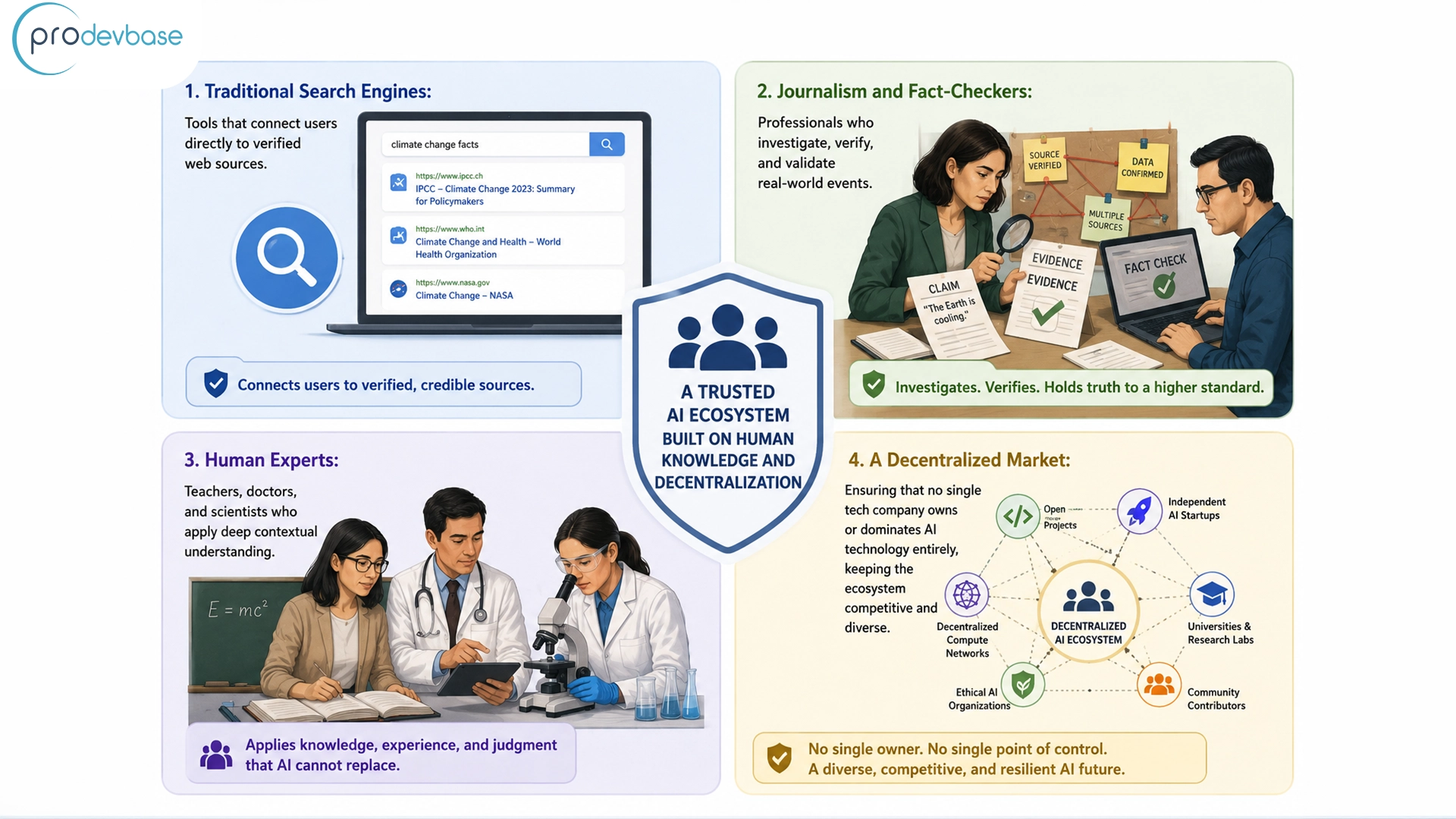
Instead of treating AI as a standalone oracle, Pichai suggests viewing it as one single component of a much larger, healthier information network. A reliable ecosystem requires multiple pillars to keep information grounded. These pillars include:
- Traditional Search Engines: Tools that connect users directly to verified web sources.
- Journalism and Fact-Checkers: Professionals who investigate, verify, and validate real-world events.
- Human Experts: Teachers, doctors, and scientists who apply deep contextual understanding.
- A Decentralized Market: Ensuring that no single tech company owns or dominates AI technology entirely, keeping the ecosystem competitive and diverse.
When automated tools are combined with these grounded platforms, a powerful system of checks and balances is created.
How to Use AI Safely and Smartly
Moving forward, the goal is reduction where necessary and balance everywhere else. This smart approach can be implemented by following three simple guidelines:
- Prioritize Human Creativity: Use automation to build rough outlines or brainstorm ideas. However, the unique human voice and personal experiences must always dictate the final piece.
- Verify Critical Facts: Treat AI outputs as a first draft. Always cross-check important statistics, legal claims, or medical advice using reliable databases or search engines.
- Treat It as an Assistant: Remember that human judgment is the ultimate director. The tool is simply there to accelerate a workflow, not to make final decisions.
Final Thoughts: The Path Forward
Ultimately, a ban on artificial intelligence is not required to protect human intellect. Instead, society must learn to coexist with it responsibly. By reducing a blind reliance on automation and actively engaging critical thinking, the rich information ecosystem remains protected. Use the technology to boost efficiency, but rely on the human mind to maintain creativity.