
AI Data Engineering Services: Powering the Future of Business Automation
Why Do Businesses Need AI Data Engineering for Long-Term Growth?
Mastering AI Data Engineering Services
Every forward-thinking enterprise aims to deploy intelligent automation. Whether an operational roadmap includes launching autonomous agents to manage inventory or building custom language models for client workflows, successful deployment hinges on a single factor: data readiness. So let’s have a deep look into Why Do Businesses Need AI Data Engineering?
Industry research continuously highlights that poor data quality remains a primary driver for stalled enterprise technology initiatives, costing organizations significant operational friction annually. Traditional infrastructures were engineered to feed static dashboards and generate weekly business intelligence reports. They lack the real-time processing capabilities, scalability, and structural flexibility required to sustain modern machine learning workloads. To bridge this operational gap, mid-market enterprises are rapidly adopting specialized AI data engineering services.
This comprehensive technical breakdown explores the mechanics of AI-optimized data architectures, highlights the technical limits of legacy systems, and demonstrates how partnering with a specialized engineering provider positions infrastructure for long-term scalability.
What is AI Data Engineering and Why Do Businesses Need AI Data Engineering?
To understand how this discipline changes operations, it is necessary to define where traditional data pipelines fall short. Conventional data engineering focuses on structured relational databases, utilizing standard Extract, Transform, and Load (ETL) routines to prepare information for human review.
AI data engineering services evolve this process for machine consumption. This specialized engineering discipline builds and maintains data architectures optimized specifically to ingest, clean, validate, and stream information into machine learning models and automated systems.
Instead of simply migrating static records, an optimized AI pipeline transforms high-volume multi-modal inputs into clean, contextual data streams. This process utilizes automated data labeling, continuous integration validation, vectorization, and automated metadata partitioning to ensure automated systems receive pristine inputs instantly.
Also Read: How AI Agents Reduce Business Costs and Improve Business Efficiency in 2026
Core Framework of an AI-Ready Architecture
- High-Throughput Streaming Ingestion: Deploying event-driven architectures (such as Apache Kafka or AWS Kinesis) to capture enterprise data the moment it is generated.
- Unstructured Data Parsing: Implementing advanced file processing layers capable of converting PDFs, images, and audio files into machine-readable text or vector formats.
- Automated Semantic Schema Enforcement: Using automated checks to prevent schema drift from corrupting deep learning models during production.
- High-Density Storage Optimization: Constructing multi-tier data lakes and cloud warehouses (like Snowflake, Databricks, or Google Big Query) optimized for low-latency vector searches and model partitioning.
Why Legacy Pipelines Fail Modern AI Workloads
Attempting to run modern automation tools on an outdated data architecture creates immediate infrastructure bottlenecks. Legacy pipelines fail during production scaling for three distinct reasons:
1. Inability to Process Multi-Modal Formats
Standard relational databases thrive on neat rows and columns. However, the vast majority of useful enterprise knowledge lives in unstructured formats—such as contracts, customer service recordings, and internal documentation. Without advanced data engineering pipelines, models cannot access these valuable operational insights.
2. The Operational Cost of Batch Processing Latency
Traditional workflows run on daily or weekly batch schedules. AI agents, however, require immediate access to updated operational realities. If an autonomous customer-facing agent relies on data that is even twelve hours old, systemic friction occurs, leading to inaccurate or obsolete outputs.
3. Pipeline Ingestion Errors and Hallucinations
Machine learning models are highly sensitive to corrupted, biased, or duplicate data points. When flawed datasets bypass basic filters, the model inevitably produces hallucinations. AI-optimized pipelines mitigate this risk by embedding automated validation checkpoints directly into the initial ingestion phase.
ProDevBase: Enterprise AI Data Engineering Services
Recruiting, training, and maintaining a specialized in-house team of data engineers requires significant time and capital overhead. ProDevBase solves this challenge by providing end-to-end, managed AI data engineering services tailored to specific organizational goals.
The technical team designs, deploys, and monitors complete data architectures, freeing internal engineering assets to focus entirely on scaling core product offerings.
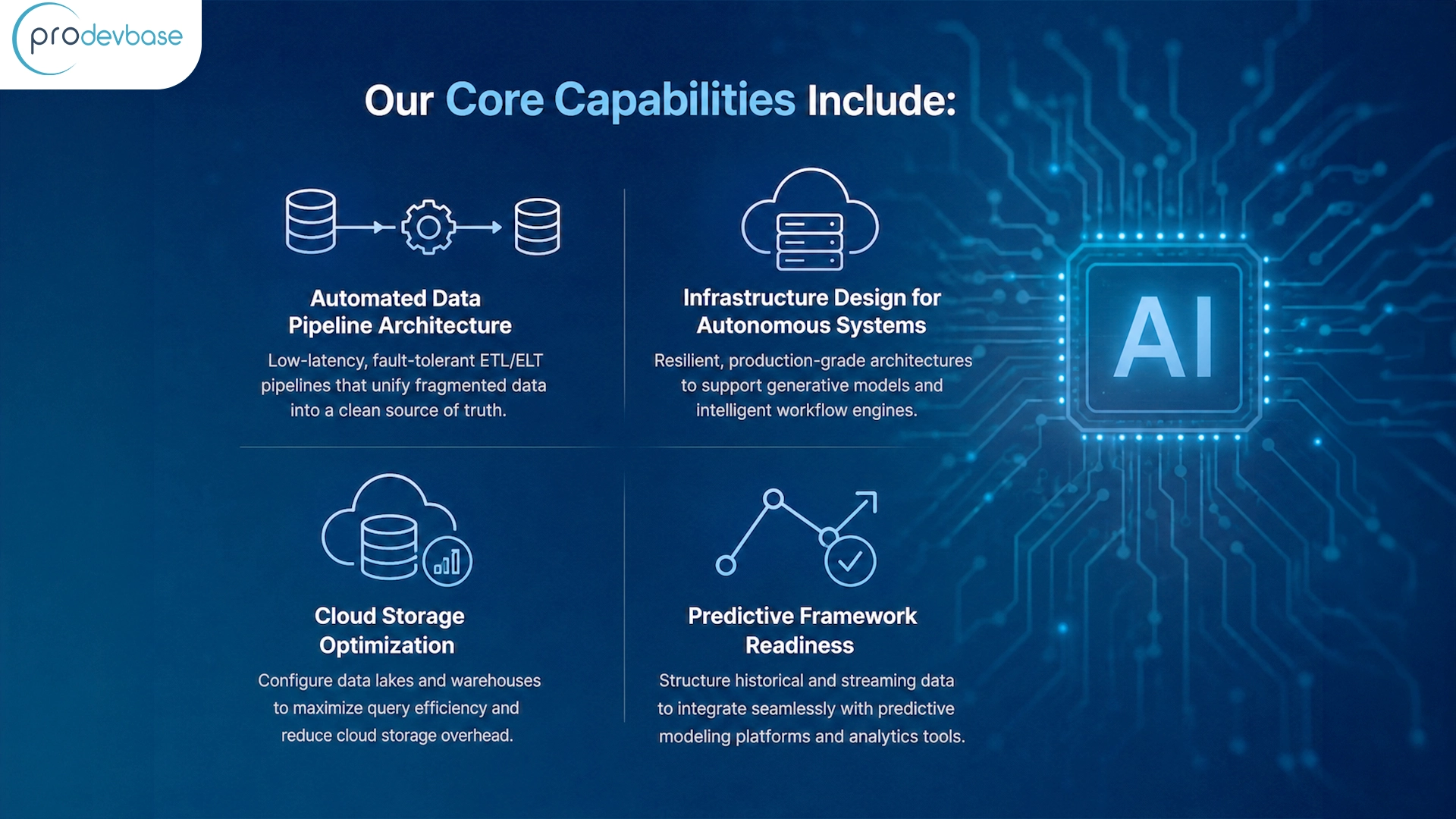
Our Core Capabilities Include:
- Automated Data Pipeline Architecture: Dedicated workflows build low-latency, fault-tolerant ETL/ELT pipelines that consolidate fragmented data across enterprise tools into a unified, clean source of truth.
- Infrastructure Design for Autonomous Systems: The engineering team constructs the resilient, production-grade architectures necessary to support advanced generative models and intelligent workflow engines.
- Cloud Storage Optimization: Technical teams configure data lakes and data warehouses to maximize query efficiency while reducing recurring cloud storage overhead.
- Predictive Framework Readiness: Specialized processes structure historical and streaming data assets to integrate directly with predictive modeling platforms, ensuring immediate compatibility with advanced analytics tools.
Strategic Advantages of Infrastructure Modernization
Optimizing data infrastructure alongside ProDevBase yields direct, sustainable business advantages:
Improved Efficiency on Technology Budgets
Modern pipelines eliminate failed proof-of-concept projects. By establishing an automated pipeline that continuously validates and structures input data, automation platforms operate at maximum accuracy.
Reduced Systemic Inefficiencies
Automated data management frameworks eliminate manual data cleaning tasks that drain engineering velocity. This architecture reduces computing resources and lowers data-processing infrastructure costs.
Proactive Data Governance and Compliance
Regulatory frameworks regarding data privacy shift constantly. The data architectures built by engineering partners feature native compliance monitoring, protecting sensitive records while ensuring complete audit trails across every layer.
Build a Resilient Data Foundation
The performance gap separating operations with unified, automated data layers from operations constrained by disconnected legacy silos grows wider each quarter. Securing a long-term market advantage requires addressing core data architecture before deploying user-facing tools.
An optimized data framework remains essential to support long-term enterprise goals.
Ready to modernize infrastructure? Contact our team to learn how dedicated AI data engineering services unlock the latent potential within enterprise data assets.
Contact Us on this E-mail- ID- [email protected] to utilize our AI driven IT Consulting services customized by professionals from MIT.
FAQs
Q1: What are AI data engineering services?
These specialized technical offerings design, deploy, and manage the infrastructure required to feed machine learning algorithms. Unlike standard IT workflows that move data into static storage, these services establish continuous, automated pipelines that cleanse, structure, and optimize raw enterprise data specifically for consumption by artificial intelligence models.
Q2: Why are dedicated AI data engineering services necessary for modern enterprises?
Traditional data systems were engineered exclusively for human review via business intelligence dashboards. Artificial intelligence models require an entirely different architecture capable of handling massive volumes of unstructured data, executing real-time streaming, and enforcing strict quality checks. Without specialized data engineering services, advanced automation projects inevitably stall due to infrastructure bottlenecks.
Q3: What core capabilities are included in enterprise AI data engineering services?
These comprehensive technical offerings typically include four core pillars:
- Multi-Modal Data Ingestion: Building workflows that capture and process unstructured files like PDFs, images, and audio recordings.
- Real-Time Stream Processing: Establishing low-latency pipelines using event-driven architectures to prevent data obsolescence.
- Automated Data Quality Governance: Implementing programmatic validation checks to instantly detect and resolve schema drift.
- Cloud Infrastructure Optimization: Configuring high-performance data lakes and warehouses optimized for vector search and model training.
Q4: How do AI data engineering services prevent model hallucinations?
Model hallucinations occur when an artificial intelligence system attempts to generate responses based on stale, corrupted, or missing data. Professional data engineering services eliminate this operational risk by embedding automated validation checkpoints directly into the initial ingestion phase. This ensures that only pristine, contextual, and fully verified data assets reach the production model.
Q5: What role do these services play in unstructured data management?
Over 80% of enterprise information resides in unstructured formats like contracts, customer service logs, and documentation. Standard relational databases cannot interpret these formats. Specialized data engineering services implement advanced parsing and vectorization pipelines that transform these chaotic, unstructured files into highly organized, machine-readable semantic data streams.
Q6: How do data engineering services safeguard corporate data privacy during model ingestion?
Enterprise data engineering services build security parameters directly into the ingestion source code. Engineers implement automated data masking, strict access controls, and comprehensive privacy tracking mechanisms during the formatting phase. This programmatic approach ensures that all training pipelines remain fully compliant with global data privacy regulations without degrading model performance.
Ready to modernize infrastructure? Contact our team to learn how dedicated AI data engineering services unlock the latent potential within enterprise data assets.