
AI Data Engineering in Finance: Powering Smarter Financial Decisions
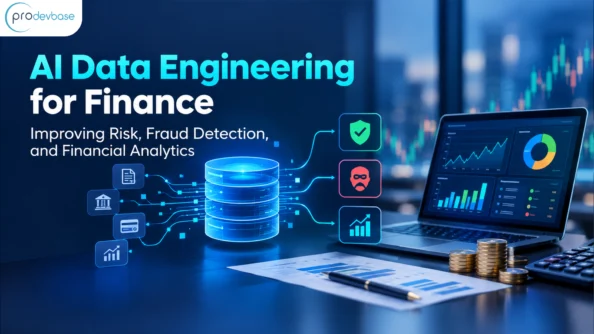
AI Data Engineering for Finance: Improving Risk, Fraud Detection, and Financial Analytics
There’s a specific kind of failure that happens in finance more often than institutions like to admit: a system correctly identifies a problem, but it does so hours after the damage is already done. A fraudulent transaction gets flagged well after the funds have moved. A risk exposure gets calculated the next morning, long after the market already shifted. Detection without speed isn’t really detection. It’s documentation of a loss that already happened. So let’s know more about AI Data Engineering in Finance.
Financial data moves constantly. Trades settle in milliseconds. Payment networks run around the clock. Regulators expect reports that reconcile down to the decimal. Against that backdrop, plenty of institutions are still running infrastructure built for a slower era: nightly batch jobs, manual reconciliation, spreadsheets stitched together by whoever inherited the process last. That setup worked, for a while.
The Batch-Processing Era Is Running Out of Road
Overnight updates made sense when transaction volumes were lower and fraud was cruder, like a stolen card number run up quickly at a gas station. Digital payments, algorithmic trading, and instant cross-border transfers changed that math entirely. Data now arrives faster than legacy systems can process it, which means decisions often get made on numbers that are already stale by the time anyone looks at them.
That lag matters more in finance than almost anywhere else. A risk model built on yesterday’s volatility can’t price today’s market swing. A credit exposure calculated last night doesn’t reflect a client’s trades from this morning. So the shift toward continuous, real-time data pipelines isn’t really optional anymore. It’s closer to table stakes.
What Actually Changes in Risk Management
Here’s the part that doesn’t get said enough. Most risk models aren’t wrong because the math is bad. They’re wrong because the data feeding them is incomplete, duplicated, mistimed, or quietly corrupted somewhere upstream. Fix the data, and the model usually gets a lot more trustworthy without touching a single formula.
That’s where engineering discipline comes in. Incoming figures, whether loan applications, market feeds, or position data, get validated before they ever reach a model. Every transformation gets logged, so when an auditor eventually asks where a number came from, there’s an actual answer instead of a shrug. And anomalies in exposure get caught within minutes instead of surfacing at quarter-end, when the damage is already done.
None of this removes human judgment from risk management. It just means the people making the calls are working from numbers they can actually trust.
Also read: From Traditional Automation to Agentic AI: Transforming Healthcare
Fraud Detection: Why Rules Alone Keep Missing Things
Rule-based fraud systems catch the obvious stuff. A charge over a set dollar amount from an unfamiliar country gets flagged, and fine, that works. But fraud that’s slightly cleverer than that sails right through, while ordinary customers get their cards declined at the worst possible moment because they triggered some blunt threshold.
Picture someone whose spending is fairly predictable: groceries, gas, a subscription or two. Then a series of small, unremarkable purchases start showing up in a pattern that doesn’t match anything they’ve done before. No single transaction looks suspicious on its own. A rule-based system misses it completely. A model trained on that person’s actual transaction history picks up on the drift almost immediately, because it isn’t looking at thresholds. It’s looking at behavior.
The other piece worth mentioning is that fraud tactics don’t hold still, so a model trained once and left alone gets stale fast. Pipelines that feed fresh transaction data back into the model on an ongoing basis keep detection sharp instead of slowly falling behind the people actively trying to beat it.
Analytics Teams Spend Too Much Time Cleaning, Not Analyzing
Ask anyone on a financial analytics desk what eats their week, and “cleaning data” comes up almost immediately. Trading platforms, customer records, and market feeds rarely agree on formatting, and duplicates sneak in constantly. The actual analysis, forecasting, stress testing, performance reporting, gets squeezed into whatever hours are left.
Consolidating those sources into one standardized structure isn’t glamorous work, but it changes everything downstream. Reports come together faster. Errors that used to slip through, like a misplaced decimal or a duplicated trade record, get caught by automated checks before they ever reach a dashboard leadership is making decisions from.
Curious how much time a cleaner data pipeline could actually give back to an analytics team? Prodevbase can map that out.
Compliance Isn’t a Separate Conversation
Basel III, GDPR, and regional reporting rules don’t care how accurate a model is if the data behind it can’t be traced. A brilliant fraud-detection model built on an untraceable data pipeline is still a regulatory problem waiting to happen. Every transformation, from raw ingestion to whatever a model finally sees, needs to be explainable on demand. Skip that step, and the technical sophistication stops mattering the moment a regulator asks a follow-up question.
It’s Genuinely Harder to Build Than It Sounds
Financial data comes from legacy mainframes, third-party vendors, and modern APIs, often simultaneously and rarely in formats that agree with each other. Untangling that requires real architectural thought, not just plugging systems together and hoping for the best.
Latency needs vary widely too. Fraud detection often needs millisecond response times, while quarterly risk reporting can tolerate a slower pace. One pipeline design almost never satisfies both, so flexibility has to be built in from day one rather than added later. And because the data itself is sensitive, encryption and access controls have to hold up at every stage. Otherwise the system meant to reduce risk ends up creating new exposure of its own.
AI Data Engineering for Finance: Where Prodevbase Fits In
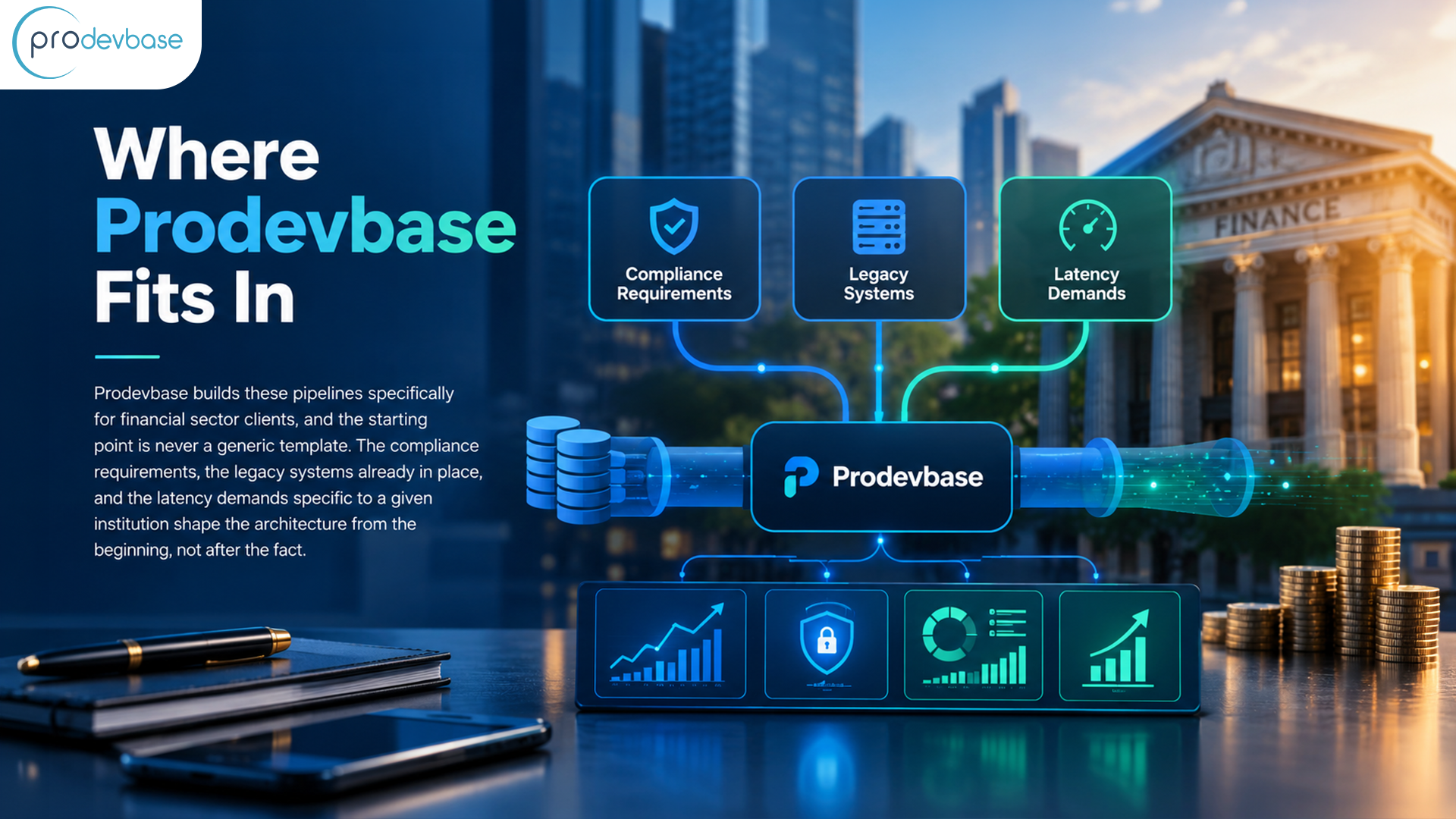
Prodevbase builds these pipelines specifically for financial sector clients, and the starting point is never a generic template. The compliance requirements, the legacy systems already in place, and the latency demands specific to a given institution shape the architecture from the beginning, not after the fact.
That’s the part that tends to get overlooked. Financial data engineering isn’t a plug-and-play exercise. It takes ongoing coordination between engineers, compliance officers, and risk analysts to build something that actually holds up under scrutiny. Prodevbase works in that space, helping institutions move off batch-based legacy systems and onto pipelines that are real-time, auditable, and built to scale as data volume grows.
Where This Is Headed
Real-time data is turning into the baseline expectation across finance, not a competitive edge. Risk models, fraud systems, and analytics platforms are all drifting toward continuous data flows instead of periodic updates. Institutions building that foundation now will likely deal with less friction later, both from regulators and from whoever is trying to beat the fraud systems next.
At the end of the day, even the most sophisticated AI model is only as good as the pipeline feeding it. Bad data in, bad decisions out. That part hasn’t changed. With firms like Prodevbase focused specifically on that layer, institutions get a partner built for the actual problem, not a generic AI vendor applying the same template to every industry.
Ready to see what this could look like in practice? Prodevbase can walk through the details.