
AI Data Engineering: Building the Foundation for Business Growth

How Does AI Data Engineering Drive Smarter Business Growth?
Data drives nearly every decision made inside a modern company. However, raw data alone rarely creates value. It has to be collected, cleaned, structured, and made ready for intelligent systems to use. This is where AI data engineering comes in. It forms the backbone of artificial intelligence projects, and without it, even the smartest algorithms struggle to perform. So let’s know more about How Does AI Data Engineering Drive Business Growth?
In this article, the concept of AI data engineering is explored in detail, along with its core components, common challenges, and the practical benefits it brings to companies aiming to scale intelligently.
What Is AI Data Engineering?
AI data engineering refers to the process of designing, building, and maintaining systems that collect, transform, and deliver data specifically for artificial intelligence and machine learning applications. Unlike traditional data engineering, which primarily supports reporting and analytics, this discipline focuses on preparing data pipelines that feed predictive models, automation tools, and intelligent decision-making systems.
Essentially, it bridges the gap between raw information and usable intelligence. As a result, businesses that invest in strong data engineering practices tend to build AI systems that are faster, more accurate, and easier to maintain over time.
Why Businesses Need AI Data Engineering Today
Companies generate massive volumes of data daily, from customer interactions to operational logs. Consequently, managing this data manually has become nearly impossible. AI data engineering solves this problem by automating the flow of information across systems, ensuring accuracy, and reducing the manual effort required to prepare datasets.
Furthermore, poorly engineered data pipelines often lead to inconsistent AI outputs. Therefore, companies that prioritize this function early tend to avoid costly rework later. In short, strong data infrastructure directly influences how reliable and scalable an AI system becomes.
Also read: Why is AI Data Engineering Important for Businesses?
Core Components of AI Data Engineering
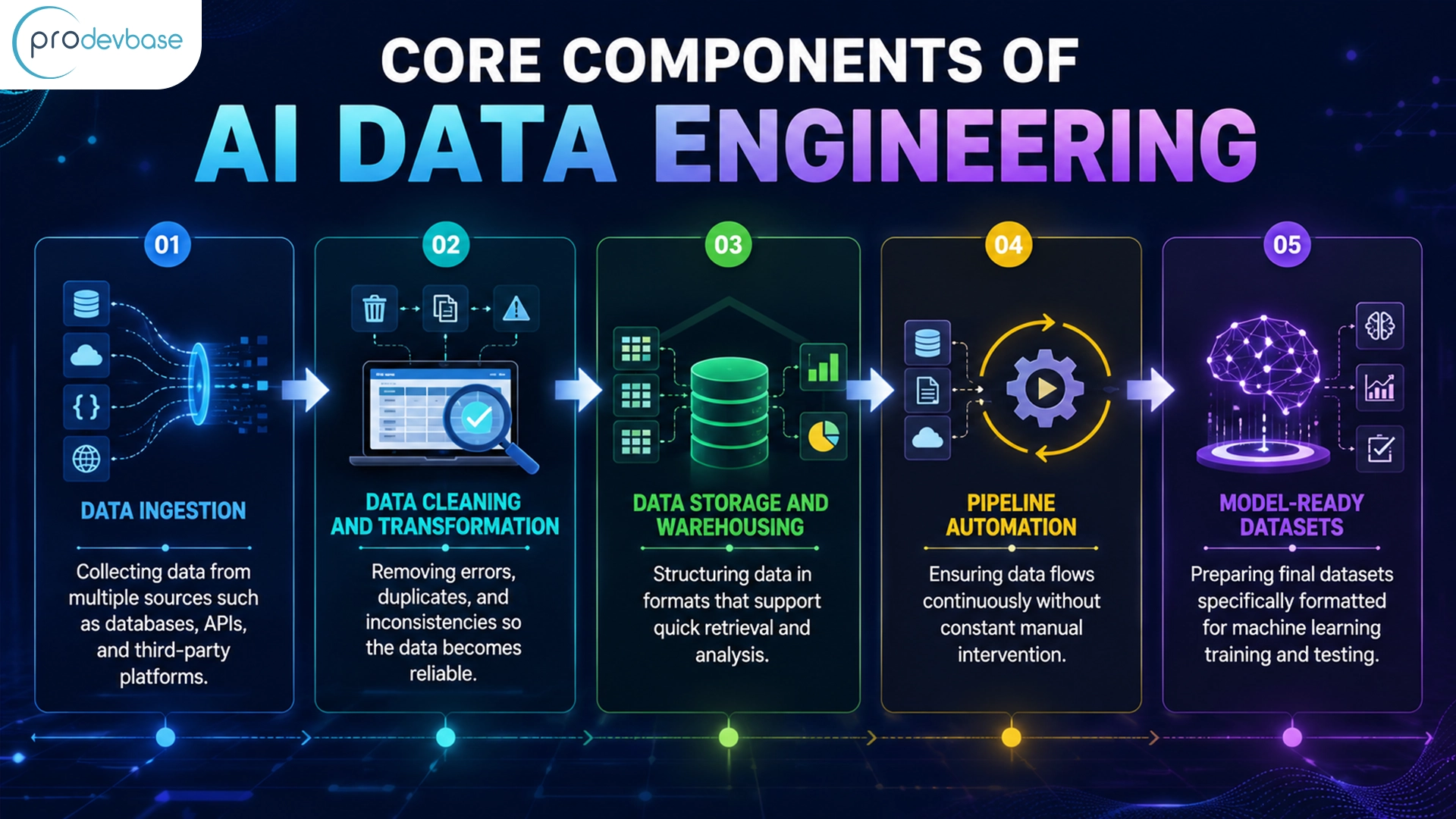
Several elements work together to form a functional AI data engineering pipeline. Below are the primary building blocks:
- Data Ingestion – Collecting data from multiple sources such as databases, APIs, and third-party platforms.
- Data Cleaning and Transformation – Removing errors, duplicates, and inconsistencies so the data becomes reliable.
- Data Storage and Warehousing – Structuring data in formats that support quick retrieval and analysis.
- Pipeline Automation – Ensuring data flows continuously without constant manual intervention.
- Model-Ready Datasets – Preparing final datasets specifically formatted for machine learning training and testing.
Together, these components create a foundation strong enough to support advanced AI applications without breaking under scale.
Common Challenges in AI Data Engineering
Despite its importance, building effective data pipelines is rarely simple. For instance, inconsistent data formats across departments often create bottlenecks. Similarly, outdated infrastructure can slow down processing speeds significantly.
Additionally, security and compliance requirements add another layer of complexity, especially when sensitive customer information is involved. As a result, companies without dedicated technical expertise often face delays, inaccurate outputs, or systems that fail to scale properly.
How Prodevbase Approaches AI Data Engineering
Prodevbase focuses on building AI data engineering systems that are both scalable and dependable. Rather than applying generic templates, the team designs pipelines tailored to the specific structure and goals of each business.
The process typically begins with a thorough audit of existing data sources. Afterward, custom pipelines are built to automate ingestion, cleaning, and transformation. Consequently, businesses working with Prodevbase gain infrastructure that supports long-term AI initiatives instead of short-term fixes.
Benefits of Partnering with Prodevbase for AI Data Engineering
Working with a dedicated technical partner offers clear advantages, particularly for companies without in-house data engineering teams. Below are a few key benefits:
- Faster deployment of AI-ready data pipelines
- Reduced errors through automated cleaning and validation
- Scalable infrastructure that grows alongside business needs
- Ongoing support to maintain pipeline performance over time
As a result, businesses can focus on strategy and growth while Prodevbase manages the technical foundation behind their AI systems.
Future of AI Data Engineering
Looking ahead, AI data engineering will likely become even more automated, with self-healing pipelines and real-time processing becoming standard practice. Meanwhile, the demand for clean, structured data will only increase as AI adoption spreads across industries.
Therefore, companies that build strong data foundations now will be better positioned to adapt as technology evolves. Ultimately, the businesses that treat data engineering as a strategic priority, rather than an afterthought, will lead in the AI-driven landscape ahead.
Conclusion
AI data engineering is no longer optional for companies pursuing intelligent automation and data-driven growth. From ingestion to model-ready datasets, each component plays a critical role in building AI systems that actually work. With the right technical partner, such as Prodevbase, businesses can build pipelines that are accurate, scalable, and ready for what comes next.
Companies looking to strengthen their AI foundation can reach out to Prodevbase to begin building a data engineering strategy suited to their specific goals.