
Agentic AI vs Traditional Healthcare Automation: What’s Actually Different?
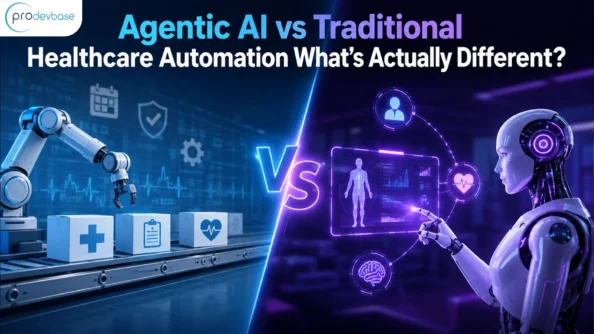
From Traditional Automation to Agentic AI: Transforming Healthcare
How Does Agentic AI Transform Healthcare Automation?
Healthcare has used automation for years. Appointment reminders. Billing software. Basic scheduling tools that quietly run in the background. Nothing new there. But something has shifted recently: a newer approach called agentic AI is changing what automation actually means inside hospitals and clinics. So what’s the real difference? Let’s break it down and also let’s more about how does Agentic AI Transform Healthcare Automation.
Traditional Automation: Reliable, But Rigid
Traditional automation follows fixed rules, nothing more and nothing less. A scheduling tool sends a reminder text three days before an appointment because a developer told it to. That’s the exact instruction, with no flexibility built in. If a patient reschedules through a different channel, or if a doctor’s availability suddenly changes, the system doesn’t adapt. It simply stalls.
That’s not necessarily a bad thing. This kind of automation has real value. It cuts down manual paperwork, speeds up claims processing, and keeps front-desk teams from drowning in repetitive tasks. Still, the moment a situation falls outside the programmed rules, a human has to step in and fix it by hand. Predictable tasks? Traditional automation handles those well. Anything messier? Not so much.
Agentic AI: A Different Kind of System Entirely
Here’s where things get interesting. Agentic AI doesn’t just follow instructions line by line. It perceives a situation, reasons through it, and takes action toward a goal, adjusting its approach as new information comes in. Instead of waiting for a person to define every single step, it can spot a problem, decide on the next move, and carry it out independently.
Picture a patient intake process. A traditional system collects basic information and files it away. An agentic AI system does something different. It reviews the intake data, flags a possible scheduling conflict, checks insurance eligibility, and notifies the right staff member, all without anyone manually triggering each step. There’s less time spent chasing details, and more time available for actual patient care.
Also read: How Healthcare Organizations Can Build Responsible Generative AI Solutions
Side by Side: Where They Really Diverge
Both systems aim to cut down manual work, so the differences aren’t always obvious at first glance. Look closer, though, and a few things stand out clearly:
- Decision-making: Traditional automation follows preset rules. Agentic AI reasons through context and makes judgment calls within defined boundaries.
- Adaptability: Traditional systems break when a scenario falls outside their programming. Agentic systems adjust as circumstances shift.
- Task scope: Traditional automation usually handles one isolated task. Agentic AI manages workflows with several steps across multiple systems at once.
- Oversight needed: Traditional tools need frequent manual attention for anything unusual. Agentic AI handles exceptions on its own, within set guardrails.
In short, traditional automation executes. Agentic AI decides, and then it executes.
Why It Actually Matters in Healthcare
Healthcare isn’t predictable. Patient volumes swing. Insurance rules change. Staffing levels shift from one day to the next. Rigid automation struggles to keep pace with that kind of environment because it simply wasn’t built for it.
Agentic AI was built for exactly that. Take prior authorization as an example. A traditional system flags a missing form and stops there, leaving someone to chase it down. An agentic system, instead, identifies the missing form, pulls the correct data from the patient record, resubmits the request, and follows up automatically if nothing comes back within a set time. That frees up real staff hours for higher-value clinical work.
It’s worth saying clearly, though, that agentic AI is not a replacement for clinical judgment. It operates within defined limits, and sensitive decisions still require human review. Even so, its ability to manage complex processes with several moving parts gives it a real edge over rule-based tools alone.
Traditional Automation Still Has a Place
Despite all that, traditional automation isn’t obsolete. Simple, repetitive tasks with one predictable outcome, such as sending a lab-result notification or generating a standard invoice, don’t need the reasoning power of an agentic system. In fact, applying agentic AI to a task that straightforward often adds complexity that isn’t necessary.
So the smartest move isn’t choosing one system over the other. It’s layering agentic AI on top of existing automation and letting each technology handle what it does best.
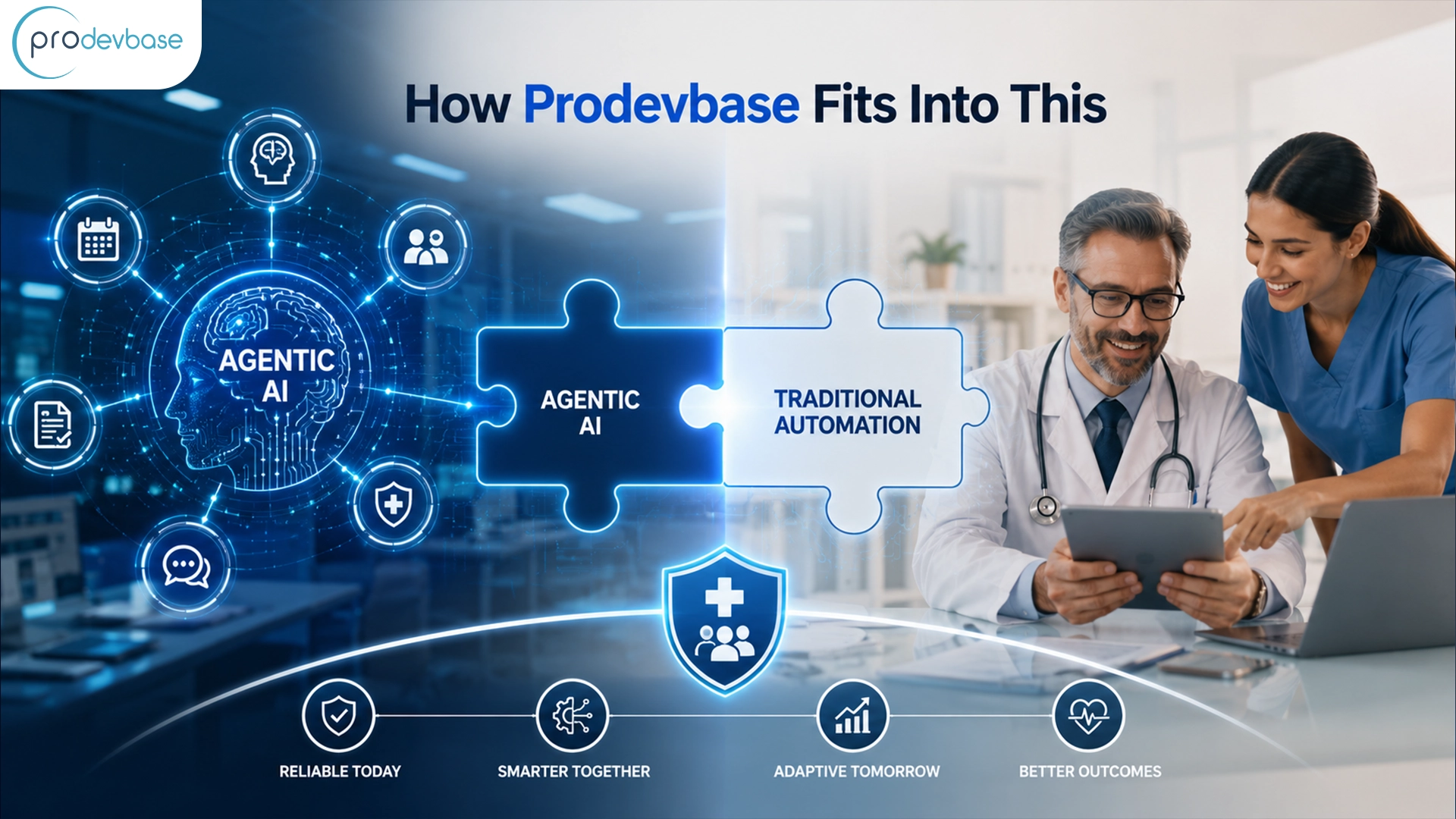
How Prodevbase Fits Into This
Prodevbase works with healthcare businesses that are ready to move past rigid, rule-based systems without losing the reliability those systems already provide. Rather than removing existing automation entirely, Prodevbase builds agentic AI layers that work alongside it, handling complex, judgment-based tasks while traditional tools continue managing routine work.
This matters because healthcare operations cannot afford disruption. A scheduling error or a missed authorization has real consequences for patients and staff alike. Prodevbase focuses on integrations that respect existing workflows while gradually introducing the adaptability that agentic AI provides, without a disruptive overhaul.
Making the Right Call
Choosing between traditional automation and agentic AI ultimately comes down to complexity. For simple, single-outcome tasks, a standard rule-based tool works fine. For complex workflows with several moving parts, a system capable of reasoning and adapting in real time offers a clear advantage.
It helps to think of this less as an either-or decision and more as a spectrum. Predictable tasks stay with traditional automation. Judgment-heavy processes move toward agentic AI. Prodevbase helps healthcare businesses map that spectrum accurately, identifying which workflows genuinely need agentic capability and which ones are already running efficiently as they are.
Final Thoughts
Traditional healthcare automation laid the groundwork for reducing manual work, and it still has its place today. Agentic AI takes that groundwork several steps further, reasoning through complexity instead of simply executing fixed instructions. Because healthcare rarely follows a predictable script, that added adaptability tends to make a measurable difference in daily operations.
For healthcare businesses considering this shift, working with a team that understands both approaches makes a real difference. Prodevbase brings that experience, helping healthcare organizations introduce agentic AI thoughtfully, one workflow at a time, without disrupting what’s already working.