
What Does Custom AI and ML Development Include? A Complete Guide
Custom AI and ML Development: What Our Service Actually Includes
Custom AI and ML Development Include for Businesses Growth?
At Prodevbase, custom AI and ML development starts with one question: what decision in your business keeps eating up hours it shouldn’t? Maybe it’s sorting support tickets by urgency. Maybe it’s flagging which invoices are likely to go unpaid. Whatever it is, we build the model around that exact task, using your own data, rather than adapting a pre-built tool that was trained on someone else’s business. Let’s know more about What Does Custom AI and ML Development Include for Business Growth.
That distinction matters more than it sounds. A generic AI tool learns patterns from a broad, average dataset. Your business, however, has its own quirks, seasonal spikes, regional differences, and unusual customer behavior. A custom model picks up on those quirks because it’s trained on your history, not a stranger’s.
So, here’s what actually goes into building one.
Where Custom AI Development Starts
Before writing a single line of model code, our team maps out the decisions you currently make manually. For example, a warehouse manager might spend an hour each morning deciding which orders to prioritize based on shipping deadlines and stock levels.
We turn that decision-making pattern into rules the model can learn. Then, the model takes over the repetitive part, while a person still reviews edge cases.
This is different from a chatbot bought off a marketplace. That chatbot was trained on generic conversations. Yours would be trained on your actual support tickets, your product names, and your customers’ typical phrasing.
Also read: Why Is AI Data Engineering Important for Businesses in 2026?
Where Custom ML Development Starts
Machine learning fits in when the goal is prediction rather than automation. Instead of following fixed rules, the model studies past outcomes and estimates what’s likely to happen next.
Say a subscription business wants to know which customers are likely to cancel next month. We’d feed the model 12–24 months of usage data, login frequency, support tickets filed, billing history and let it find the combination of signals that shows up right before someone leaves.
Over time, as more customers churn or stay, the model’s predictions get sharper. That’s the part that separates ML from a fixed spreadsheet formula: it adjusts itself as new outcomes come in.
What Goes Into Every Project
A finished AI or ML system isn’t just “the model.” It’s a chain of smaller pieces, each one built to hold up the next.
- Data engineering – pulling scattered data (CRM exports, spreadsheets, app logs) into one clean, usable format
- Model design – choosing an approach that fits the problem, whether that’s a decision tree for a rules-based task or a neural network for something like image recognition
- Training – running the model against real historical examples until its predictions stop improving
- Testing – checking the model against data it hasn’t seen yet, to catch overfitting before launch
- Integration – wiring the model into your CRM, app, or internal dashboard so it actually gets used
- Monitoring – watching accuracy after launch, since customer behavior and market conditions shift over time
Skip the testing step, for instance, and you might launch a model that looked accurate on paper but falls apart the moment real, messy customer data hits it.
The Kinds of Problems This Solves
Not every business needs the same type of model. The right fit depends on what you’re trying to solve.
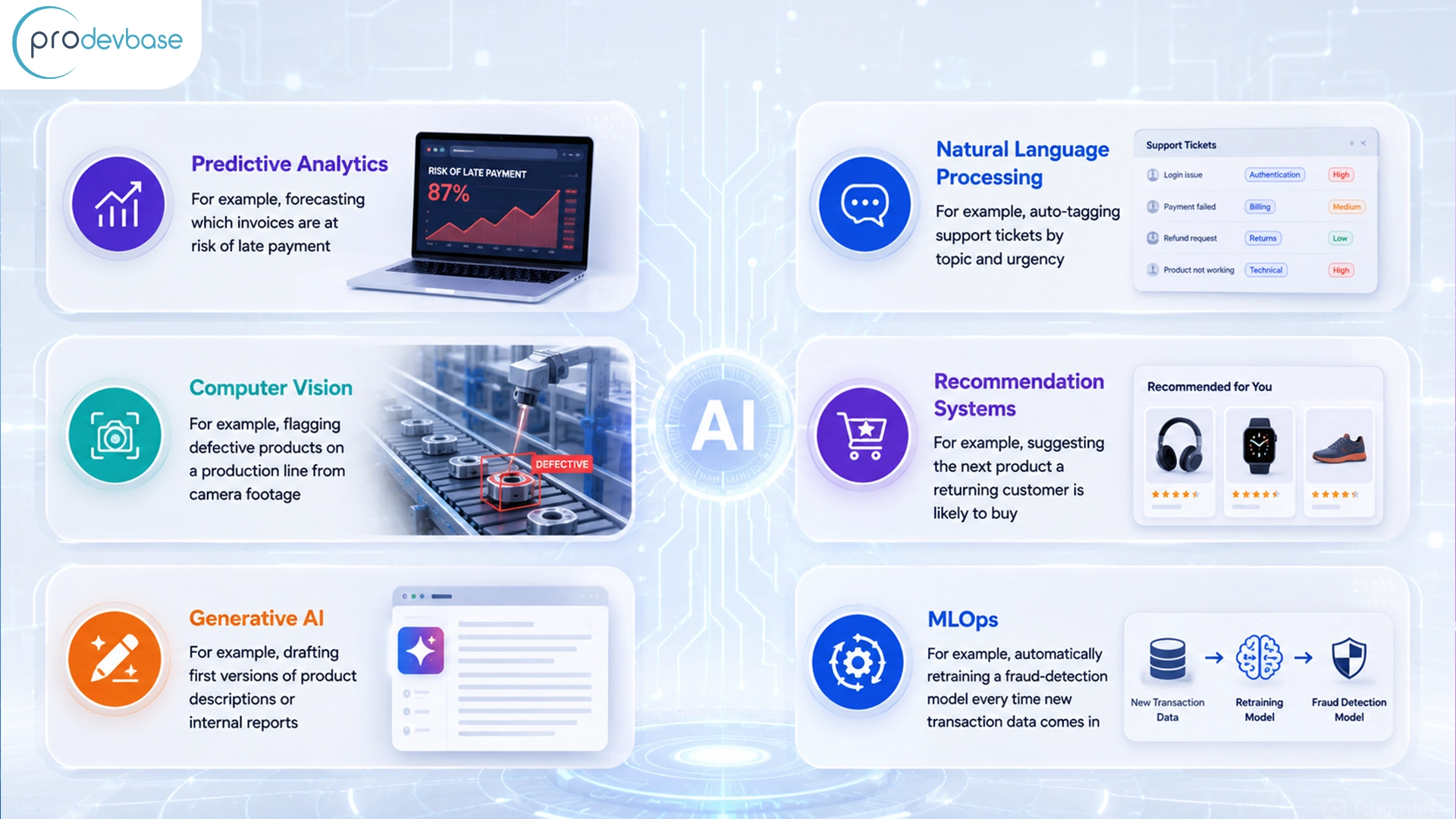
- Predictive analytics – for example, forecasting which invoices are at risk of late payment
- Natural language processing – for example, auto-tagging support tickets by topic and urgency
- Computer vision – for example, flagging defective products on a production line from camera footage
- Recommendation systems – for example, suggesting the next product a returning customer is likely to buy
- Generative AI – for example, drafting first versions of product descriptions or internal reports
- MLOps – for example, automatically retraining a fraud-detection model every time new transaction data comes in
How a Project Moves From Idea to Working System
Here’s roughly how a build unfolds, start to finish:
Discovery – we sit down with your team and pin down the exact decision or prediction you need help with
Data prep – we gather what data exists, clean out duplicates and gaps, and structure it for training
Model design – we pick an approach suited to the problem size and data volume
Training and testing – we run the model against historical data, then validate it against fresh examples
Deployment – we plug the model into wherever your team already works, so it doesn’t require a new tool to learn
Monitoring – we track live accuracy and retrain the model as your data changes
The Tools Behind the Build
Depending on the project, our team draws on a specific stack rather than a fixed toolkit for every client.
- Frameworks – TensorFlow or PyTorch for deep learning tasks; Scikit-learn for lighter, rules-based models
- Cloud infrastructure – AWS, Google Cloud, or Azure, chosen based on where your existing data already lives
- Data pipelines – Apache Spark or SQL-based pipelines for cleaning and moving data at scale
- MLOps – MLflow or Kubeflow for tracking model versions and automating retraining
A small project, say, a single prediction model for one team, might only need Scikit-learn and a basic SQL pipeline. A company-wide fraud detection system, on the other hand, usually needs the full stack, including automated retraining.
The Bottom Line
Custom AI and ML development isn’t one deliverable. It’s a sequence: understanding the real problem, engineering the data, building and testing the model, wiring it into your existing tools, then watching it over time as conditions change.
At Prodevbase, we build each of these pieces around your actual data and workflow, not a template built for someone else’s business. If you’re weighing where a project like this would even start for your team, that first discovery conversation is usually the fastest way to find out.