
Why AI Projects Fail: 10 Production Mistakes Businesses Make
Why AI Projects Fail in Production: 10 Mistakes Businesses Should Avoid
AI projects often look successful during the prototype stage. A model works, a demo produces impressive results, and the business sees potential. But when the same AI solution moves into a real production environment, unexpected problems can appear. Poor data, security issues, integration challenges, rising costs, and unreliable outputs can prevent an AI project from delivering the expected business value. So let’s have a look at Why Do AI Projects Fail in Production.
The difference between an impressive AI demo and a successful production system is production readiness. Businesses need to think beyond the AI model and build the right foundation around it.
1. Starting AI Without a Clear Business Problem
Many businesses start an AI project because they want to use AI, rather than because they have identified a specific problem to solve. This can lead to solutions that look impressive but have little business impact.
A successful AI project should begin with a clear business objective. Whether the goal is reducing operational costs, improving customer support, automating repetitive tasks, detecting fraud, or helping employees make faster decisions, the expected outcome should be defined before development begins.
2. Poor Data Quality
AI is only as reliable as the data supporting it. During a prototype, teams often work with a small set of clean and prepared data. Production systems are different. They may need to process incomplete, duplicated, outdated, inconsistent, or unstructured information from multiple sources.
This is why AI data engineering is an important part of production AI. Reliable pipelines, data validation, data governance, and continuous data management help create a stronger foundation for AI applications.
3. Choosing Technology Before Understanding Requirements
Businesses sometimes select an AI model or technology first and then try to fit it into their business problem. This can increase costs and create unnecessary technical complexity.
The right AI technology depends on factors such as accuracy, response time, data sensitivity, infrastructure requirements, scalability, and budget. Understanding these requirements first helps businesses select an AI architecture that fits their actual needs.
4. Not Testing AI Performance Properly
A successful response from an AI model does not necessarily mean the system is ready for production.
AI applications need continuous evaluation for accuracy, relevance, consistency, safety, and reliability. Businesses should define measurable evaluation criteria and test AI systems using realistic scenarios before exposing them to large numbers of users.
5. Ignoring Enterprise Integrations
Production AI usually needs to work with existing business systems. An AI application may need access to CRM platforms, ERP systems, databases, APIs, cloud platforms, or internal applications.
If these integrations are not considered during the architecture stage, the project can face delays, performance problems, and additional development costs.
Also read: AI Data Engineering for Finance: Improving Risk, Fraud Detection, and Financial Analytics
6. Treating Security as an Afterthought
Production AI can work with sensitive customer, employee, financial, or business information. Security therefore needs to be considered from the beginning.
Access controls, authentication, encryption, secure APIs, data privacy, audit logging, and appropriate human oversight should be part of the AI solution rather than added after deployment.
7. Underestimating AI Costs
An AI prototype may have low costs because it is used by only a few people. Production usage can be very different.
As users and workloads increase, businesses may face higher model usage, cloud infrastructure, storage, monitoring, and API costs. Planning for these expenses early can help organizations build AI systems that are both useful and financially sustainable.
8. Launching Without AI Monitoring
Deployment is not the final step in an AI project. Once an AI system starts handling real workloads, its performance needs to be monitored.
Businesses should track response quality, system performance, data changes, unexpected outputs, usage, and operating costs. Monitoring helps teams identify issues early and continuously improve the AI application.
9. Building Without Future Scalability
An AI solution that works for 100 users may not work the same way for 100,000 users. Increased traffic, larger datasets, higher API usage, and additional integrations can put pressure on the system.
Production architecture should therefore consider scalability from the beginning. Cloud infrastructure, APIs, databases, model selection, and application architecture should be designed with future growth in mind.
10. Treating AI Development as a One-Time Project
AI is not something businesses build once and forget. Models, data, business requirements, regulations, and user expectations can change over time.
Successful AI solutions require continuous monitoring, evaluation, optimization, and improvement. Businesses should treat AI as an ongoing capability rather than a one-time technology implementation.
How Businesses Can Make AI Production-Ready
Moving from an AI prototype to production requires a complete approach. Businesses should first define the business problem, validate the use case, prepare reliable data, select the appropriate technology, design secure architecture, integrate existing systems, test performance, and establish monitoring.
The process should continue after launch through regular evaluation and optimization.
Prototype → Validate → Build → Integrate → Deploy → Monitor → Scale
This approach helps businesses move beyond experimental AI and build solutions that can support real business operations.
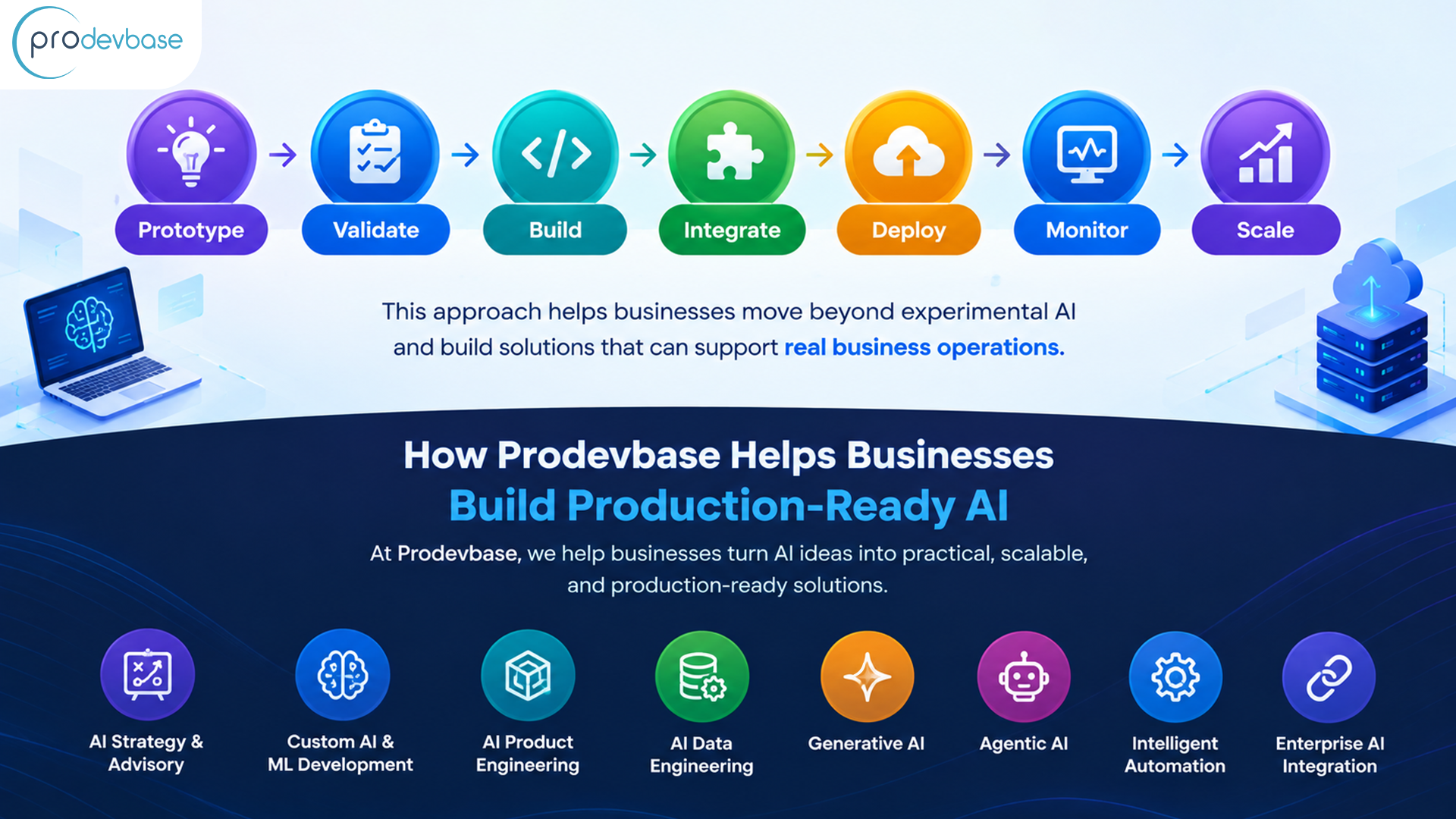
How Prodevbase Helps Businesses Build Production-Ready AI
At Prodevbase, we help businesses turn AI ideas into practical, scalable, and production-ready solutions.
Our services cover AI Strategy & Advisory, Custom AI & ML Development, AI Product Engineering, AI Data Engineering, Generative AI, Agentic AI, Intelligent Automation, and Enterprise AI Integration.
We focus on more than just building an AI model. Our approach considers the complete AI environment, including data, infrastructure, integrations, security, performance, scalability, and ongoing improvement.
If your AI project works in a demo but is struggling to move into production, Prodevbase can help identify the gaps and build a stronger path to deployment.
Ready to turn your AI project into a production-ready solution? Talk to Prodevbase today.
Frequently Asked Questions
Why do AI projects fail in production?
AI projects can fail because of poor data quality, unclear business objectives, inadequate testing, integration challenges, security problems, unexpected costs, limited scalability, and lack of monitoring.
How can businesses move AI from prototype to production?
Businesses should validate the use case, prepare production-quality data, select the right technology, build secure architecture, integrate existing systems, test performance, and continuously monitor the AI solution.
What makes an AI solution production-ready?
A production-ready AI solution needs reliable data, security, scalability, testing, monitoring, system integrations, cost management, and a clear connection to business objectives.
How can Prodevbase help with AI development?
Prodevbase provides AI strategy, custom AI development, AI product engineering, AI data engineering, generative AI, agentic AI, and intelligent automation services to help businesses build and scale AI solutions.