
Small Language Models vs Large Language Models: Choosing the Right AI
SLM vs LLM: Which AI Model Is Right for Your Business?
Why Model Size Matters for Business
Companies now have to decide between an SLM and an LLM. Generative AI has moved from an experiment to a common tool. As a result, business leaders must choose between small language models and large language models.
Large language models (LLMs) are trained on very large datasets. They have tens or hundreds of billions of parameters. This size lets them handle tasks such as drafting, analysis, and reasoning. Small language models (SLMs), by contrast, are more compact. They generally have fewer than ten billion parameters and need only moderate hardware.
Neither option is always superior. The right choice depends on the task, the data available, and the budget. Once you understand the trade-offs, you can invest in AI that delivers real returns. This guide explains each option in simple language. It also shows you how to make your choice with confidence.
What Are Large Language Models?
LLMs are general-purpose systems. They can understand and generate text on almost any topic. Because of their large scale, they reason well and handle vague, multi-step requests.
Teams use LLMs through cloud APIs, so there is less infrastructure to manage. However, the cost per request is higher. Responses may also be slower, and data will leave your environment. For this reason, LLMs suit teams that need a wide range of skills and want to get going quickly.
Also read: Why AI Projects Fail in Production: 10 Mistakes Businesses Should Avoid
What Are Small Language Models?
SLMs are lightweight models built for specific tasks. For instance, you can adapt one to your company’s own data and then deploy it on-premises or on an edge device.
SLMs also respond very quickly, and they cost much less to operate. On the other hand, they lack the range of an LLM. Nevertheless, they often do very well at specific tasks such as classification or internal Q&A. For this reason, SLMs suit teams that need speed, cost savings, and control.
Key Differences in SLM vs LLM
Here is a quick look at small language models compared to large language models in six main areas.
- Size and parameters – Large language models contain tens to hundreds of billions of parameters. In contrast, small language models usually have under one billion or about ten billion.
- Cost – SLMs are less expensive to train, tune, and operate. LLMs, on the other hand, have greater compute costs and higher per-token API fees.
- Speed – SLMs respond more quickly. This helps with real-time processing and high-volume use.
- Data privacy and control – Companies can run SLMs on their own infrastructure. LLMs, however, usually operate via third-party cloud services.
- Task scope – LLMs handle open-ended, cross-domain tasks best. SLMs, in contrast, perform best when the task is clearly defined.
- Customization – Teams can adjust SLMs more quickly and at a lower cost using their own data. As a result, they can create highly specialized behavior.
If you’re unsure which model suits your workflow, why not ask our AI team for a free consultation? Our Custom AI and ML Development service can help you choose the right model.
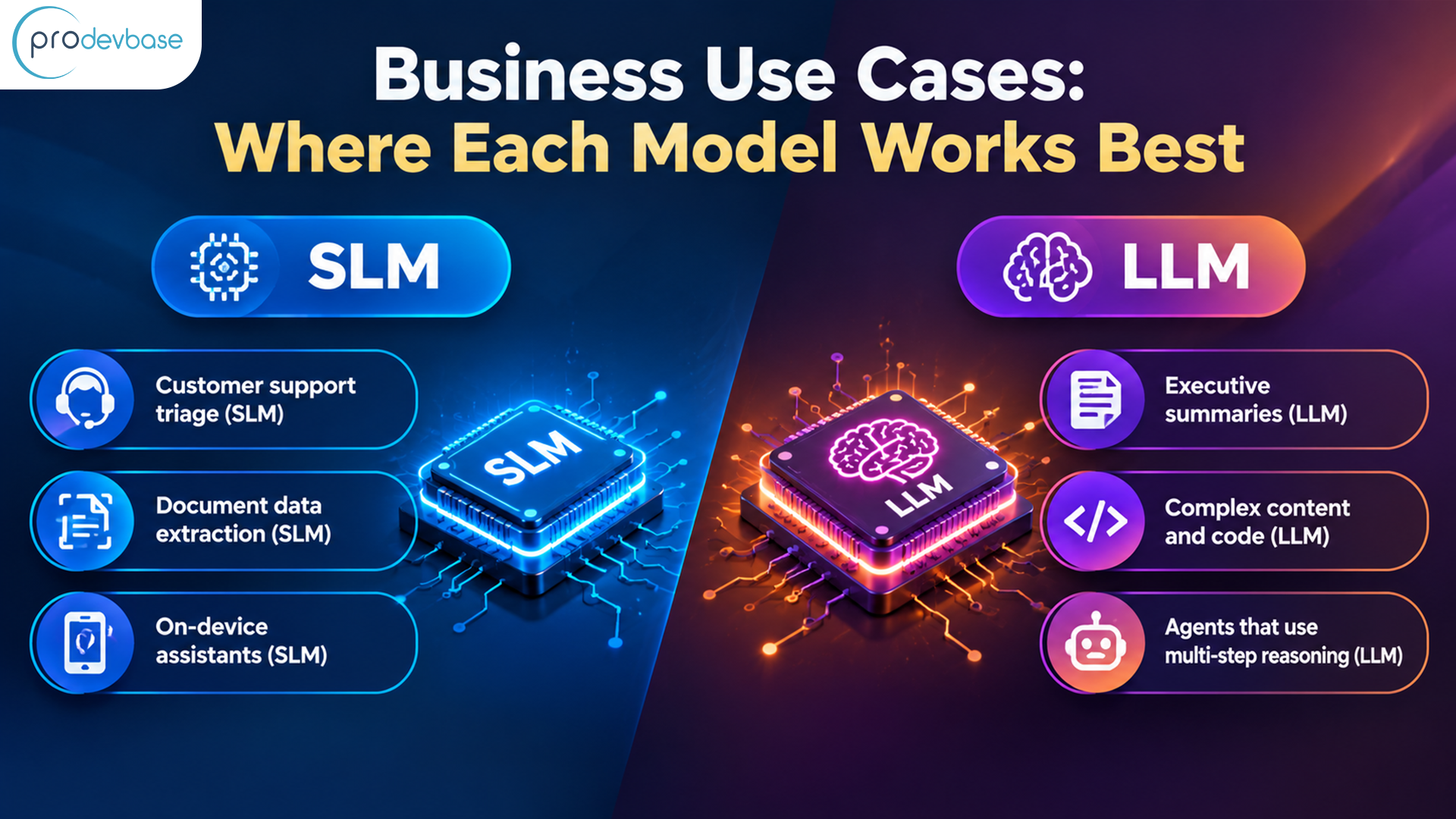
Business Use Cases: Where Each Model Works Best
Value comes from matching the model to the particular workload. When speed, cost, and privacy matter, lighter models work most effectively. Heavier models, however, only prove their worth when reasoning depth and flexibility matter. The following are the most common examples.
- Customer support triage (SLM) – A fine-tuned model can identify user intent and direct incoming tickets. It can also give immediate answers to common questions.
- Document data extraction (SLM) – It can pull invoice numbers, dates, and line items from hundreds of thousands of files at a low cost.
- On-device assistants (SLM) – Offline assistants work in mobile apps, retail kiosks, and field-service tools.
- Executive summaries (LLM) – An LLM can convert market reports and long documents into executive summaries.
- Complex content and code (LLM) – It works with long-form content, technical documentation, and code changes across more than one file.
- Agents that use multi-step reasoning (LLM) – These agents plan tasks, use tools, and handle unclear instructions.
How to Choose Between an SLM and an LLM
To go from idea to a working model, follow these six steps.
Step 1: Define the business problem – First, name the task, the users, and the outcome you wish to improve.
Step 2: Evaluate data sensitivity – Next, evaluate the sensitivity of the data. Then decide whether the data can leave your environment. This decision will lead you to choose between cloud and on-premises deployment.
Step 3: Establish benchmarks – Before testing, set goals for accuracy, latency, and cost per request.
Step 4: Test both kinds of models – Run the SLM and the LLM on actual samples. Then compare their quality, speed, and cost together.
Step 5: Fine-tune and integrate – Once you have selected a model, adapt it using data specific to your domain. After that, connect it to your current systems.
Step 6: Monitor and iterate – Finally, keep an eye on accuracy, drift, and user feedback, and iterate. Over time, a great many teams adopt a hybrid system. In it, SLMs handle simple tasks, and LLMs handle complex ones.
Tools and Technologies for SLM and LLM Deployment
The AI ecosystem covers every stage, from selection through to monitoring. With a flexible system, you can change models when your requirements change. Many of these tools are also open source.
- Models – Open-weight models include Llama, Mistral, Phi, and Gemma. Companies such as Anthropic, OpenAI, and Google offer commercial large language models.
- Fine-tuning – Hugging Face Transformers, PEFT/LoRA, and PyTorch let you adapt models efficiently.
- Deployment – You can deploy locally using Ollama, vLLM, and llama.cpp. Alternatively, AWS Bedrock, Azure AI, and Google Vertex AI provide managed hosting.
- Retrieval and monitoring – Tools such as LangChain, LlamaIndex, and observability tools can build and track retrieval pipelines.
A great many organizations find that a hybrid method works best. For example, a routing layer sends standard, high-volume requests to a fast SLM. It then passes complex queries on to an LLM. This balances quality and cost. Custom AI and ML Development makes this kind of setup possible, because it builds the routing, fine-tuning, and integration around your own data and systems.
The Bottom Line
Small and large language models complement each other. Small language models offer speed, low cost, and data control, while large language models offer greater breadth and reasoning capabilities. Therefore, begin by defining the business problem. Then test the various options on real data, and finally scale up those that prove successful. To sum up, SLMs versus LLMs is not a question with a single winner.
Prodevbase offers Custom AI and ML Development services tailored to your business needs. We advise on AI, help you choose a model, and build custom solutions for your workflows. If you’re looking for the right model for your business, why not get in touch with us now to arrange a consultation?
Frequently Asked Questions (FAQs)
What is the main difference between a small and a large language model?
It is one of scale and scope. Large language models have many more parameters, so they can carry out a wide range of complex tasks. Small language models, in contrast, are compact and optimized for specific tasks.
Is it cheaper to use small language models than large language models?
Yes, it generally is. Smaller models need less computing power for training, fine-tuning, and running. As a result, they cost less, particularly when volumes are large.
Can small language models be as accurate as large ones?
On narrow and well-defined tasks, a finely tuned small language model can match a general large language model. On broad reasoning tasks, however, large language models usually perform better.
Which model provides better data privacy?
SLMs are usually the better option. You can run them on-premises or on the device, so sensitive data stays within your environment.
Can businesses use both SLMs and LLMs?
Yes, they can. In this combined approach, SLMs take on simple, high-volume tasks. Meanwhile, LLMs handle the more complex requests.
Can you build a custom AI model for my business?
Yes. Our Custom AI and ML Development service covers model selection, fine-tuning, and integration with your existing systems.