
Hyperautomation: The Future of Intelligent Business Automation
Hyperautomation Explained: What Comes After Intelligent Automation
Intelligent automation solved a real problem: repetitive tasks stopped consuming valuable time. However, once several automated workflows exist side by side, a new challenge emerges. These workflows often operate in isolation, disconnected from each other and disconnected from the broader business. Hyperautomation is the response to exactly that gap.
Prodevbase works with businesses moving past isolated automation toward something more connected and scalable. This piece breaks down what it actually involves, and why it tends to follow intelligent automation rather than replace it.
What Hyperautomation Actually Means
According to the sources, hyperautomation is a business-driven, disciplined approach organizations use to rapidly identify, vet, and automate as many business and IT processes as possible. Consequently, it isn’t a single tool. Instead, it’s an orchestration layer that connects automated processes so they work together rather than in silos.
For instance, intelligent automation might handle invoice processing on its own. Meanwhile, it also connects that invoice workflow to procurement, inventory, and financial reporting, so a single trigger cascades across several systems at once. As a result, the value compounds rather than staying contained to one department.
Also read: How Can Generative AI Improve Marketing Content Without Losing Brand Voice?
Why Intelligent Automation Alone Reaches a Ceiling
Intelligent automation typically starts with a single, well-defined process. Therefore, early wins come quickly, and momentum builds fast. However, as more processes get automated independently, a fragmentation problem tends to appear. Each workflow runs well on its own, yet none of them share data or context.
Consequently, teams end up with dozens of efficient but disconnected automations. Rather than one seamless operation, it becomes a patchwork of isolated improvements. This is precisely the ceiling hyperautomation is designed to break through.
Core Components of a Hyperautomation Strategy
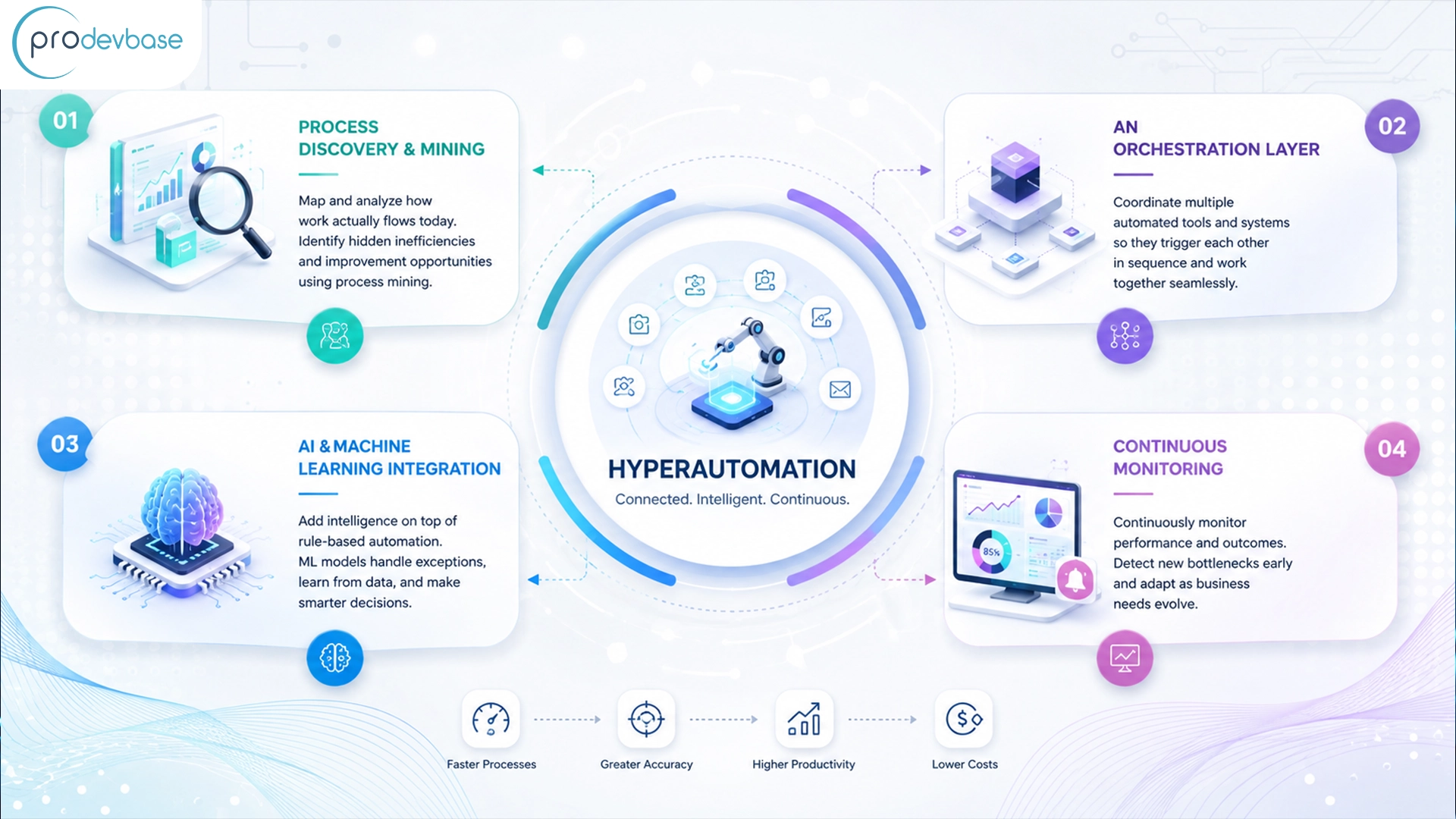
Process Discovery and Mining. Before connecting anything, existing processes need mapping. Process mining tools analyze how work actually flows through systems today, often revealing inefficiencies that were never visible before.
An Orchestration Layer. Specifically, this layer coordinates multiple automated tools so they trigger each other in sequence. Without it, automations remain isolated, regardless of how sophisticated each one is individually.
AI and Machine Learning Integration. Meanwhile, layering machine learning on top of rule-based automation allows systems to handle exceptions and ambiguous cases that rigid automation cannot.
Continuous Monitoring. Additionally, hyperautomation isn’t a one-time build. Ongoing monitoring identifies where new bottlenecks form as business needs shift.
Where Hyperautomation Delivers the Most Value
It tends to matter most in businesses already running several disconnected automations, particularly across finance and accounting, supply chain operations, customer service, and human resources. In each case, connecting previously separate workflows removes friction that individual automations, however well built, cannot solve alone.
For context on where this fits within a broader automation journey, see our guide on Intelligent Automation Use Cases.
Getting the Sequence Right
Moving toward hyperautomation without first stabilizing individual automated processes tends to create more complexity, not less. Therefore, the sequence matters: intelligent automation lays the foundation, and it extends that foundation across the wider business.
Prodevbase follows this exact progression when guiding businesses from isolated automation toward a connected, orchestrated system, since skipping ahead often means rebuilding the foundation later.
What This Means Going Forward
Hyperautomation isn’t a replacement for intelligent automation. Rather, it’s the next logical stage once enough individual automations exist to justify connecting them. Prodevbase has seen this shift play out consistently: businesses that reach this stage typically see automation move from a collection of isolated tools into a genuinely coordinated operating layer.
As more processes move toward automation throughout 2026, the gap between isolated efficiency and connected efficiency will likely widen. For businesses further along in their automation journey, this transition often determines whether automation investment compounds or simply accumulates. We continue helping close that exact gap.