
Generative AI for Marketing Content: Scale Without Losing Brand Voice

How Can Generative AI Improve Marketing Content Without Losing Brand Voice?
Marketing teams are under constant pressure to produce more content, faster, across more channels. Consequently, generative AI has become the default answer for scaling output. However, speed alone isn’t the goal. Without careful oversight, generative AI for marketing content can quietly erode the very brand voice that took years to build. So let’s have a look at How Can Generative AI Improve Marketing Content.
This tension, between scale and consistency, defines how well a generative AI rollout actually performs. Prodevbase addresses this exact challenge for marketing teams building AI-assisted content pipelines, and the patterns are consistent across industries.
Why Brand Voice Breaks Down First
Generative models are trained on broad, general patterns of language. Therefore, left unguided, they tend to produce content that sounds competent but generic. A blog post might read smoothly, yet lack the specific tone, vocabulary, and rhythm that makes a brand recognizable.
This is rarely a technical failure. Instead, it happens because voice guidelines are often undocumented or too vague for a model to follow. As a result, the model defaults to the safest, most average version of the writing style it has learned.
You might be missed to read: How Generative AI Services Improve Customer Experience?
Building a Voice Framework Before Scaling Output
A reliable fix starts before any content gets generated. Specifically, a clear voice framework should define tone, sentence rhythm, vocabulary preferences, and words to avoid. Additionally, real examples of strong past content help anchor the model to a concrete standard rather than an abstract description.
Once that framework exists, prompts can reference it directly. Consequently, output becomes far more consistent, since the model has something specific to match instead of guessing at tone.
Human Review Still Matters
Even with strong prompts, generated drafts benefit from editorial review before publishing. Meanwhile, this review shouldn’t slow production to a crawl. Instead, it should focus narrowly on tone accuracy, factual correctness, and brand alignment.
Over time, this review process generates valuable feedback. Therefore, that feedback can further refine prompts and style guides, gradually reducing the amount of editing each draft needs. This is the layered approach Prodevbase builds into content workflows: framework first, generation second, lightweight review third.
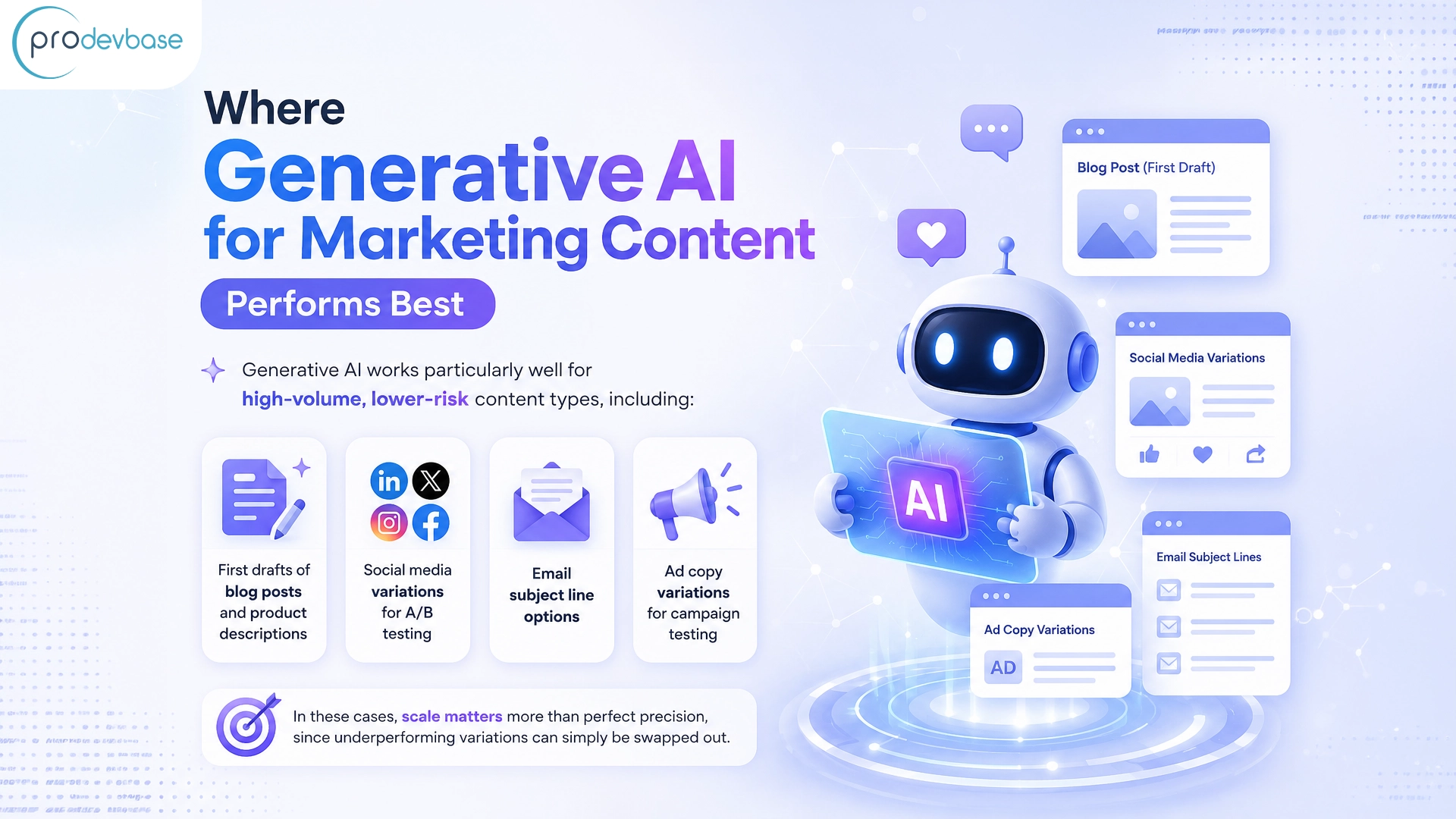
Where Generative AI for Marketing Content Performs Best
Generative AI works particularly well for high-volume, lower-risk content types, including:
- First drafts of blog posts and product descriptions
- Social media variations for A/B testing
- Email subject line options
- Ad copy variations for campaign testing
In these cases, scale matters more than perfect precision, since underperforming variations can simply be swapped out.
Where It Needs Tighter Control
Conversely, high-visibility content, such as brand campaigns, executive communications, or anything tied to public reputation, needs tighter human involvement. In these situations, generative AI works best as a drafting assistant rather than a final decision-maker.
A Practical Path Forward
Scaling marketing content doesn’t require choosing between speed and consistency. Rather, it requires sequencing them correctly: a strong voice framework first, generative tools second, and targeted human review third.
Marketing teams that follow this order typically see output multiply without noticeable dips in quality. Prodevbase has applied this exact sequence while helping marketing teams scale generative AI content without losing what makes their brand recognizable in the first place. As adoption grows through 2026, this sequencing will likely separate teams that scale well from those that scale loudly but inconsistently. Prodevbase continues refining this framework as new models and marketing channels emerge.