
What Is AI-Ready Data Infrastructure? A Complete Guide to Modernizing Legacy Systems
Modernizing Legacy Systems for AI-Ready Data Infrastructure
Legacy systems were built for a different era of computing, long before AI workloads existed. Consequently, these systems tend to buckle under the volume, speed, and structure AI initiatives now demand. AI-ready data infrastructure does not simply mean adding new tools on top of old ones. Rather, it requires rethinking how data is stored, moved, and accessed from the ground up.
Prodevbase works with businesses untangling legacy infrastructure specifically to prepare it for AI workloads, rather than layering automation on top of systems that were never designed to support it. This piece walks through what modernization actually requires, and why skipping steps tends to backfire later.
Why Legacy Systems Block AI Progress
Legacy databases were typically designed around rigid schemas and scheduled batch jobs. Therefore, they struggle with the unstructured, high-velocity data that AI models depend on. Additionally, these systems often live in silos, with little communication between departments or platforms.
As a result, an AI model attempting to pull data from three disconnected legacy systems frequently receives inconsistent formats, duplicate records, and conflicting timestamps. Consequently, model accuracy suffers before a single prediction gets made, since the problem started upstream in the infrastructure itself.
Also read: How Do You Choose Between Custom AI and Off-the-Shelf AI for Your Business?
Core Steps to Modernize Legacy Infrastructure
Audit Existing Systems First. Before changing anything, a full inventory of existing data sources, formats, and dependencies needs mapping. Otherwise, modernization efforts risk breaking processes that still matter.
Decouple Data From Legacy Applications. Specifically, data should be separated from the applications built around it decades ago. This allows infrastructure to evolve without requiring a full rebuild of every connected system at once.
Introduce a Modern Data Layer. Meanwhile, a cloud-native or hybrid data layer can sit between legacy systems and newer AI tools, translating formats and unifying access points. As a result, AI workloads gain consistent access without waiting for every legacy system to be replaced outright.
Establish Governance During Migration. Additionally, moving data without governance in place tends to simply relocate old problems rather than solve them. Therefore, validation rules and access controls should be built into the migration itself, not added afterward.
Automate Data Quality Checks. Finally, automated validation catches formatting errors and duplicate records before they reach AI systems, rather than after a model has already trained on flawed data.
A Practical Migration Sequence
Rushing modernization tends to create new problems faster than it solves old ones. First, inventory and classify existing data sources by business criticality. Next, decouple the highest-priority data from its legacy application layer. Then, introduce the modern data layer incrementally, rather than attempting a single disruptive cutover. After that, layer in governance and automated quality checks before AI workloads begin drawing from the new infrastructure.
Prodevbase follows this exact sequence when modernizing legacy infrastructure for AI readiness, since a rushed migration frequently carries a steeper cost than a phased one executed properly.
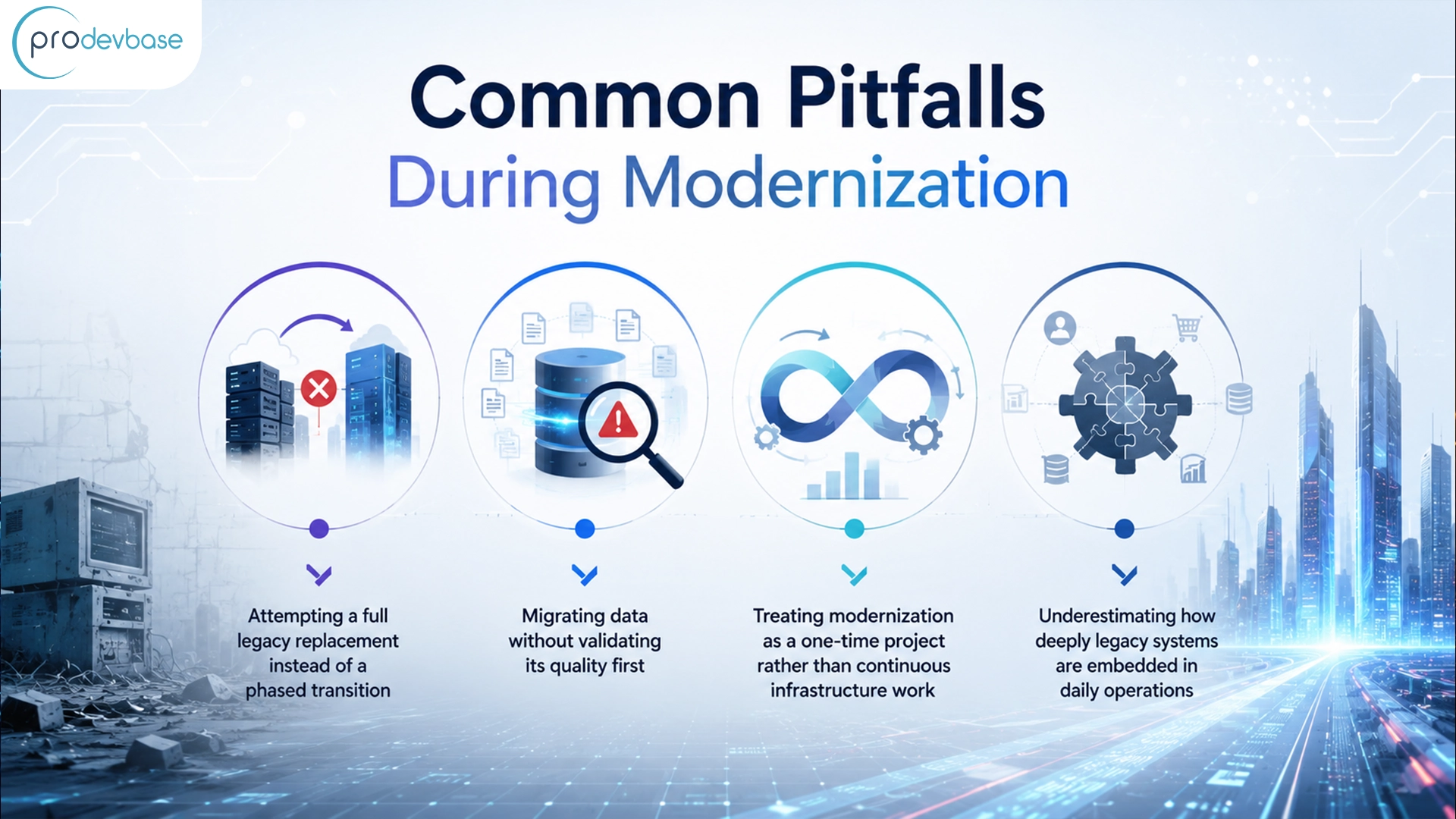
Common Pitfalls During Modernization
Several patterns tend to derail modernization efforts:
- Attempting a full legacy replacement instead of a phased transition
- Migrating data without validating its quality first
- Treating modernization as a one-time project rather than continuous infrastructure work
- Underestimating how deeply legacy systems are embedded in daily operations
Avoiding these pitfalls typically depends on sequencing decisions correctly from the outset, rather than reacting to problems after they surface.
Why This Work Cannot Be Skipped
Skipping infrastructure modernization rarely saves time in practice. Instead, it shifts the cost downstream, where it resurfaces as poor model performance, unreliable predictions, or expensive emergency fixes. Prodevbase has seen this pattern hold consistently: AI initiatives built on unmodernized legacy infrastructure tend to stall well before reaching production.
Moving Forward
Modernizing legacy systems is rarely glamorous work, yet it consistently determines whether AI initiatives succeed or stall. As AI adoption accelerates through 2026, infrastructure readiness will likely separate businesses that scale confidently from those still fighting fires in outdated systems. Prodevbase continues helping businesses build that foundation before legacy gaps turn into costly setbacks.