
Why AI Projects Fail Without the Right Data Infrastructure

Why Data Infrastructure Decides AI Success
The Hidden Reason Behind Failed AI Initiatives
Each year companies put a great deal of money into artificial intelligence. Yet a major portion of AI projects never make it to production. The main cause of many of these failures is inadequate data infrastructure. For instance, a superb model cannot learn from data that is dispersed, out of date, or damaged. So let’s have a look on What Is AI Data Infrastructure
Data infrastructure forms the basis on which information is collected, stored, cleaned, and supplied to models. If it is lacking, even sophisticated algorithms will make poor predictions. It follows that executives must regard data readiness as an initial step rather than something done later on. Moreover, a robust infrastructure reduces delivery time and cuts long-term costs.
Teams often move quickly towards building models because this seems exciting, while the pipelines associated with the models are neglected. As a result, projects come to a standstill when they reach the testing, deployment, or scaling stages.
How Weak Data Foundations Break Models
Since models pick up patterns from the information they are given, defective inputs lead to defective outputs. If the samples are biased, values are missing, or entries are duplicated, all the results are distorted. In the same way, out-of-date data causes predictions that no longer correspond to reality. As a result, business teams soon stop trusting the system. Once trust has disappeared, adoption falls and the project loses its funding.
The Cost of Ignoring Scalability
A prototype can perform well using a small spreadsheet. However, production systems have to handle millions of records in real time. If there is no scalable storage and computing power, latency increases considerably.
For example, a recommendation engine that takes ten seconds to respond will lose customers. In a similar way, a fraud detection model that is slow to score transactions will fail to identify the threat. Therefore, design the infrastructure with growth in mind from the very beginning.
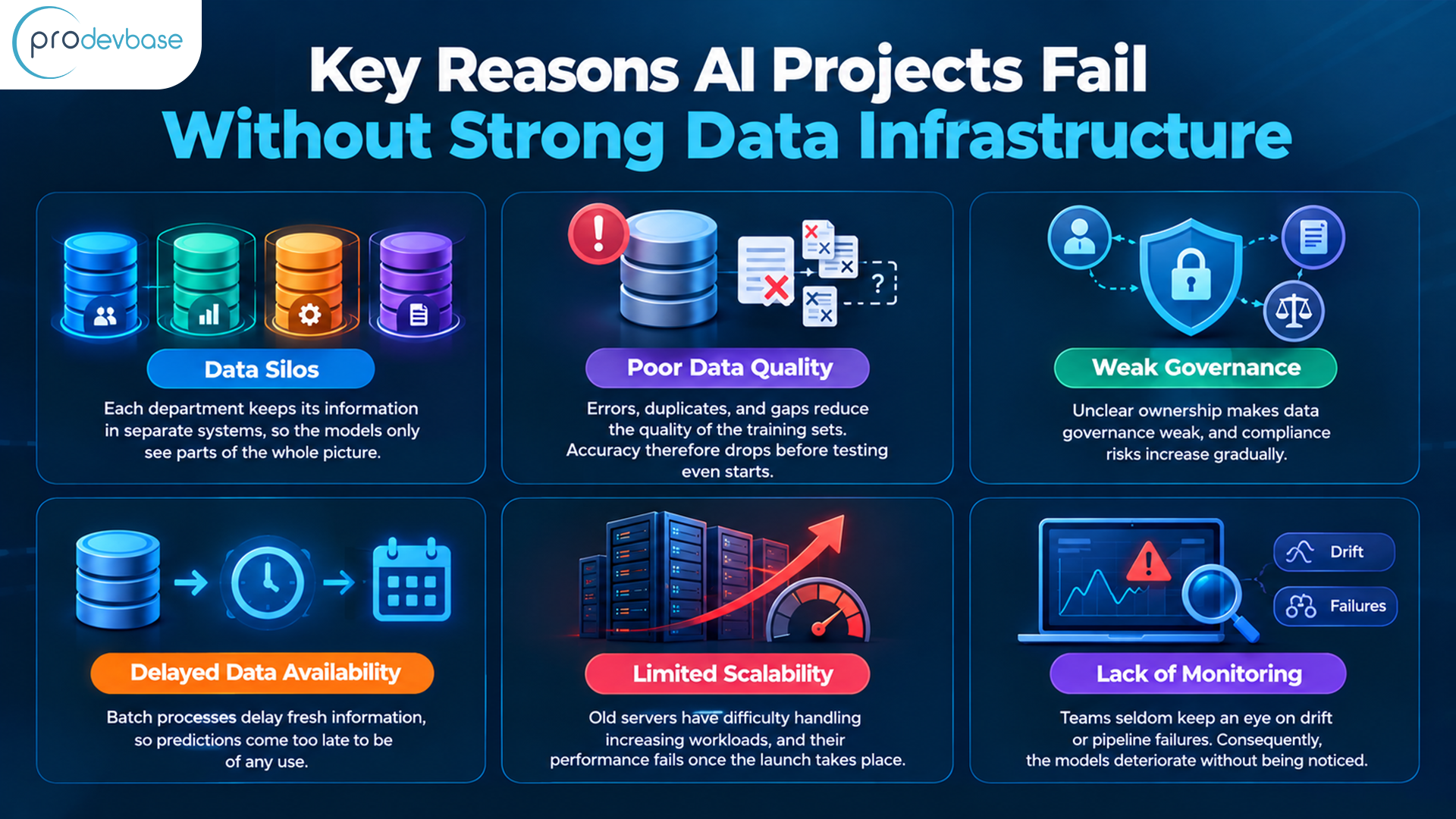
Key Reasons AI Projects Fail Without Strong Data Infrastructure
- Data Silos – Each department keeps its information in separate systems, so the models only see parts of the whole picture.
- Poor Data Quality – Errors, duplicates, and gaps reduce the quality of the training sets. Accuracy therefore drops before testing even starts.
- Weak Governance – Unclear ownership makes data governance weak, and compliance risks increase gradually.
- Delayed Data Availability – Batch processes delay fresh information, so predictions come too late to be of any use.
- Limited Scalability – Old servers have difficulty handling increasing workloads, and their performance fails once the launch takes place.
- Lack of Monitoring – Teams seldom keep an eye on drift or pipeline failures. Consequently, the models deteriorate without being noticed.
Real-World Use Cases Where Data Infrastructure Matters
Reliable pipelines play a role in AI across all industries. To make this clear, look at the following examples.
- Banking – A bank feeds transaction data into a feature store, so risky payments are detected within milliseconds.
- Manufacturing – For predictive maintenance, a factory links its machine sensors to a central platform. Repairs can then be carried out before breakdowns occur.
- E-commerce – An online store uses customers’ browsing and purchase history to make product suggestions seem relevant.
- Healthcare – A hospital standardizes imaging and patient records so that diagnostic models can learn from consistent inputs.
- Logistics – A logistics company combines data on the weather, sales, and shipping. As a result, its inventory plans remain accurate.
- Telecommunications – A telecommunications provider cleans and indexes its knowledge base, so the answers remain correct and up to date.
You might missed to read: SLM vs LLM: Which AI Model Is Right for Your Business?
Steps to Build a Data Infrastructure for AI
Step 1 – Identify and Assess Data Sources: List all the sources, their owners, and the different formats they take. Then assess each source in terms of its quality and relevance.
Step 2 – Define Business Goals: Make sure your data needs correspond to specific outcomes. For instance, a churn model requires billing and usage history.
Step 3 – Design the Architecture: Select storage, ingestion, and processing layers that can scale. Also prepare for both batch and streaming workloads.
Step 4 – Clean and Standardize: Remove the duplicates, correct the formats, and deal with the missing values. Then record each rule for future teams.
Step 5 – Set Up Governance: Designate owners, set access controls, and keep track of data lineage. At the same time, comply with privacy regulations from the beginning.
Step 6 – Monitor and Improve: Continuously monitor quality, latency, and drift. Lastly, retrain the models when the patterns change.
Tools and Technologies for AI-Ready Data Infrastructure
The correct tools make each stage of the data lifecycle easier. Yet, the selection of tools should be based on strategy and not on trends.
- Storage (Data Lakes and Warehouses) – Cloud data lakes and warehouses such as Amazon S3, Snowflake, and Google BigQuery store structured and raw data.
- Data Movement and Transformation – Apache Kafka, Apache Airflow, and dbt move and transform data reliably, and they also support real-time flows.
- Data Validation and Lineage – Great Expectations, Collibra, and Apache Atlas are used for validating data and tracking lineage.
- MLOps and Monitoring – MLflow, Kubeflow, and Evidently AI handle experiment management, deployment, and detection of drift.
It can be difficult to choose and connect these tools, which is why expert advice is useful. It saves time and avoids expensive rework. Prodevbase assists businesses with selecting, integrating, and managing these technologies by offering specialized AI services. It also designs pipelines based on actual business objectives. Consequently, the models get to production more quickly.
Build AI on a Solid Foundation
If you’re ready to launch a successful AI project, Prodevbase can provide you with AI services, covering everything from data audits to model deployment. Get in touch with the team now to arrange a practical roadmap.
Conclusion
The success of AI relies on the foundation of the model. Companies should therefore invest in data quality, governance, and scalability before attempting to use advanced algorithms. Otherwise, even the best model will fail in actual deployment. Yet, if the right strategy is adopted, data can become a lasting source of competitive advantage.
Prodevbase offers AI services tailored to your business needs. Begin building a solid data infrastructure today and turn your AI aspirations into tangible results.