
The Best Intelligent Automation Use Cases Transforming Businesses in 2026
Intelligent Automation Use Cases: Healthcare, Finance, and Retail
Every industry runs differently. A hospital manages patient lives while a bank guards financial assets. Meanwhile, a retailer races to meet intense consumer demand. These are unique problems that require distinct solutions. So let’s have a look at The Best Intelligent Automation Use Cases.
That is exactly why intelligent automation use cases vary so much from one sector to the next. This technology combines robotic process automation, artificial intelligence, and machine learning. Because it is not a one-size-fits-all tool, it adapts and learns constantly. When you deploy it in the right context, it delivers results that generic software simply cannot match.
This blog explores the most powerful and proven intelligent automation use cases across healthcare, finance, and retail. Each section digs into specific applications that are saving time, cutting costs, and improving outcomes right now. If you are evaluating technology for your business, this guide will help you find the highest value opportunities.
What Is Intelligent Automation?
Before diving into specific industries, a quick definition helps set the stage. Intelligent automation combines three core technologies into a single ecosystem.
Robotic Process Automation
Robotic process automation utilizes software bots that handle repetitive, rule-based tasks. These tasks include copying data, filling forms, or sending automated notifications.
Artificial Intelligence
Artificial intelligence includes systems that analyze data, recognize complex patterns, and make independent decisions. Crucially, these systems learn from outcomes over time.
Machine Learning
Machine learning relies on algorithms that improve automatically based on new data streams. This capability enables highly accurate predictions and adaptive behavior.
Together, these technologies allow organizations to automate complex, judgment-based workflows. Processes that previously required extensive human expertise can now run autonomously. Let us look at how this plays out across three distinct industries.
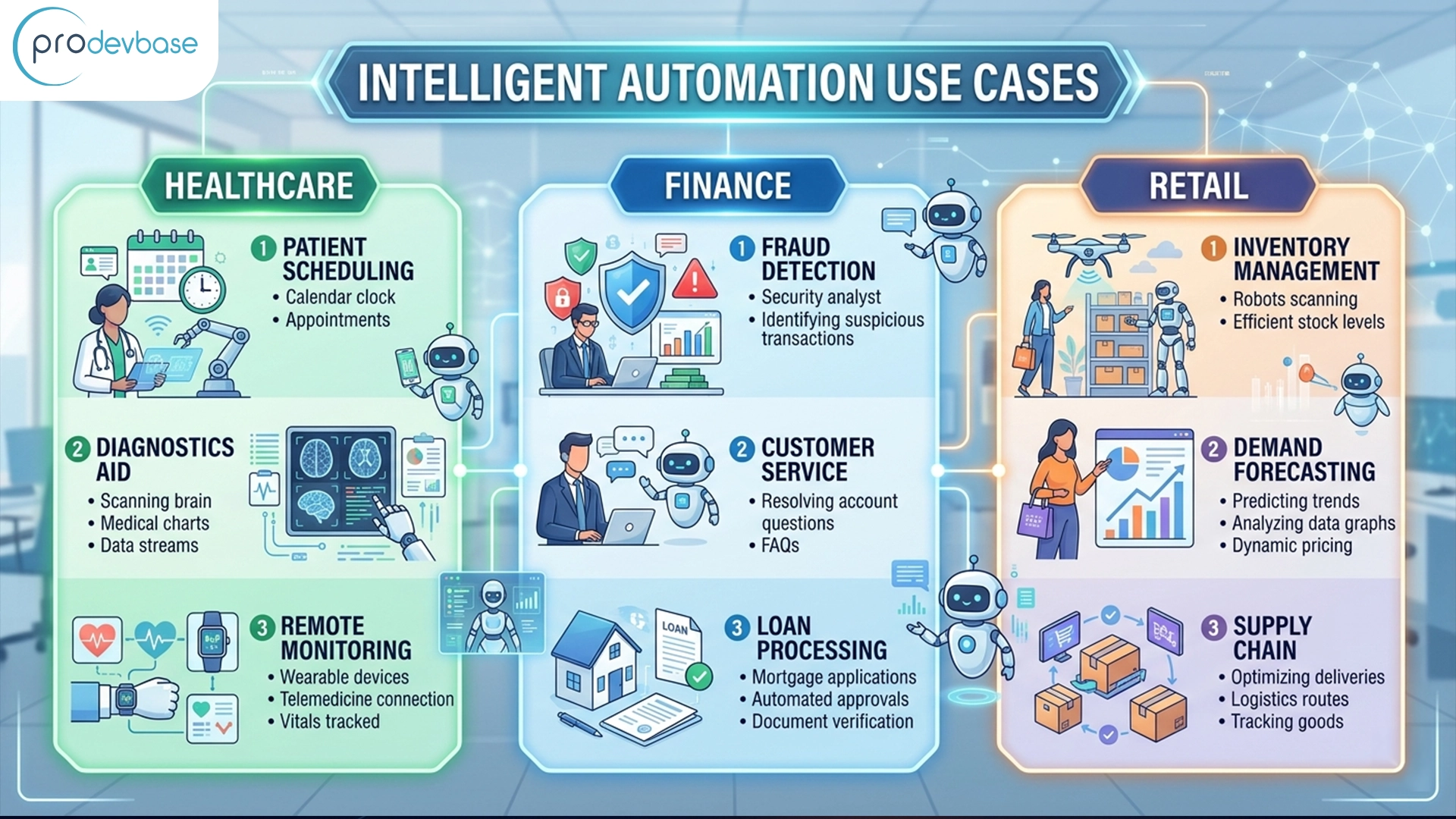
Intelligent Automation Use Cases in Healthcare
Healthcare is one of the most data-intensive industries on the planet. Care teams deal with mountains of patient records, insurance claims, and compliance requirements every day. Fortunately, intelligent automation handles this administrative overload so professionals can focus entirely on patients.
Automated Prior Authorization Processing
Prior authorization is one of healthcare’s most frustrating bottlenecks. Insurers require providers to get approval before performing procedures or prescribing medications. Manually, this process can take days, which delays care and exhausts staff.
Intelligent automation extracts clinical data from electronic health records automatically. After that, it matches the data against payer criteria and submits the requests. The system tracks status in real time and flags complex cases for human clinical review. Consequently, providers achieve faster approvals and fewer denials.
Revenue Cycle Management and Claims Processing
Healthcare revenue cycle management involves a long chain of sensitive processes. Mistakes in patient registration or insurance verification lead to immediate claim rejections.
Intelligent automation bots verify insurance coverage before appointments even begin. During the next phase, artificial intelligence reviews claims for coding errors before submission. Automated systems also correct rejected claims and match incoming payments against expected reimbursements. As a result, hospitals report dramatic reductions in denial rates and faster cash collection.
Patient Data Management and EHR Updates
Physicians spend an alarming amount of time on documentation. Intelligent automation addresses this burden by updating patient records using voice-to-text technology.
The software pulls relevant history from multiple systems into a single unified view. It also triggers follow-up care reminders based on standard treatment protocols. This reduces clinician burnout while improving the accuracy of patient records.
Clinical Trial Management
Running a clinical trial requires managing enormous volumes of unstructured data. Intelligent automation helps by screening patients and matching them to open trials. Furthermore, the software monitors milestones, validates incoming data, and generates compliance reports for regulatory submissions. These automated workflows accelerate trial timelines significantly.
Hospital Bed and Resource Management
Efficient bed management is critical to daily hospital operations. Intelligent automation predicts patient discharge timelines using historical and real-time data. Following that prediction, the system notifies housekeeping teams the moment beds become available. This matching process optimizes staff scheduling and reduces patient wait times.
Intelligent Automation Use Cases in Finance
The financial services industry is naturally data-driven and process-heavy. Banking, insurance, and wealth management involve repetitive workflows that are ideal candidates for technology. Today, the main difference lies in the scale and sophistication of what automation can handle.
Know Your Customer and Anti-Money Laundering Compliance
Regulatory compliance is a massive resource burden in financial services. For example, manual customer onboarding can take days of document review.
Intelligent automation transforms this process by extracting data from identity documents using optical character recognition. The system cross-references customer data against global watchlists in seconds. It flags anomalies for human review while processing routine cases automatically. Therefore, institutions reduce onboarding times while maintaining strict compliance standards.
Loan Origination and Credit Decisioning
Traditional loan processing involves multiple slow steps. Staff must collect documents, verify income, and assess creditworthiness manually.
With intelligent automation, document verification happens instantly. Credit scoring models run in real time using artificial intelligence. The system generates loan decisions within minutes for straightforward cases and escalates edge cases to human underwriters. Banks using this approach drop processing times from weeks to hours.
Fraud Detection and Prevention
Financial fraud is a growing threat, and traditional rules often miss novel patterns. Artificial intelligence changes the equation by monitoring transactions in real time across millions of accounts.
The system identifies unusual behavioral patterns that deviate from historical activity. It triggers automatic account holds for flagged transactions while learning continuously from new fraud tactics. This reduces frustrating false positives while catching actual fraud before losses occur.
Financial Reporting and Reconciliation
The month-end close is a painful process in most finance departments. Intelligent automation solves this by aggregating data from multiple ledgers automatically.
The software reconciles accounts in real time and flags discrepancies instantly. It also generates management reports and provides variance analysis that surfaces meaningful insights. Finance teams consistently reduce close times from weeks to mere hours.
Trade Settlement and Back Office Operations
Back office operations in capital markets are notorious for manual effort. Intelligent automation matches trade confirmations between counterparties automatically. Additionally, it processes corporate actions like dividends and manages settlement workflow exceptions. These capabilities allow financial institutions to increase trading volumes without adding headcount.
Intelligent Automation Use Cases in Retail
Retail operates on thin margins, high transaction volumes, and shifting consumer demand. Intelligent automation helps retailers move faster, personalize experiences, and operate leaner from the supply chain to the storefront.
Inventory Management and Demand Forecasting
Out-of-stock items cost retailers revenue, while overstocks eat into profit margins. Intelligent automation solves both problems by aggregating sales data, seasonal trends, and weather signals.
The system generates automated replenishment orders when inventory falls below dynamic thresholds. It predicts demand spikes with machine learning and alerts buyers in advance. Retailers using this technology report measurable reductions in excess inventory holding costs.
Personalized Customer Experience and Marketing Automation
Mass marketing is increasingly ineffective because modern customers expect relevance. Intelligent automation enables real-time customer segmentation based on browsing behavior and purchase history.
The software triggers personalized email campaigns based on specific customer actions. It also powers dynamic product recommendations and deploys chatbots to handle customer inquiries around the clock. The direct impact includes higher conversion rates and increased customer lifetime value.
Supply Chain Visibility and Logistics Optimization
Retail supply chains span thousands of manufacturers, distributors, and stores. Intelligent automation provides end-to-end shipment tracking with automated alerts when deliveries are at risk.
The software selects carriers automatically based on cost and speed criteria. It optimizes delivery routes using real-time traffic data and processes customer returns faster. This improves on-time delivery rates and gives retailers total control over fulfillment costs.
Price Optimization
Pricing in retail is a constant balancing act between competitiveness and margin. Intelligent automation supports real-time competitor price monitoring using web scraping tools.
The system applies dynamic price adjustments based on demand signals and inventory levels. It also optimizes markdowns for aging inventory at the perfect moment. Retailers implementing intelligent pricing see immediate improvements in gross margins.
You might missed: Why AI Strategy and Advisory Services are Essential for Enterprises in 2026?
Store Operations and Workforce Management
Running physical stores efficiently requires coordinating staffing and merchandising.
Image recognition technology monitors planogram compliance to ensure shelves stay correctly stocked. The system also sends performance reports directly to managers without manual data entry. These capabilities reduce operational overhead while maintaining consistent in-store standards.
Comparing Intelligent Automation Use Cases
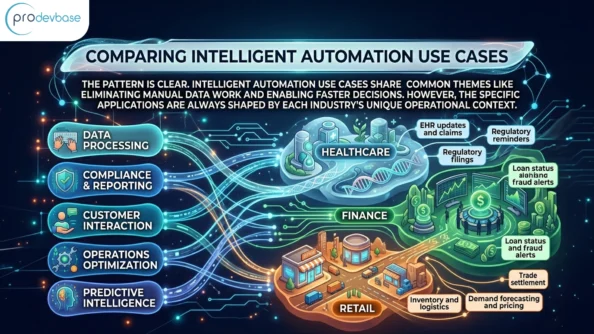
The table below outlines how these automation strategies apply across different business functions.
| Use Case Category | Healthcare | Finance | Retail |
|---|---|---|---|
| Data Processing | EHR updates and claims | KYC and loan documents | Supplier invoices and returns |
| Compliance & Reporting | Regulatory filings | AML and compliance audits | Labor law scheduling |
| Customer Interaction | Appointment reminders | Loan status and fraud alerts | Chatbots and personal offers |
| Operations Optimization | Bed management and staffing | Trade settlement | Inventory and logistics |
| Predictive Intelligence | Patient discharge timing | Credit scoring and fraud eyes | Demand forecasting and pricing |
The pattern is clear. Intelligent automation use cases share common themes like eliminating manual data work and enabling faster decisions. However, the specific applications are always shaped by each industry’s unique operational context.
Key Factors That Determine Success
Not every intelligent automation implementation succeeds. The organizations that get the most out of this technology share a few common traits.
Start with well-defined processes
Automation works best where inputs, steps, and outputs are clearly understood. The three industries listed above all have plenty of these structured environments.
Invest in Data Quality
Intelligent automation is only as good as the data it receives. Organizations that maintain clean, well-structured data see faster and more reliable results.
Design for Exceptions
No automated process handles every scenario perfectly. The best implementations clearly define when a case should escalate to a human and make that handoff seamless.
Measure Specific Metrics
Whether the goal is faster claim processing or lower fraud losses, successful organizations define metrics upfront. They track these numbers rigorously to prove ROI.
Train the Workforce
Automation changes daily roles instead of just replacing processes. Organizations that invest in helping employees adapt see better adoption and superior outcomes.
This is precisely the kind of end-to-end implementation thinking that Prodevbase brings to every engagement. We help organizations across healthcare, finance, and retail identify the right processes, build the right architecture, and measure what actually moves the needle.
What to Expect as Intelligent Automation Matures
The use cases described in this blog represent where the technology stands today. However, the future trajectory points toward even greater sophistication.
Agentic AI systems are beginning to emerge across all three industries. These autonomous agents are capable of making multi-step decisions and managing complex workflows end-to-end. In healthcare, this means AI agents that coordinate care pathways across multiple providers. In finance, agents will manage entire regulatory compliance workflows, while retail systems will autonomously execute supply chain decisions.
The organizations building strong intelligent automation foundations today will be the best positioned to adopt these next-generation capabilities as they mature.
Conclusion: Tailored Use Cases Deliver Real Impact
Intelligent automation is a powerful platform-level capability. Even so, the use cases that deliver real impact are deeply specific to the industry, the process, and the data environment.
Healthcare organizations can reclaim thousands of clinician hours by automating administrative workflows. Financial services firms can move faster, reduce fraud losses, and cut compliance costs. At the same time, retailers can compete more effectively on price and customer experience without expanding headcount.
The common thread is clear. Intelligent automation use cases succeed when they are grounded in a clear understanding of where manual processes create friction.
If the businesses are ready to move from evaluation to execution, Prodevbase works with organizations in healthcare, finance, and retail to design and deploy intelligent automation solutions. These systems are built for real operational environments rather than just proof-of-concept demos. The use cases in this guide are exactly the kinds of problems our team helps solve every day.
Frequently Asked Questions
What are the most common intelligent automation use cases in healthcare?
The most common include automated prior authorization, claims processing, revenue cycle management, EHR data management, and hospital resource optimization.
How is intelligent automation used in financial services?
Key finance use cases include KYC and AML compliance, loan origination, real-time fraud detection, financial close reconciliation, and trade settlement automation.
What intelligent automation use cases deliver the fastest ROI in retail?
Demand forecasting and inventory management typically deliver fast, measurable ROI. Price optimization and personalized marketing automation also generate strong returns relatively quickly.
Is intelligent automation the same as robotic process automation?
No. Robotic process automation handles simple, rule-based tasks. Intelligent automation combines that capability with artificial intelligence and machine learning to handle complex, judgment-based processes.
Which industries benefit most from intelligent automation?
Healthcare, financial services, and retail are among the highest impact sectors. Additionally, manufacturing, logistics, insurance, and telecommunications see significant benefits from these deployments.