
What are the Best Intelligent Automation Strategies for Business Growth in 2026
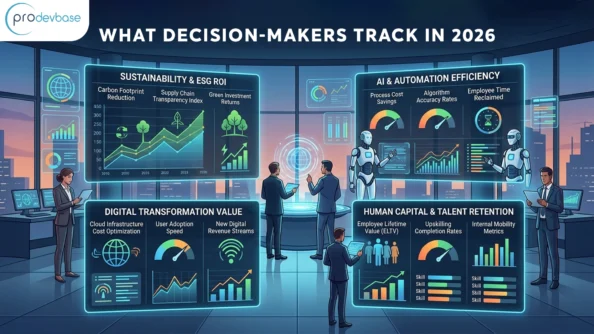
The Best Intelligent Automation Strategies in 2026?
Introduction: The Pilot Era Is Over
In 2026, the gap between organizations using intelligent automation and those still “evaluating” it is no longer a crack; it is a canyon. While many leaders spent the last 24 months in pilot phases, the most resilient enterprises moved straight into autonomous orchestration. Consequently, this shift has transformed intelligent automation from a luxury of the tech-forward into the primary engine for operational survival. So let’s have a look at what are the Best Intelligent Automation Strategies in 2026?
Boardroom discussions have officially moved past the “what” and “why.” The mandate from the C-suite focuses entirely on the “where” and the “how much.” As the pilot era concludes, the focus shifts toward scaling real-world applications that yield measurable returns by the second quarter. Prodevbase recognizes that in this landscape, execution is the only metric that matters.
This blog serves as a guide to real intelligent automation use cases in 2026, the ROI metrics that drive growth, and the deployment mistakes that still cost companies millions.
Industry-Wise Intelligent Automation Use Cases
1. Banking and Financial Services
Banking remains the highest-volume adopter of intelligent automation due to the precision required in high-frequency transactions.
- Real-Time Fraud Detection: Systems now analyze transactions in under 400 milliseconds. Manual review queues that once took 48 hours are resolved in minutes.
- Hyper-Speed Loan Processing: Standard retail loans that took 12 days to process in 2023 now take 4 to 6 hours. Specifically, automation handles document ingestion, credit checks, and risk scoring.
2. Healthcare
Healthcare automation has moved from simple billing to advanced clinical support.
- EHR Data Automation: Systems extract and classify data from unstructured clinical notes. This reduces the administrative burden on doctors by 30% to 40%.
- Claims Adjudication: Claim cycles have dropped from 14 days to under 24 hours. Furthermore, coding errors have been reduced by 60%.
3. Retail and Manufacturing
- Dynamic Demand Forecasting: Automation now ingests social media sentiment, weather patterns, and competitor pricing to update inventory levels in real-time.
- Predictive Maintenance: By monitoring vibration and temperature sensors, intelligent automation identifies failure signatures weeks in advance. This reduces unplanned downtime by up to 45%.
ROI Metrics: What Decision-Makers Track in 2026
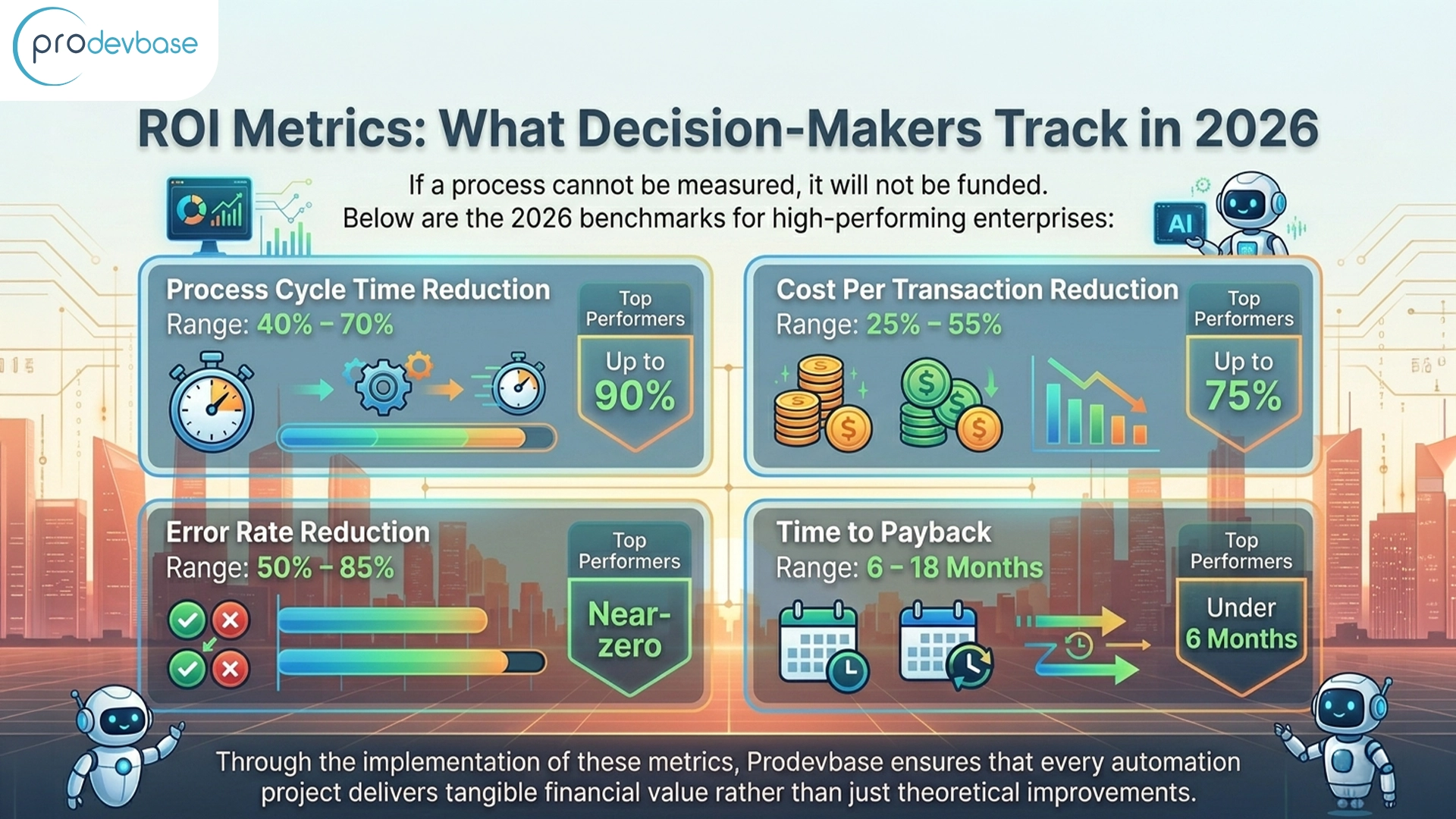
If a process cannot be measured, it will not be funded. Below are the 2026 benchmarks for high-performing enterprises:
| ROI Metric | Range | Top Performers |
|---|---|---|
| Process Cycle Time Reduction | 40% – 70% | Up to 90% |
| Cost Per Transaction Reduction | 25% – 55% | Up to 75% |
| Error Rate Reduction | 50% – 85% | Near-zero |
| Time to Payback | 6 – 18 Months | Under 6 Months |
Through the implementation of these metrics, Prodevbase ensures that every automation project delivers tangible financial value rather than just theoretical improvements.
You may missed to read: Why AI Strategy and Advisory Services Are Defining Enterprise Success in 2026?
Common Mistakes to Avoid
Even in 2026, avoidable failures persist. To maintain a competitive edge, avoid these three traps:
- Paving the Cow Path: Automating a broken, inefficient process only makes failure happen faster. Redesign the workflow before applying automation.
- Governance Gaps: Without clear audit trails and exception-handling protocols, automated systems create massive regulatory liability.
- Vague KPIs: Deploying without a baseline measurement makes it impossible to prove value to the board.
How to Identify the Right Automation Candidates
Not every process is a good fit for an autonomous workflow. Use this 3-Point Checklist to score candidates:
- High Volume/Rule-Based: Does the task follow consistent logic? For example, invoicing or data entry.
- Low Strategic Value: Is a skilled professional wasting time on repetitive tasks?
- High Error Sensitivity: Is the process prone to fatigue or human oversight?
Pro Tip: Map the top 20 processes, score them 1–5 on these criteria, and prioritize the “Quick Wins” first to build internal momentum.
Conclusion: Moving Toward Autonomous Excellence
The organizations winning in 2026 are not those with the best slide decks; they are those with the best execution. Intelligent automation is no longer a future trend; it is the baseline for operational survival.
There is no need to automate an entire company on day one. Simply identify the two processes where automation will deliver the fastest ROI and start there.
Ready to find the ideal entry point? Prodevbase helps organizations bridge the gap between “technical potential” and “actual ROI.” Let’s build a prioritized 2026 automation roadmap today.