
From Idea to Launch: How to Build an AI-Powered SaaS Product
How to Build an AI-Powered SaaS Product From Scratch
Building a SaaS product is no longer just about creating software that users can access online. Businesses increasingly want applications that can understand user requirements, automate tasks, generate insights, and deliver more personalized experiences. So let’s have a look at How to Build an AI-Powered SaaS Product.
This is where AI-powered SaaS products create new opportunities. From intelligent customer platforms to automated business applications, AI can turn traditional software into a more useful and responsive product.
However, developing an AI-powered SaaS product requires more than connecting an AI model to an application. Businesses need the right product strategy, software architecture, data infrastructure, and development approach.
So, how do you build an AI-powered SaaS product from scratch? Let’s explore the process.
What Is an AI-Powered SaaS Product?
An AI-powered SaaS product is a cloud-based software application that uses artificial intelligence to provide features such as prediction, automation, content generation, recommendations, or intelligent search.
For example, a traditional CRM helps businesses store customer information and track sales activities. An AI-powered CRM can go further by summarizing customer interactions, identifying sales opportunities, and suggesting follow-up actions.
Other examples include:
- AI-powered project management platforms that summarize updates and identify delays.
- Intelligent customer support applications that understand requests and suggest responses.
- AI analytics platforms that turn business data into useful insights.
- Document management software that extracts information and summarizes files.
The purpose is to solve a specific user problem through software that becomes more useful with intelligent capabilities.
Also read: How to Connect Multiple Business Systems Using AI Agents
How to Build an AI-Powered SaaS Product From Scratch
A successful product starts with a clear business requirement. The following steps help turn an idea into a working SaaS application.
1. Identify a Real Business Problem
Before selecting an AI model or development framework, understand what users actually need.
Identify the tasks that take too much time, the problems existing software cannot solve, and the features customers would be willing to pay for.
For example, if finance teams spend hours reviewing documents, you could develop a SaaS application that extracts invoice details, identifies missing information, and prepares records for approval.
Start with one clear problem instead of trying to build a product that does everything.
2. Validate the Product Idea and Define the MVP
Once you understand the problem, check whether there is a real market for the solution.
Speak with potential customers, study competing products, and identify the features that matter most.
Next, define a Minimum Viable Product (MVP). This is the first usable version of your application with only the essential features.
For example, an AI-powered document management SaaS product could initially include:
- Secure user registration and login.
- Document upload and storage.
- AI-based information extraction.
- Search and document summaries.
- A dashboard to review results.
Starting with an MVP helps validate demand before investing in a larger development project.
3. Choose the Right AI Technology and Architecture
Not every SaaS product needs the same AI technology.
Depending on the application, you may need a generative AI model, machine learning algorithms, recommendation systems, or a combination of different approaches.
Consider the following technologies:
- Generative AI: For content creation, summaries, and conversational features.
- Machine Learning: For predictions, classification, and pattern recognition.
- Large Language Models (LLMs): For natural language understanding and intelligent assistants.
- Retrieval-Augmented Generation (RAG): For applications that need answers based on specific business documents or knowledge.
- APIs and Model Integration: For connecting AI capabilities with the application’s backend.
Your architecture should also account for user management, databases, APIs, cloud infrastructure, and future product growth.
4. Develop the SaaS Application
The next step is building the actual product.
A typical AI-powered SaaS application includes three important layers:
Frontend: The interface users interact with, including dashboards, forms, reports, and AI-powered features.
Backend: Handles business logic, user authentication, APIs, subscriptions, and communication between application components.
AI Layer: Connects AI models, processes requests, manages context, and returns relevant outputs to the application.
For SaaS platforms serving multiple customers, the architecture should also support tenant separation, access permissions, and secure data handling.
A well-planned application makes it easier to introduce new features without rebuilding the entire product.
5. Implement Security and Data Protection
AI-powered SaaS applications may process customer records, business documents, and other confidential information.
Security should be part of development from the beginning.
Important measures include:
- Role-based access controls.
- Secure authentication and API management.
- Encryption of sensitive information.
- Separation of customer data.
- Monitoring and activity logs.
- Data retention and privacy policies.
Businesses should also test AI outputs and restrict sensitive actions where human approval is necessary.
6. Test AI Features Before Launch
Traditional software testing alone is not enough for AI-powered products.
AI responses can vary depending on the input, available data, and model behavior. Therefore, test both the application and its intelligent features.
Evaluate:
- Accuracy and relevance of AI responses.
- Application speed and response time.
- Model usage and operating costs.
- Security and access permissions.
- Performance under increased user activity.
- User experience across different scenarios.
Testing with realistic business examples helps identify problems before customers encounter them.
7. Launch, Monitor, and Scale the Product
Launching the first version is only the beginning.
After deployment, monitor application performance, user activity, AI response quality, and infrastructure costs.
Use customer feedback to improve existing features and identify what should be developed next.
As usage increases, the product may require better infrastructure, optimized model usage, improved data pipelines, and additional integrations.
Continuous improvement helps the SaaS product remain reliable as the customer base grows.
Common Challenges in AI-Powered SaaS Development
Building an AI-powered SaaS application comes with several practical challenges.
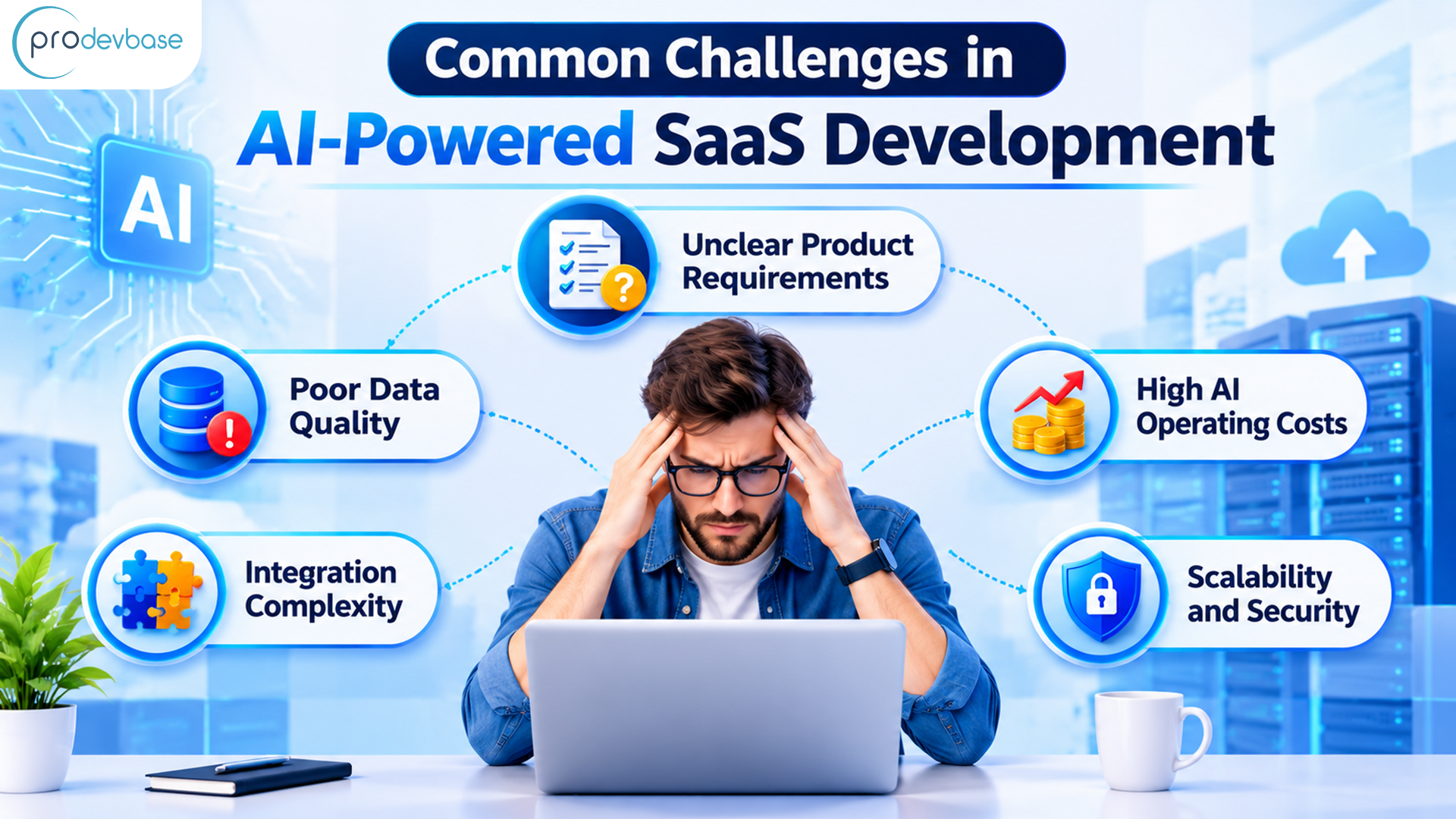
- Unclear Product Requirements: Building too many features without validating customer needs can increase development time and cost.
- Poor Data Quality: Incomplete or inconsistent data can affect AI performance.
- High AI Operating Costs: Model usage and infrastructure expenses can increase as customer activity grows.
- Integration Complexity: Connecting AI models with databases, APIs, and third-party applications requires careful engineering.
- Scalability and Security: The product must support growing usage while protecting customer information.
Addressing these challenges during planning and development can reduce expensive changes later.
Why Choose Prodevbase for AI Product Engineering?
Building an AI-powered SaaS product requires product planning, software development, AI integration, and reliable infrastructure.
Prodevbase provides AI Product Engineering Services to help businesses turn product ideas into practical, scalable applications.
Our capabilities include:
- AI Product Strategy and Discovery: Understanding business requirements, assessing technical feasibility, and creating a product roadmap.
- Full-Stack AI Application Development: Building complete applications with user-friendly interfaces, secure APIs, and backend systems.
- Model Integration and Orchestration: Connecting AI models, managing context, and coordinating multiple AI capabilities.
- Production Reliability and Optimization: Monitoring performance, improving response times, and managing AI operating costs.
- Custom AI Development: Building intelligent features around specific business requirements.
From initial product planning to deployment and ongoing improvements, our focus is on developing software that solves real problems and supports business growth.
Ready to Build Your AI-Powered SaaS Product?
Have an AI SaaS idea but need the right engineering team to bring it to life?
Prodevbase helps businesses plan, develop, and scale AI-powered software products with the right combination of product strategy, full-stack engineering, and AI integration.
Explore our AI Product Engineering Services or contact our team to discuss your product requirements.
Conclusion
Building an AI-powered SaaS product from scratch requires more than choosing an AI model. It involves understanding customer problems, validating the product idea, designing the right architecture, developing secure applications, and continuously improving performance.
A practical approach is to begin with a focused MVP, validate it with real users, and expand the product as business requirements grow.
With the right product engineering approach, businesses can turn AI ideas into reliable software products that deliver lasting value.
Follow us on LinkedIn for more insights on AI product engineering, enterprise software, and intelligent technology solutions.