
How to Build an AI Governance Framework for Secure and Scalable Business Growth

How to Build an AI Governance Framework Before You Scale
Scaling AI without governance in place is a common mistake, and it rarely surfaces until real damage has already occurred. As a result, many AI initiatives stall not because the technology fails, but because no one defined who is accountable when something goes wrong. An AI governance framework solves this problem before scale magnifies it. So let’s know about how to Build an AI Governance Framework.
Prodevbase works with growing businesses to build governance structures early, well before automation touches customer-facing decisions. This piece walks through what that framework actually requires, step by step.
Why Governance Comes Before Scale, Not After
Early AI pilots often run in isolated, low-risk environments. Because of this, gaps in oversight rarely cause visible harm at that stage. However, once a model moves into production and starts influencing pricing, hiring, lending, or customer service, the same gaps become expensive fast. Retrofitting governance after deployment, in turn, is significantly harder than building it upfront. Rather than reacting to a failure that already happened, this structure should exist before scaling begins.
Also read: When Is Human in the Loop AI the Right Choice for Your Business?
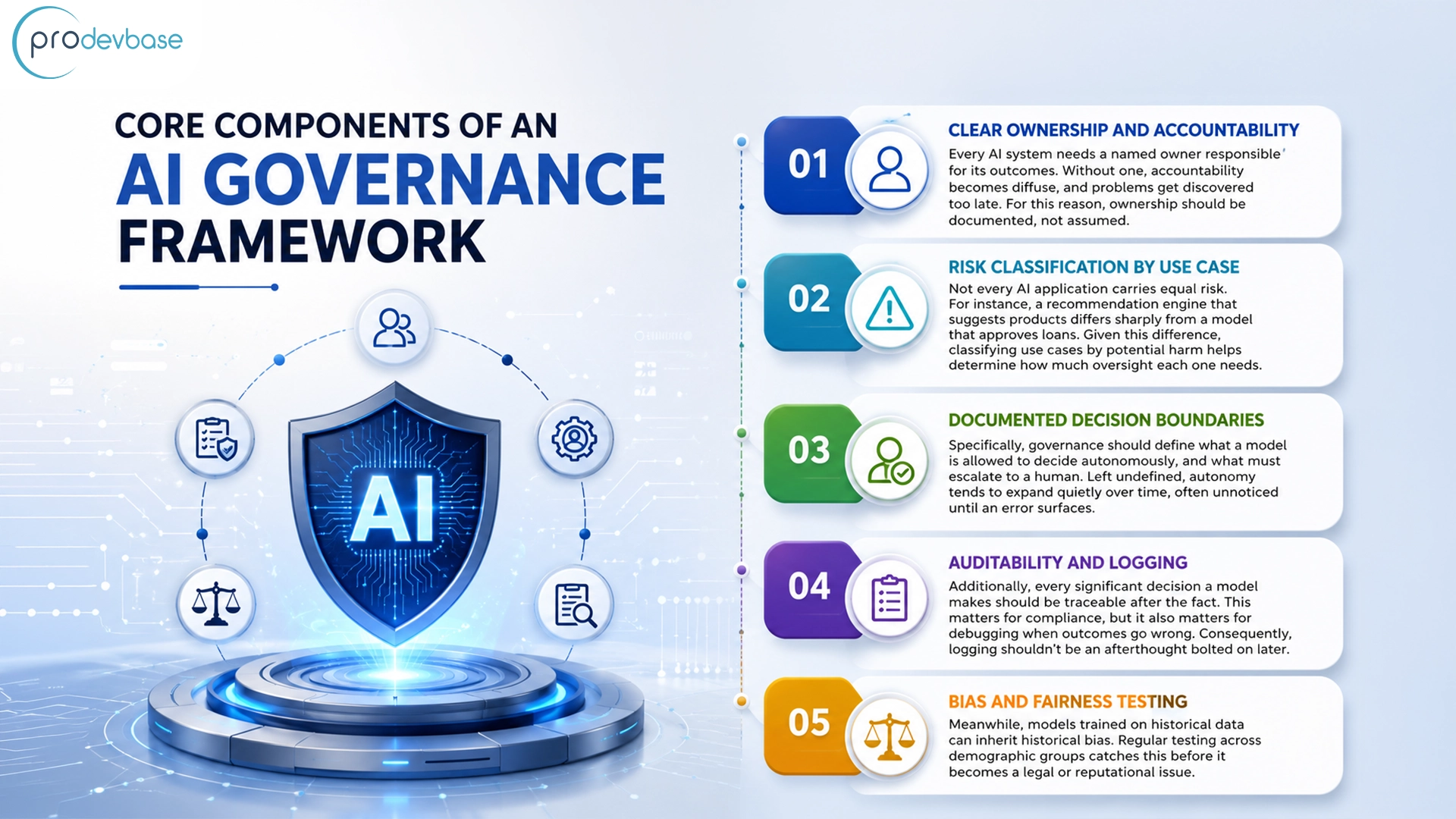
Core Components of an AI Governance Framework
1. Clear Ownership and Accountability
Every AI system needs a named owner responsible for its outcomes. Without one, accountability becomes diffuse, and problems get discovered too late. For this reason, ownership should be documented, not assumed.
2. Risk Classification by Use Case
Not every AI application carries equal risk. For instance, a recommendation engine that suggests products differs sharply from a model that approves loans. Given this difference, classifying use cases by potential harm helps determine how much oversight each one needs.
3. Documented Decision Boundaries
Specifically, governance should define what a model is allowed to decide autonomously, and what must escalate to a human. Left undefined, autonomy tends to expand quietly over time, often unnoticed until an error surfaces.
4. Auditability and Logging
Additionally, every significant decision a model makes should be traceable after the fact. This matters for compliance, but it also matters for debugging when outcomes go wrong. Consequently, logging shouldn’t be an afterthought bolted on later.
5. Bias and Fairness Testing
Meanwhile, models trained on historical data can inherit historical bias. Regular testing across demographic groups catches this before it becomes a legal or reputational issue.
Building the Framework Step by Step
A practical build order tends to work better than trying to govern everything at once. First, inventory existing AI use cases, since nothing can be governed without first knowing what exists. Next, classify each by risk level, since low, medium, and high risk cases need different levels of oversight. Then, assign named owners, since accountability without a name attached rarely holds up under pressure. After that, define escalation paths, specifically deciding what triggers human review before it becomes urgent. Finally, build audit logging in from day one, since retrofitting this later is considerably more expensive.
Following this exact sequence is how Prodevbase helps businesses formalize governance ahead of scaling, since skipping steps tends to surface problems later, at a higher cost.
Common Governance Mistakes
Several patterns show up repeatedly during early-stage AI governance work. Treating governance as a compliance checkbox rather than an operational discipline is one. Assigning ownership to a committee instead of a single accountable person is another. Delaying bias testing until after a public complaint forces the issue happens often. Building automation faster than the escalation paths meant to contain it is a recurring risk.
Even so, each of these mistakes is avoidable, but only if governance is treated as infrastructure, not paperwork.
Governance as a Growth Enabler, Not a Brake
Governance is frequently framed as something that slows AI adoption down. In reality, the opposite tends to be true. Clear ownership, defined risk boundaries, and audit trails allow scaling to happen with confidence, rather than guesswork.
Businesses that build governance early, as a result, tend to scale AI faster, not slower, since fewer surprises emerge once volume increases. Prodevbase has seen this pattern hold consistently across AI strategy and advisory engagements, where structure built early prevents costly rework later.
Getting Started
Building an AI governance framework, in the end, doesn’t require a large compliance department or months of preparation. Rather, it requires a clear inventory, honest risk classification, and a commitment to defining boundaries before autonomy expands past them.
As AI systems take on more consequential decisions throughout 2026, the businesses that scale successfully will be the ones that built governance first. Prodevbase, looking ahead, continues helping teams put this structure in place before scale turns small gaps into expensive ones.