
Agentic AI: The Balance Between Autonomy and Accountability
When Is Human in the Loop AI the Right Choice for Your Business?
An AI agent can now approve a loan, triage a support ticket, or flag a fraudulent transaction in seconds. No human ever touches the decision. Consequently, it’s tempting to assume that more autonomy always means better results. However, that assumption doesn’t hold up under scrutiny. In reality, human-in-the-loop AI, a model in which humans and machines share decision-making, often outperforms fully autonomous systems in high-stakes situations. At Prodevbase, this balance sits at the core of how Agentic AI solutions are designed for growing businesses. So let’s know about when should Businesses use Human in the Loop AI.
What Human in the Loop AI Actually Means
Human-in-the-loop AI, often shortened to HITL, pairs automated decision-making with human review at key checkpoints. Rather than letting an algorithm act entirely on its own, the system pauses, flags, or escalates certain decisions for validation.
For instance, a fraud detection model might automatically clear low-risk transactions. Meanwhile, it routes high-value transactions to a human analyst first. As a result, speed and accuracy work together instead of one being sacrificed for the other. Therefore, the real distinction from full autonomy isn’t about capability. It’s about where accountability sits.
Also read: Why Businesses Need Custom AI and ML Development to Grow
Why Full Autonomy Isn’t Always Practical
Full autonomy promises speed, scale, and lower overhead. Additionally, it removes bottlenecks caused by manual review. On paper, this looks like a clear win.
Nevertheless, autonomy introduces risk in proportion to how consequential a decision is. For example, an AI system approving small marketing adjustments carries minimal downside if it errs. Conversely, approving loan applications or medical recommendations carries a much higher cost of failure. Consequently, the real question isn’t whether a process can be automated. Instead, it’s what happens when automation gets it wrong, and how quickly that can be caught.
Where Human in the Loop AI Adds the Most Value
High Stakes or Irreversible Decisions. Financial approvals, healthcare recommendations, and legal determinations fall into this category. Therefore, a human checkpoint reduces the chance of costly, irreversible errors.
Ambiguous or Novel Situations. AI models perform well on familiar patterns. However, they often struggle with edge cases outside their training data. In these situations, human judgment fills the gap.
Regulated Industries. Healthcare, finance, and legal services frequently require documented human accountability. As a result, human-in-the-loop design is often a regulatory requirement, not just a safety measure.
Early Deployment. When a new AI system first goes live, confidence in its accuracy is still forming. Consequently, human review during this phase catches errors before they scale. This is precisely how Prodevbase phases in autonomy for new clients, gradually and only once trust is earned.
Where Full Autonomy Makes More Sense
Human oversight isn’t free. It adds latency and requires staffing. Thus, full autonomy works best in lower-risk, high-volume scenarios, such as:
- Routing routine support tickets
- Sending automated appointment reminders
- Flagging duplicate data entries
- Adjusting inventory reorder points
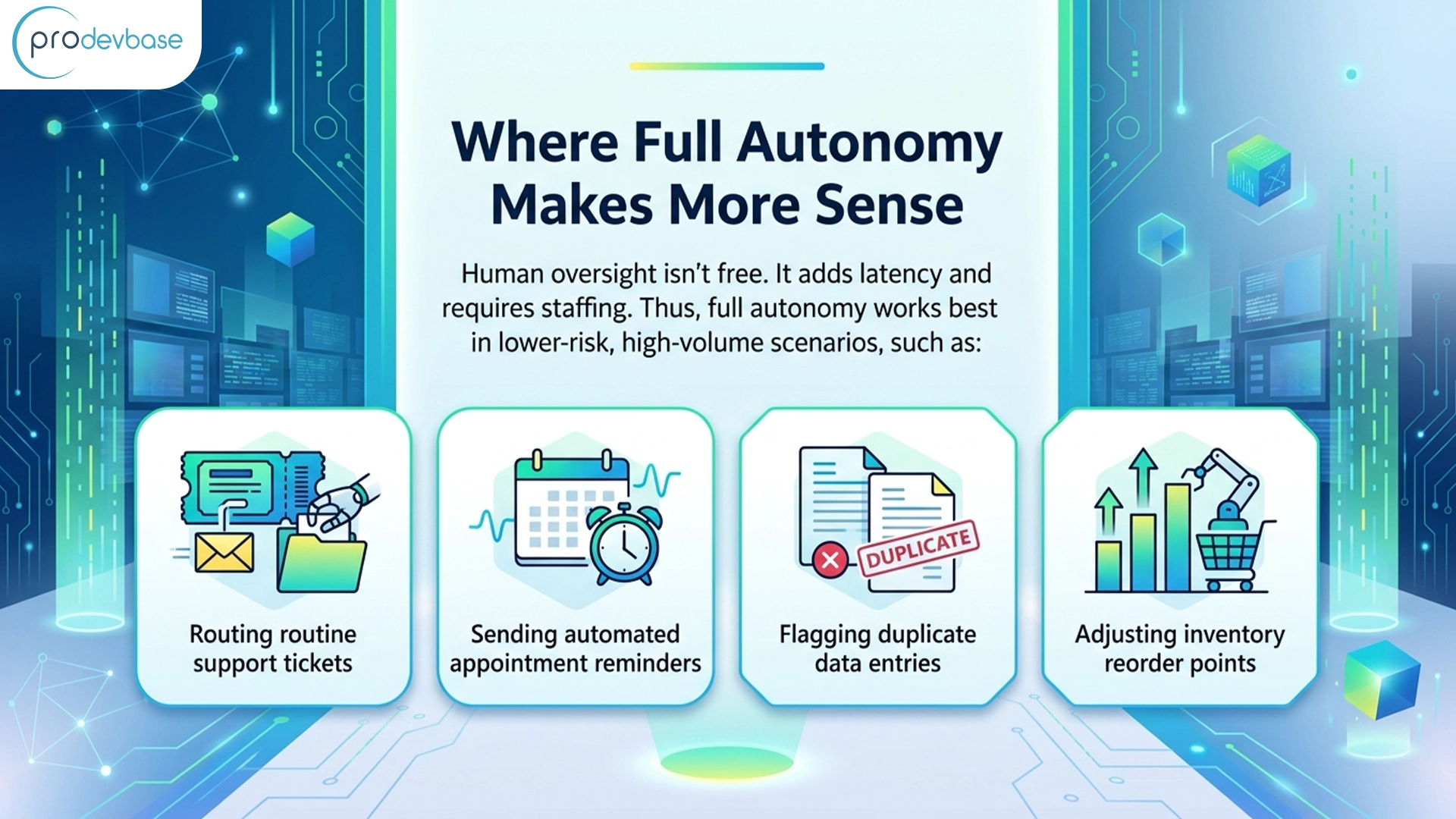
In these cases, errors are low-cost and easily reversible. Therefore, a human checkpoint would slow things down without meaningfully reducing risk.
Finding the Right Balance
Rather than treating autonomy as all or nothing, a more useful approach grades decisions by risk and reversibility, the same framework Prodevbase applies when scoping a new agentic AI project.
- Cost of a wrong decision. Low-cost errors can be automated fully; high-cost errors warrant review.
- Reversibility. Reversible actions carry less risk than permanent ones.
- Model maturity. Newer deployments need tighter involvement; proven workflows can shift toward autonomy.
Applying this framework consistently makes it possible to scale automation intelligently rather than applying one standard everywhere.
The Bigger Picture
Full autonomy isn’t a finish line. It’s one point on a spectrum. Moreover, treating it as the ultimate goal overlooks the real purpose of AI adoption: better outcomes, not simply less human involvement.
Human-in-the-loop AI isn’t a step backward. Instead, it’s a deliberate design choice balancing speed with accountability. Ultimately, the smartest AI deployments aren’t the ones with the least human involvement. They’re the ones with the right amount, in the right places. Prodevbase helps growing businesses build exactly that kind of thoughtful, human-in-the-loop AI strategy, one deployment at a time.