
How to Build an AI-Powered Fraud Detection System for Financial Businesses: Custom AI/ML and Predictive Analytics

How to Build an AI Fraud Detection System Using Custom AI/ML
Why Rules Alone Fail Against Modern Fraud
Financial fraud is escalating rapidly. Banks, lenders, insurers, and fintechs are under daily attack. Therefore, an AI-powered fraud detection system is no longer a nice-to-have; it’s a necessity. Custom AI/ML models and predictive analytics are capable of identifying potentially fraudulent activity in milliseconds. As a result, teams are able to stop losses before any money actually leaves the account. So let’s know more about How to Build an AI Fraud Detection System.
Traditional rule engines still have a place. However, the problem with them is that they can’t keep up with new fraud patterns. The fraudster will test the boundaries, learn the thresholds, and adapt in days. Machine learning, on the other hand, learns from the new data and can update its view of risk. As a result, there are fewer false alerts and real threats come to light far faster.
This guide walks readers through the entire process. It starts with the building blocks, then goes on to the use cases, the steps, and the tools. Finally, it closes with how Prodevbase can support financial businesses with AI services right through from strategy to deployment.
How Custom AI/ML Detects Fraud
Supervised models learn from labelled cases of fraud (i.e., cases where fraud has been confirmed). For example, a gradient boosting or neural network would score each transaction against the historical patterns. Meanwhile, unsupervised models such as isolation forests will find outliers without any labels. This is important because new forms of fraud will have no history. Likewise, graph models can be used to find rings of accounts, devices, and merchants. Together, all of these form a multi-layered defense.
Where Predictive Analytics Fits
Predictive analytics takes the raw signal and turns it into a forward-looking risk score. For example, it can tell teams which accounts are likely to be the subject of a takeover this week. It can also rank the alerts so that the analysts are looking at the highest-risk cases first. As a result, investigation time is reduced, and the customer experience improves. Real-time scoring also makes it possible to approve safe payments instantly.
Core Components of an AI-Powered Fraud Detection System
- Data ingestion layer: ingests the transactions, logins, device data, and customer profiles from the bank systems in real time.
- Feature engineering engine: builds signals such as transaction velocity, location shifts, and spending baselines.
- Machine learning models: use a combination of supervised, unsupervised and graph models to score risk with very high precision.
- Real-time decision engine: applies the scores and business rules to either approve, challenge or block the payment.
- Case management console: provides analysts with alerts, evidence and model explanations in one place.
- Feedback and monitoring loop: sends analyst outcomes back into the retraining and, in addition, tracks model drift over time.
Also read: How AI Can Help Businesses Detect Revenue Leakage
Fraud Detection Use Cases in Financial Services
Different financial products are exposed to different risks. Therefore, the models should be appropriately matched to the risk they are protecting. The following use cases illustrate where AI provides clear value.
- Card payment fraud: models spot a sudden series of high-value purchases in a new country within seconds.
- Account takeover: behavioral biometrics have detected a login with atypical typing speed and a new device.
- Loan application fraud: algorithms catch synthetic identities by comparing the data on the documents with the data on the linked records.
- Insurance claim fraud: pattern analysis has revealed a number of claims linked to the same repair shop and the same adjuster.
- Anti-money laundering: graph analytics to trace the layered transfers through a series of shell accounts and identify the hidden networks.
- Merchant and chargeback fraud: predictive scoring to identify merchants with increasing dispute rates before the losses get out of hand.
Step-by-Step Process to Build the System
Step 1: Define fraud goals and metrics. Start with clear objectives in terms of detection rate, false positive rate, and approval speed. Also set a loss budget for each product line.
Step 2: Collect and prepare the data. Get the historical transactions, the confirmed fraud labels, and customer records. Then clean, merge, and secure the data in accordance with the privacy rules.
Step 3: Engineer the features. Create the behavioral signals (e.g., spend averages, device history). In fact, good features will often trump the model choice.
Step 4: Train and validate the models. Try out several algorithms on separate data sets. Because fraud is going to be a rare event, we’ll need to use resampling and precision-recall evaluation techniques.
Step 5: Deploy with real-time scoring. Connect the model into the payment flows via low-latency APIs. Likewise, add a form of explainability so the analysts understand why a decision was made.
Step 6: Monitor and retrain. Track drift, check quality, and pick up any new fraud patterns on a weekly basis. Finally, retrain on analyst feedback to keep the system sharp.
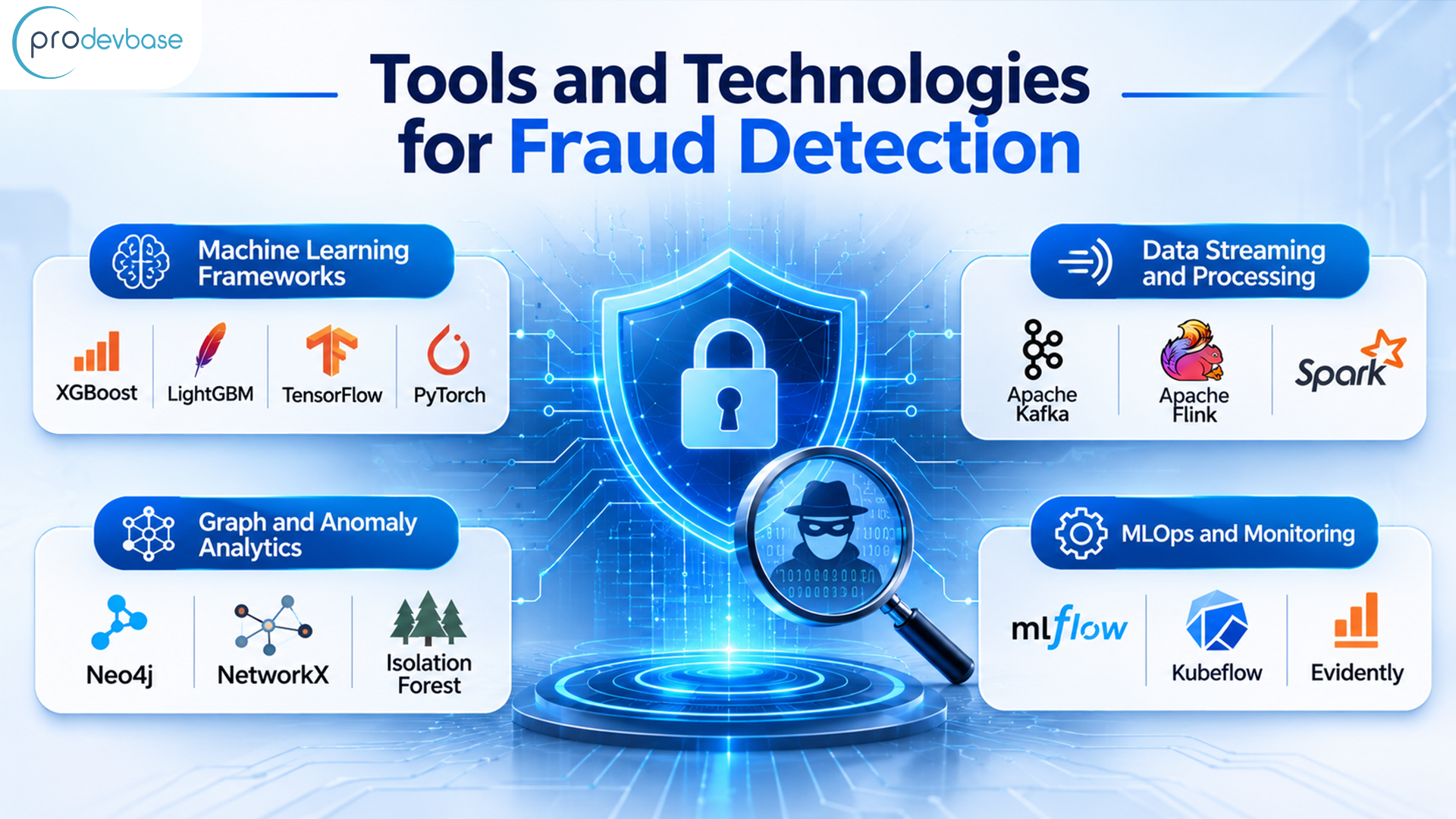
Tools and Technologies for Fraud Detection
The right stack depends on volume, latency requirements, and compliance. Prodevbase will select and integrate the appropriate tools as part of its bespoke AI development services. The main categories are as follows.
- Machine learning frameworks: XGBoost, LightGBM, TensorFlow and PyTorch for model training and tuning.
- Data streaming and processing: Apache Kafka, Apache Flink and Spark for real-time event pipelines.
- Graph and anomaly analytics: Neo4j, NetworkX and the isolation forest libraries for ring and outlier detection.
- MLOps and monitoring: MLflow, Kubeflow and Evidently for versioning, deployment and drift detection.
Cloud platforms (AWS, Azure, Google Cloud) all have managed services for scaling. Additionally, teams can use explainability libraries (e.g., SHAP) to meet audit and regulatory requirements. Therefore, the right stack will enable businesses to scale quickly and be trusted.
Ready to strengthen fraud defenses?
Fraud teams need smarter tools. Therefore, get in touch with the AI experts to put together a bespoke AI/ML fraud detection solution tailored to a particular risk profile.
Conclusion
An AI-powered fraud detection system provides financial businesses with a real-world solution to the problem of fraud. Custom AI/ML models are able to identify the subtle patterns that are invisible to the human eye, while predictive analytics allows risk to be ranked prior to any loss occurring. As a result, a business is able to protect its revenue, reduce the number of false positives, and maintain customer confidence.
Prodevbase provides AI services and solutions to individual financial businesses. Get in touch with the team to start building a fraud detection system that learns, evolves, and scales.