
How AI Can Help Businesses Detect Revenue Leakage
Why Revenue Leakage Quietly Drains Business Profits
What Revenue Leakage Really Means
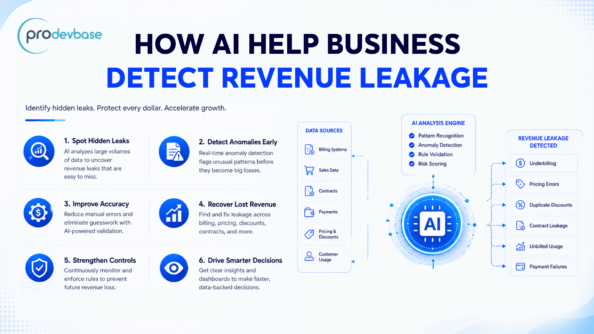
AI revenue leakage detection helps businesses identify hidden financial losses caused by billing errors, missed payments, pricing discrepancies, and unbilled services. By using AI to analyse financial data, companies can detect revenue gaps early and take corrective action to protect profitability.
Industry studies frequently estimate that leakage amounts to a few percent of annual revenue. For a company of medium size, this figure becomes a substantial amount. That is why leakage deserves the same attention as cost control.
Traditional audits seldom manage to detect the problem in time. Spreadsheets are only examined once each quarter, and so the damage continues to increase. Moreover, the data is held in separate systems, which means that any patterns remain hidden. As a result, minor errors carry on occurring month after month.
“Businesses can strengthen this approach through effective AI strategy and advisory services that align AI capabilities with financial goals.”
Where Leakage Usually Hides
Leakage is evident at each stage of the revenue cycle. There is a risk involved in pricing, quoting, contracting, billing, collections, and renewals. For instance, a sales representative might approve a discount that never expires. In a similar way, a customer on a usage-based basis may use a service without that usage leading to an invoice. Yet no one is aware of the gap.
Why Manual Reviews Fall Short
Manual checks have to rely on samples. The reviewers look at a small number of invoices and then suppose that the rest are okay. Yet errors seldom occur in a clear, regular pattern. At the same time, transaction volumes continue to increase, which means that the amount of work exceeds what the team can handle. For these reasons, AI provides a practical alternative since it examines all the records almost in real time.
Key Ways AI Detects Revenue Leakage
To begin with, here are the main methods that finance teams depend on.
- Odd invoice detection: Since the machine learning system has learned what normal billing patterns are, it is able to identify invoices that appear to be different.
- Contract matching: Next, the text-reading software checks the billed amounts against the terms of the contract.
- Usage matching: When it comes to usage matching, the AI compares the service logs with the invoices to identify any activity that has not been billed.
- Pricing and discount checks: When it comes to pricing and discount checks, the algorithms are able to identify expired promotions, unapproved markdowns, and inconsistent price lists.
- Renewal and churn forecasting: The models used for forecasting renewal and churn alert the teams when a contract might expire or decrease in size.
- Collections monitoring: In the area of collections monitoring, AI keeps an eye on late payments, failed charges, and write-offs to safeguard cash flow.
Practical Use Cases of AI in Revenue Leakage Detection
Various industries have different kinds of leakage, yet the same AI techniques can be used in all of them. For example, the instances listed below illustrate how teams put these methods into practice.
- Software: The software offers a service in which AI identifies customers who are using premium features yet have only paid for a basic plan.
- Telecom: For Telecom, the call and data records are matched with the billing files to identify any usage that has not been billed.
- Healthcare: An analysis of claims shows that charges have been overlooked and coding errors have been made before they are submitted.
- Logistics: The system uses AI to compare delivery records with invoices to identify any missing surcharges.
- Retail: For retail, the systems detect the differences in prices between the checkout data and the approved catalogues.
- Utilities: The analysis of meter data reveals faulty readings and consumption that has not been billed.
Also read: How AI Is Reshaping Financial Operations and Customer Experience
How to Implement AI for Revenue Leakage Detection
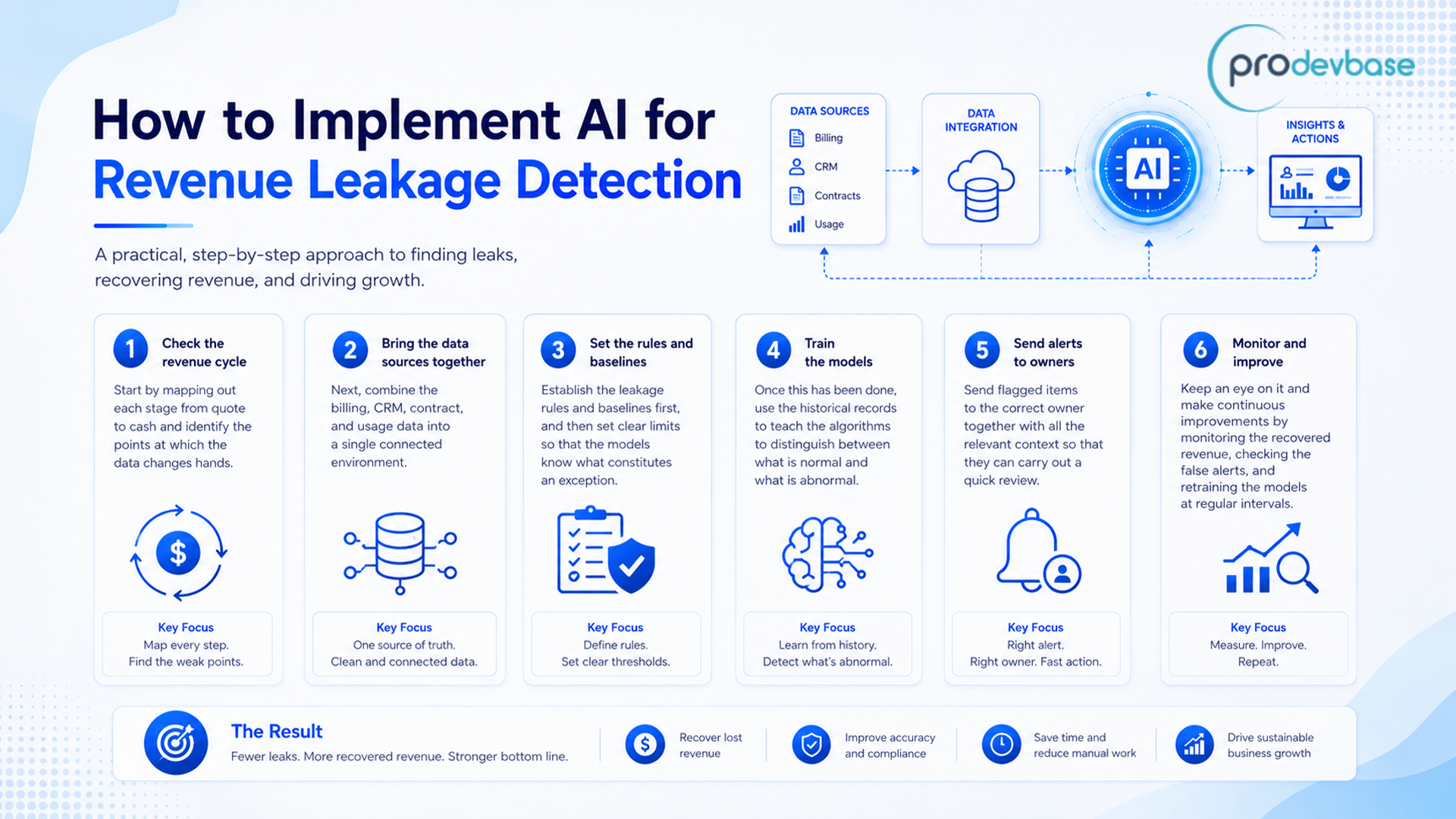
- Check the revenue cycle: Start by mapping out each stage from quote to cash and identify the points at which the data changes hands.
- Bring the data sources together: Next, combine the billing, CRM, contract, and usage data into a single connected environment.
- Set the rules and baselines: Establish the leakage rules and baselines first, and then set clear limits so that the models know what constitutes an exception.
- Train the models: Once this has been done, use the historical records to teach the algorithms to distinguish between what is normal and what is abnormal.
- Send alerts to owners: Send flagged items to the correct owner together with all the relevant context so that they can carry out a quick review.
- Monitor and improve: Keep an eye on it and make continuous improvements by monitoring the recovered revenue, checking the false alerts, and retraining the models at regular intervals.
Tools and Technologies Behind AI Revenue Assurance
The choice of the appropriate toolset will depend on the amount of data, the existing systems, and the in-house skills. In reality, the solutions generally involve four layers, and furthermore, each layer supports the one that follows it.
- Data integration: Tools including Fivetran, Airbyte, and Snowflake are able to connect billing, CRM, and ERP data.
- Machine learning platforms: Python libraries, Azure Machine Learning, and AWS SageMaker provide support for model training and launching.
- Document reading: Key terms are extracted from contracts by means of spaCy, Hugging Face models, and Azure Document Intelligence.
- Dashboards and alerts: The findings are turned into clear and visible signals by using Power BI, Tableau, and Slack.
It is not true that revenue can be recovered simply through the use of technology. Just as important are clean data, clear ownership, and consistent follow-up. Because of this, businesses often choose to work with Prodevbase, a company that designs AI services to match existing finance systems and procedures. Moreover, carrying out the rollout in phases helps to reduce risk and demonstrates early successes.
Willing to stop losing revenue in silence?
Hidden leakage continues to increase until it is looked for. Prodevbase is able to evaluate billing workflows, identify weak points, and create AI models that quickly highlight lost income. Why not contact the team now to arrange a discovery call?
Conclusion
Revenue leakage is expensive, and it also goes unnoticed and is easy to ignore. Luckily, AI provides finance and operations teams with a quicker method of identifying it. By combining checks on unusual invoices, matching contracts, and predictive models, teams can protect income that has already been earned. Moreover, the greatest benefits come from acting early, since revenue that is recovered goes directly to profit.
Prodevbase provides AI services that are tailored to meet business requirements. Get in touch with us now and begin turning hidden losses into recovered revenue.