
How AI Demand Forecasting Helps Businesses Prevent Stockouts and Overstocking
How to Build an AI-Powered Demand Forecasting System
Why Demand Forecasting Matters
Demand forecasting is all about avoiding stock-outs and dead stock. It’s absolutely critical to revenue and cash flow. Spreadsheets and manual estimates simply can’t keep up with the changing market. That’s why businesses are now moving to an AI-powered demand forecasting system. So let’s know about How to Build an AI Demand Forecasting System.
This guide walks through the full build. It starts with why the traditional way of doing things simply doesn’t work. It then goes on to describe the key components, the practical use cases, and the six steps to actually implement it. It finishes off with a list of the tools that make it all possible.
Although that sounds a bit technical, the logic is very simple. The model looks at historical sales, identifies the patterns, and then forecasts future demand. The planner therefore has time to act before a shortage or a surplus occurs.
Why Traditional Forecasting Falls Short
Classic methods are based on moving averages and a lot of manual judgement. A planner might take last year’s figures and just add on a constant growth rate. That completely ignores the impact of promotions, the weather, competitor pricing, and the sheer fact that trends can change overnight. Departments will also often have their own data, so the forecasts don’t necessarily match up. The end result is that stock levels drift increasingly away from actual demand.
Why an AI-Powered Demand Forecasting System Works Better
ML models learn from large datasets and learn very quickly. They incorporate their own internal records as well as external signals such as holidays, search trends, and local events. They are also continuously updated as new data comes in. As a result, accuracy improves over time rather than remaining static. Indeed, businesses often report a significant reduction in forecast error following the switch.
Core Components of an AI-Powered Demand Forecasting System
- Data Pipeline – First, it gathers the sales, inventory, pricing, and promotion records into one clean store.
- Feature Engineering – Next, it takes the raw records and turns them into useful signals (seasonality, lags, price changes, and so on).
- Forecasting Models – Then algorithms (gradient boosting, neural networks, and so on) predict demand by product and location.
- Validation Layer – Afterwards, it is tested against held-out data, so weak models never make it into production.
- Planning Dashboard – Meanwhile, this shows the forecasts, the confidence ranges, and the alerts in a format that planners can read quickly.
- Monitoring Engine – Finally, it tracks drift and error and then kicks off a retrain when performance starts to degrade.
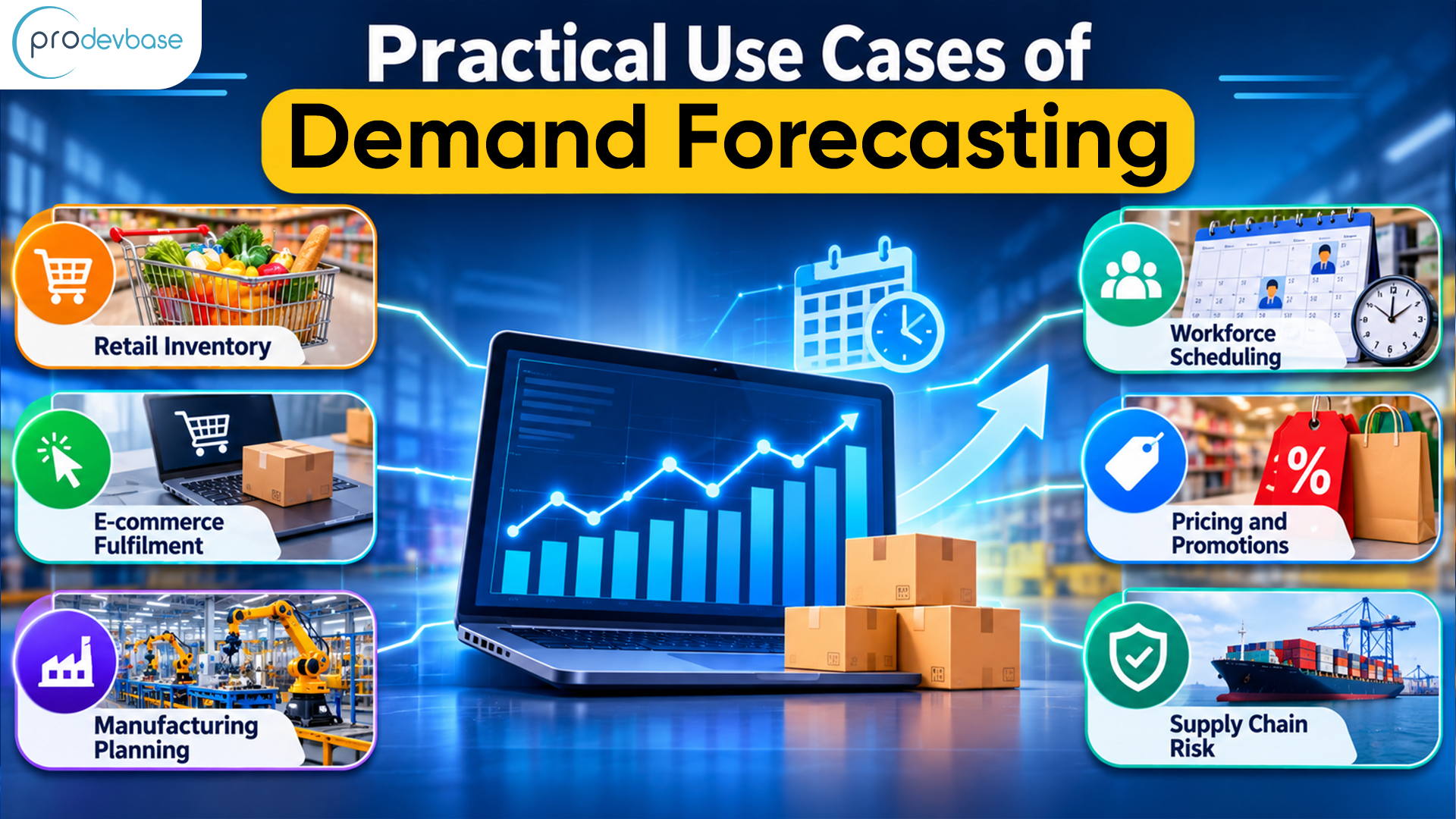
Practical Use Cases of Demand Forecasting
Forecasting has applications across a wide range of industries. The following examples show where the impact is seen first.
- Retail Inventory – For example, a grocery chain forecasts weekly demand per store to reduce waste and avoid empty shelves.
- E-commerce Fulfilment – Similarly, an online seller positions stock close to high-demand areas before a major sale goes live.
- Manufacturing Planning – In addition, the factory schedules its raw material orders based on forecasted customer orders.
- Workforce Scheduling – Likewise, a restaurant group matches staff shifts to anticipated footfall.
- Pricing and Promotions – Also, a fashion brand tests discount depth against the forecasted sales lift.
- Supply Chain Risk – Finally, a distributor sees the demand spikes coming and can lock in transport capacity well in advance.
You might missed to read: How to Protect Sensitive Business Data When Using Generative AI?
Steps to Build an AI-Powered Demand Forecasting System
Step 1 – Define the Business Goal. First of all, name the decision that the forecasts are going to support (for example, weekly reorder quantities). Then set a target for the metric (for example, MAPE). That will keep the team focused on what it is trying to achieve.
Step 2 – Collect and Clean the Data. Start off by getting the sales history, stock levels, prices, and promotions. Then get rid of the duplicates, fill in the gaps, and make sure the time periods are all aligned. Because models inherit the data’s flaws, clean data is essential.
Step 3 – Engineer the Features. Create the lag values, the rolling averages, and the calendar flags. Next, add in any external signals that fit (weather, holidays, and so on). As a result, the model sees the context behind each sales pattern.
Step 4 – Train and Compare the Models. Train the models (ARIMA, Prophet, and gradient boosting). Next, compare them on the held-out data. Finally, pick the one with the lowest error and stable results.
Step 5 – Deploy and Integrate. Package up the model as an API and integrate it into the ERP or inventory system. At the same time, set up automated forecast runs so that planners get fresh numbers without any manual intervention.
Step 6 – Monitor and Improve. Track forecast error on a weekly basis and watch out for data drift. Also, retrain the model if accuracy deteriorates. This ensures that the forecasts remain accurate over time.
Tools and Technologies for Demand Forecasting
The right stack will obviously vary depending on the data volume, the team’s skills, and the budget. That said, there are well-proven options in each layer.
- Data Platforms – For example, Snowflake, BigQuery, and Databricks handle the storage and processing of large sales datasets.
- Modeling Libraries – Likewise, scikit-learn, XGBoost, Prophet and PyTorch cover this in the Python world.
- MLOps and Deployment – In addition, MLflow, Airflow and Docker take care of experiment tracking, scheduling and release.
- Visualisation and BI – Finally, Power BI, Tableau and Looker all turn the forecasts into clear dashboards.
Tool selection has an impact on total cost over the long term. Open-source libraries will of course save on licensing costs, whereas a managed platform will save on the time it takes to set up. Prodevbase helps teams make that decision and build a stack that works for their data and their budget. As a result, they get to production much quicker.
Ready to Build a Smarter Forecast?
Prodevbase designs and delivers AI services, including demand forecasting, predictive analytics, and custom ML development. Therefore, get in touch with the team today to book a free consultation and talk through a forecasting roadmap.
Conclusion
An AI-powered demand forecasting system turns the data into a very confident plan. It reduces stock costs, improves service levels, and enables faster decisions. Early adopters therefore gain a real, lasting advantage over competitors who still rely on the old guesswork approach.
Prodevbase provides AI services and solutions to meet specific business requirements. Get the conversation started today and turn demand data into real growth.