
How to Protect Sensitive Business Data When Using Generative AI
Generative AI Security Risks for Businesses: 7 Ways to Protect Your Sensitive Data
Understanding the Risk Behind AI Prompts
Generative AI enables teams to write, code, and analyse at speed. The catch is that each prompt can contain sensitive information. Leaders therefore need to understand how to protect sensitive business data when using generative AI. One small mistake can easily become a major data leak. So let’s have a look on Generative AI Security Risks for Businesses.
For instance, an employee might paste a client contract into a chatbot and thereby have the sensitive terms outside the company network. Certain tools also store the prompts used to train their models, so that content can end up outside of company control.
The risk is very manageable. First, we have clear rules that define the boundaries. Next, we have secure tools in place to protect the data. Finally, we have trained people to use both. The business can therefore move at speed with no fear of leaks.
Common Ways Data Leaks Happen
Firstly, staff use their own personal AI accounts for work. Secondly, browser add-ons can be reading the pages without consent. Thirdly, the access controls are so weak that shared chat histories are exposed. Shadow AI is therefore able to spread freely as teams adopt the tools without telling IT. The end result is that the security teams have no visibility at all.
Legal and Compliance Pressure
Laws like GDPR, HIPAA and India’s DPDP Act all impose very specific duties. A careless prompt can therefore be a breach of law. Client contracts will often contain clauses prohibiting the sharing of any information with third parties. In addition, fines can obviously damage a brand for years. Hence, protection should be in place from the outset.
Key Risks of Using Generative AI With Business Data
- Prompt leakage – staff could type private text into public chatbots, so the tool could end up storing it.
- Model training exposure – certain providers train on input, so private text can reappear later on.
- Shadow AI – unapproved tools bypass the security reviews, so IT can’t monitor them.
- Insecure integrations – plugins and APIs exposing data when their permissions are too wide.
- Prompt injection – hidden text in files can trick the model, and so it may end up revealing data.
- Compliance breaches – the sharing of regulated data without consent can result in fines.
Practical Use Cases That Require Careful Handling
Generative AI can be used for a whole host of tasks. Each of those tasks, however, will require its own set of safeguards. The examples below illustrate a few of the cases where that is of importance.
- Customer support – the bots summarise the tickets, so we have to mask the personal details first.
- Software development – the assistants can suggest code, but be careful that API keys don’t end up in the prompts.
- Legal review – the tools summarise the contracts, so only private setups should be doing the work.
- Financial reporting – models draft analysis, so unreleased figures are strictly controlled.
- HR ops – AI screens the CVs, so the employee records have to be anonymised.
- Marketing – the teams produce the campaigns, yet the launch plans have to remain secret.
Also read: How Does Generative AI Improve Product Design? Key Benefits Explained
Step-by-Step Process to Secure Generative AI Usage
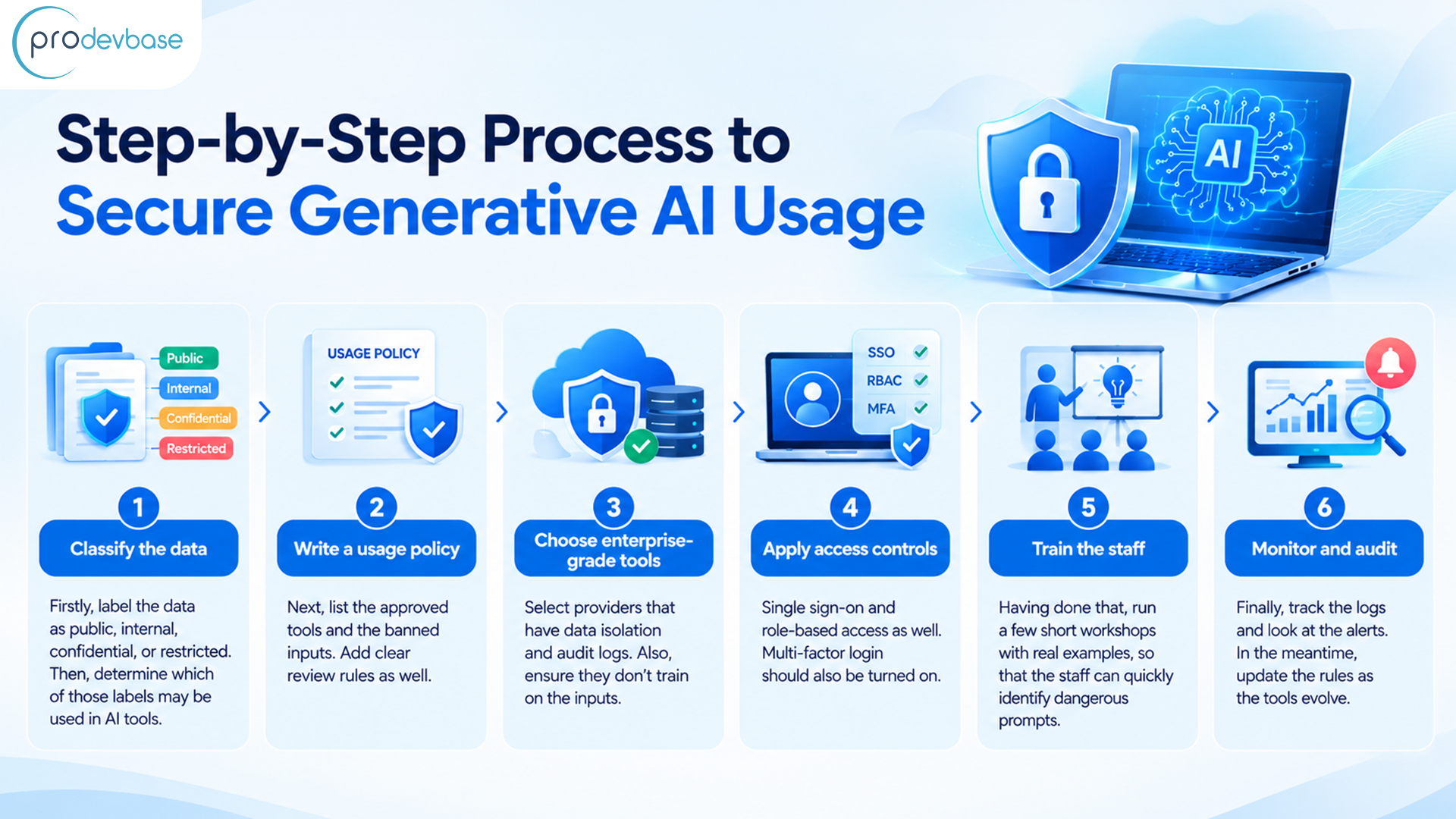
Step 1 – Classify the data: Firstly, label the data as public, internal, confidential, or restricted. Then, determine which of those labels may be used in AI tools.
Step 2 – Write a usage policy: Next, list the approved tools and the banned inputs. Add clear review rules as well.
Step 3 – Choose enterprise-grade tools: Select providers that have data isolation and audit logs. Also, ensure they don’t train on the inputs.
Step 4 – Apply access controls: Single sign-on and role-based access as well. Multi-factor login should also be turned on.
Step 5 – Train the staff: Having done that, run a few short workshops with real examples, so that the staff can quickly identify dangerous prompts.
Step 6 – Monitor and audit: Finally, track the logs and look at the alerts. In the meantime, update the rules as the tools evolve.
Tools and Technologies That Support Data Protection
Technology enables policy. That’s why organisations should be using multiple layers rather than relying on a single control.
- Data loss prevention (DLP) – Microsoft Purview and Google Cloud DLP prevent sensitive text from leaving the network.
- Secure AI platforms – Azure OpenAI Service, Amazon Bedrock and Google Vertex AI all provide private endpoints.
- Identity and Access Management – Okta and Microsoft Entra ID enforce single sign-on and least privilege access.
- Encryption and monitoring – Cloud Key Services and Splunk encrypt the data and flag odd activity.
Although the tools are important, the setup is equally important. Prodevbase, for example, helps organizations to build their own private AI environments and put in place clear guardrails. Besides, self-hosted models keep the data within the organization’s own systems, so there’s far less exposure.
Ready to Adopt AI Safely?
Prodevbase offers AI services including secure chatbot development, custom model integration and AI governance consulting. Get in touch with the team to put together a secure AI plan.
Conclusion
Generative AI delivers real value. Still, careless use puts private data at risk. Therefore, classify data, set policies, choose secure tools, and train staff. Likewise, monitor usage often. Prodevbase offers AI services tailored to business needs. Reach out today and start using AI with confidence.