
From AI Agents to AI Teams: How to Build a Multi-Agent System for Enterprise Operations
Building a Multi-Agent AI System for Enterprise Operations
Why Enterprises Are Moving Beyond Single Bots
A multi-agent AI system uses a team of agents, each responsible for a specific task (e.g., data retrieval, approval routing, reporting). The end result is that complex workflows run much faster and with far fewer errors. Instead of replacing brittle scripts with a multi-agent system, enterprises end up replacing them with a flexible digital team. So let’s have a look on How to Build a Multi-Agent AI System.
Traditional automation is rule-based, so it breaks at the first sign of an input change. Agentic AI, on the other hand, reasons, plans, and adapts to new situations. Agents can also call tools, query databases, and pass work on to a peer without waiting for a person. That flexibility is what enables the operations team to deal with exceptions rather than re-running the same checks over and over again.
For instance, a finance team could have one agent for invoice capture, one for validation, and one for payment scheduling. Meanwhile, a supervisor agent looks at the whole chain. As a result, human staff only look at the items that have been flagged. Similarly, an IT team could have one agent triaging tickets and another dealing with common requests. In effect, this pattern frees up skilled people to do strategic work.
How Agents Collaborate
Firstly, the orchestrator takes a goal and breaks it down into smaller tasks. Then the worker agents pick up the tasks that are relevant to their skill set. Next, a review agent checks each output against company policy. Finally, the results return to the orchestrator for delivery.
Shared memory ensures the context is consistent, so agents don’t redo work that has already been completed. Likewise, message protocols define how agents ask for help, report progress, and escalate. In short, collaboration is as much about well-defined protocols as it is about capable models.
Why Architecture Matters
Because enterprise data is sensitive, design choices are significant. Clear roles limit access. Likewise, narrow permissions mean that one bad agent can’t touch systems outside of its own. Therefore, a good architecture reduces risk and builds trust.
Beyond security, good design has a direct bearing on cost. Without limits, agents can loop, call models over and over again, and blow the bill out of proportion. So budgets, timeouts, and retry caps should all be set up front. In addition, a fallback to a human reviewer protects the business when the agent is in any doubt.
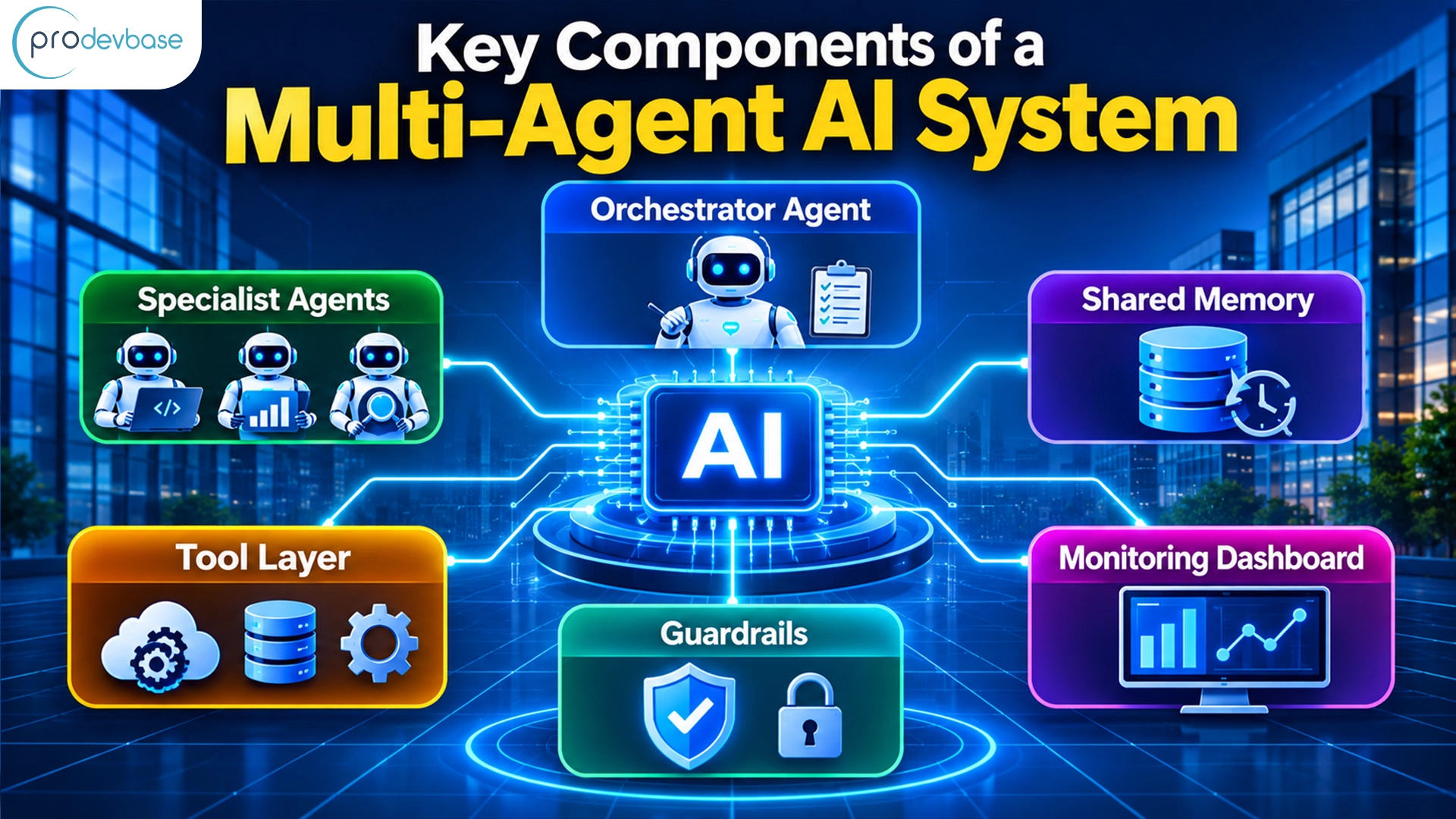
Key Components of a Multi-Agent AI System
- Orchestrator Agent: Deals with goal setting, task assignment, and conflict resolution between agents. As a result, the entire workflow remains aligned with the business objective.
- Specialist Agents: Do focused work such as research, coding, forecasting, or document analysis. Because they’re so narrow in remit, accuracy improves.
- Shared Memory: Stores the context, the history, and the past decisions. Therefore, agents won’t do the same thing twice and will maintain a consistent answer.
- Tool Layer: Connects the agents to APIs, databases, and enterprise software. That way, the agents can act on live data rather than guessing.
- Guardrails: Enforce policies, permissions, and compliance rules on all actions. Moreover, they block unsafe outputs prior to delivery.
- Monitoring Dashboard: Tracks performance, cost, and errors in real time. Hence, teams can pick up issues early and fix them quickly.
Enterprise Use Cases
Enterprises in all sorts of industries are using agent teams to solve real-world problems. The following are a number of examples which demonstrate clear returns. Although they are all very different in detail, they all follow the same pattern of having specialist agents working under a coordinating layer.
- IT Service Desk: The triage agent deals with the tickets, and the resolver agent deals with password and access issues, which resolve automatically. Afterwards, a summary agent logs the result.
- Finance Ops: The agents pull the invoice data, match it to the purchase order, and flag any anomalies. In turn, the auditors get clean, traceable records.
- Supply Chain: Forecasting agents predict demand. In addition, procurement agents adjust orders and alert planners to any delays.
- Customer Support: A routing agent reads the intent, and a knowledge agent then drafts the appropriate reply. Meanwhile, sensitive escalated cases pass to a human.
- HR Onboarding: Agents create the accounts, schedule the training, and answer the policy questions. As a result, new hires reach productivity much quicker.
- Compliance Monitoring: Audit agents scan the contracts and transactions for policy breaches. Similarly, they produce evidence for the regulators.
Also read: Why Data Engineering Is Becoming the Backbone of Enterprise AI?
Steps to Build a Multi-Agent AI System
Step 1: Define the business goals. Start with one clear, measurable outcome (e.g., a 30% reduction in ticket resolution time). That keeps the team focused. Otherwise, projects drift into a series of experiments that never reach production.
Step 2: Map the workflows. Break the process down into individual tasks, and then decide which tasks require reasoning and which require simple rules. For instance, a date check is a rule, while a contract review requires reasoning.
Step 3: Design the agent roles. Give each agent a clear purpose, a toolset, and a permission level. Likewise, write a short charter for each role. Consequently, overlap and confusion drop dramatically.
Step 4: Choose the frameworks and models. Pick an orchestration framework and language models that meet the requirements for latency, cost, and security. In addition, compare hosted and self-managed options, as data residency rules may constrain the choice.
Step 5: Build, test, and add guardrails. Run the simulations first. Afterwards, add human approval for high-risk actions (e.g., payments, data deletion). Also, test with dirty, real-world inputs, because clean samples mask weaknesses.
Step 6: Deploy and monitor. Deploy in stages, starting with a single team or region. Then monitor accuracy, speed, and cost, and iterate on the prompts and policies. Finally, roll out to other workflows once the results have stabilized.
Tools and Technologies for Multi-Agent Systems
The right stack speeds up delivery. However, tooling should be selected as a consequence of the architecture, not as the driver of it. Teams often select tools first and then find themselves rebuilding later on. Therefore, finalize the roles and workflows first, and then compare the vendors.
- Orchestration Frameworks: LangGraph, CrewAI, AutoGen and Semantic Kernel all provide a way of orchestrating agent workflows. However, they offer different levels of control and speed.
- Language Models: GPT, Claude, Gemini, and open-source models such as Llama do the reasoning. Notably, smaller models can handle fairly straightforward tasks at a much lower cost.
- Data and Memory: Vector databases (Pinecone, Weaviate, pgvector, etc.) store the data. Similarly, Redis handles short-term memory for the active session.
- Observability and Security: LangSmith, OpenTelemetry, and role-based access controls provide tracing and protection. As a result, auditors can follow each decision from inception to conclusion.
Integration is equally important. For example, connectors to ERP, CRM, and ticketing systems are the key determinant of whether agents are actually of value. Likewise, clean data and clear ownership are as critical as the quality of the model itself. Prodevbase helps enterprises pick and connect the right components through a suite of practical AI services, from the planning stage all the way through to deployment.
Ready to Launch a Multi-Agent AI System?
Talk to Prodevbase today and turn disparate workflows into a fully coordinated, intelligent operation.
Conclusion
A multi-agent AI system takes disparate tasks and turns them into a coordinated, measurable workflow. Therefore, enterprises that start small, put in the guardrails, and scale carefully see sustainable outcomes. Moreover, a solid foundation of well-defined roles, shared memory, and monitoring is key to maintaining reliability as the system grows. Prodevbase offers AI consulting, custom agent development, and enterprise integration tailored to business needs. Get in touch with the team to get started.