
Why Data Engineering Is Becoming the Backbone of Enterprise AI

Data Engineering for Enterprise AI: The Foundation Behind Intelligent Business
The Shift From Models to Data
AI data engineering services are becoming essential for enterprises that want to build reliable and scalable AI solutions. As artificial intelligence moves beyond small-scale experiments into everyday business operations, organizations must focus on the quality, accessibility, and management of the data that powers their AI models. In fact, data engineering for enterprise AI is now the single thing that will determine whether a model works or doesn’t work in production.
Because models learn from patterns, bad input leads to bad output. For example, a forecasting model that learns from a lot of duplication and stale data is going to produce very poor forecasts. Therefore, leaders will always invest in the pipelines, the quality checks, and the governance before they’ll invest in any new model.
Meanwhile, enterprise data is continuing to grow across the cloud apps, the sensors and the customer platforms. Consequently, raw data on its own is not going to be able to power AI. Teams need to collect it, clean it, structure it, and get it to the right people at the right time. That’s the job of the data engineers.
What Data Engineers Actually Do
Firstly, the data engineers build the pipelines that take the data from the source systems and get it into the central platform. They then clean and transform the raw records into a clean, consistent format. They also set up the storage, the access controls, and the monitoring so that the teams can have confidence in the results.
In other words, data engineers are the ones who build the road that the AI travels on. Teams can’t get the AI to production without that road.
Why AI Projects Stall Without Strong Data Foundations
Unfortunately, a large proportion of AI initiatives fail well before they even get to launch. It’s not usually the model that’s the problem. Instead, it’s the data (often scattered), the lack of ownership, and the slow data pipelines. Similarly, manual data prep eats up so much time that teams would rather spend on innovation.
Thus, a solid data foundation shortens the delivery cycles. It also reduces risk as teams can trace each output back to a trusted source.
Also Read: Building a Private Enterprise AI Assistant with Generative AI and AI Data Engineering
Key Benefits of Enterprise AI Data Engineering
AI data engineering services deliver measurable benefits for enterprises by improving data quality, accelerating AI development, strengthening governance, and supporting scalable business operations. The six benefits that really matter to business leaders are as follows.
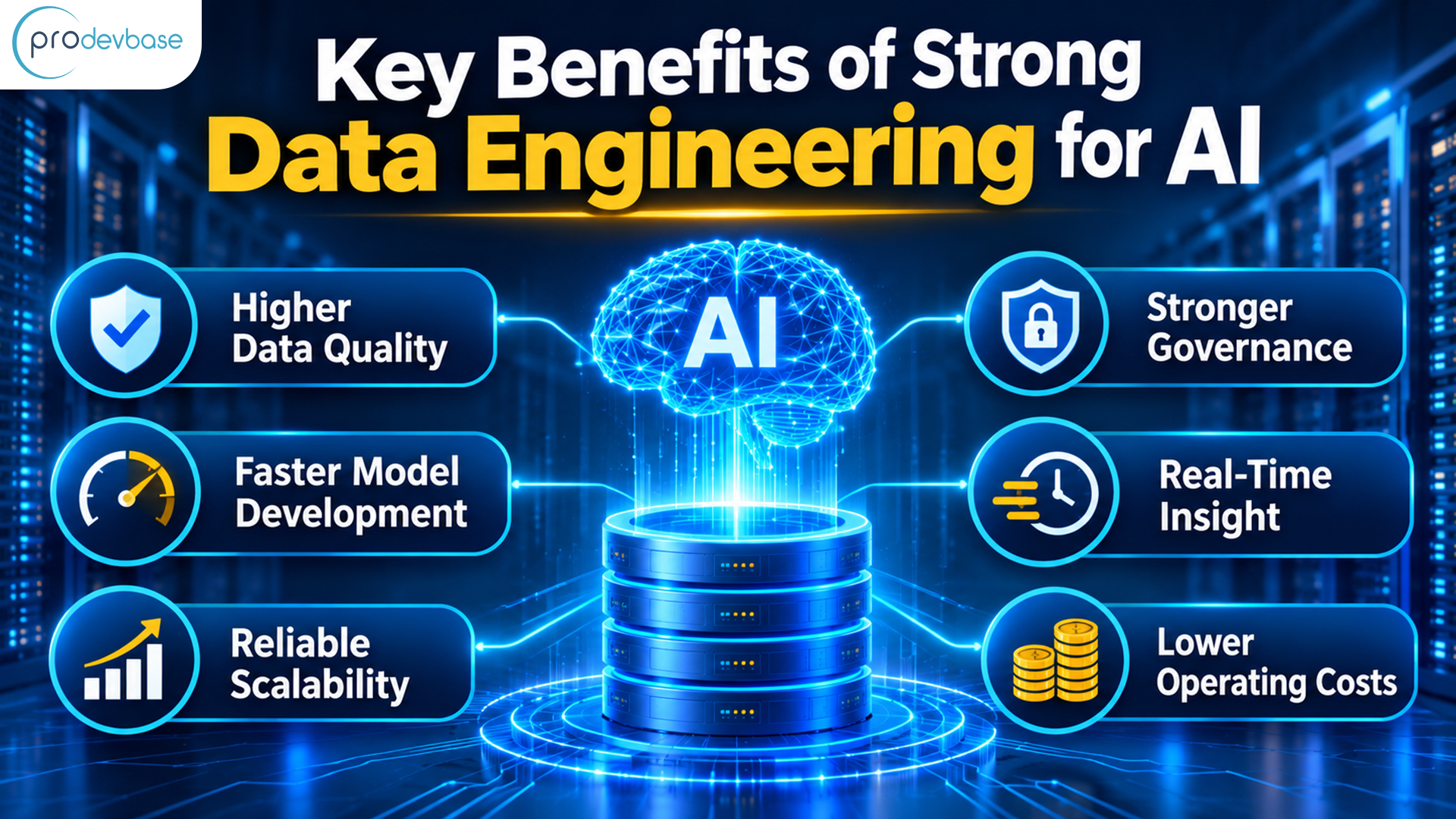
- Higher Data Quality – Automated validation strips out the duplicates, errors, and gaps prior to the data even getting to the models.
- Faster Model Development – Ready-to-use datasets mean data scientists can train and test their ideas in days rather than months.
- Reliable Scalability – Our robust pipelines are able to cope with increasing volumes without breaking or slowing down.
- Stronger Governance – Clear lineage, access controls, and audit trails underpin compliance and trust.
- Real-Time Insight – The streaming architecture provides the data in real time so the predictions are based on the current state of the world.
- Lower Operating Costs – Automation eliminates the need for manual work and stops the expensive rework that would otherwise occur following a failed deployment.
Real-World Use Cases
Absolutely, strong data engineering underpins AI in all sorts of industries. The following are a few examples of how pipelines can take raw data and turn it into business value.
- Retail Demand Forecasting – Unified sales, weather, and inventory feeds enable the models to forecast stock requirements by store.
- Fraud Detection in Banking – Streaming of transaction data enables the identification of suspicious activity in seconds.
- Predictive Maintenance in Manufacturing – Sensor data on the machines themselves can reveal the early signs of failure before a breakdown actually occurs.
- Personalized Healthcare – Patient records from disparate systems can support risk scoring and individualized treatment plans.
- Customer Support Automation – Clean ticket histories and knowledge bases power accurate chatbots and routing tools.
- Supply Chain Optimization – Connected logistics data enables route planning and early warning of delays.
How to Build an AI-Ready Data Foundation
A clear roadmap will keep teams focused. Therefore, just follow these six steps in order.
Step 1: Define Business Goals – Start by working out what decisions the business wants AI to help with, as that will then dictate each technical choice.
Step 2: Audit the Existing Data – Next, map the sources, the formats, and the quality issues to pick up the gaps as early as possible.
Step 3: Design the Architecture – Then pick a warehouse, a lakehouse, or a hybrid that meets the volume and speed requirements.
Step 4: Build Automated Pipelines – After that, build the ingestion and transformation pipelines that will run automatically and reliably with no manual intervention required.
Step 5: Add Quality and Governance Controls – Furthermore, apply validation rules, cataloging, and access policies to ensure accuracy and privacy.
Step 6: Monitor and Optimize – Finally, track performance, cost, and data drift and tune the system as things change.
Tools and Technologies Behind Enterprise Data Engineering
Of course, no one product does it all. A smart stack will cover the entire journey from source to model. The key categories that enterprises use are as follows:
- Data Ingestion and Streaming – Apache Kafka, Apache NiFi, and AWS Kinesis to capture both batch and real-time data from a range of sources.
- Storage and Warehousing – Snowflake, Google BigQuery, Amazon Redshift and the Databricks Lakehouse.
- Transformation and Orchestration – dbt, Apache Spark and Apache Airflow for clean data and reliable workflow scheduling.
- Governance and Observability – Collibra, Great Expectations and Monte Carlo all track lineage, quality and pipeline health.
Although tools are important, strategy is equally important. For that reason, Prodevbase helps enterprises to select, integrate, and manage the right stack for AI services (from data pipelines through to ML deployment). They also ensure that each technical decision is in line with a clear set of business outcomes.
Building an AI-Ready Data Foundation for Enterprise AI
Start with a clear data strategy today. Prodevbase provides end-to-end AI services (data engineering, model development, support, etc.). Get in touch to arrange a consultation and turn data into a sustainable competitive advantage.
Conclusion
In short, successful AI is all about good data. The models will get all the attention. Yet it’s the data engineering that underpins enterprise AI that actually determines the accuracy, the speed, and the trust. Therefore, the organizations that put their money into the pipelines, the quality of the data, and the governance of the data will be able to scale AI with confidence. Meanwhile, the others are just going to be stuck at the pilot stage.
Prodevbase offers AI services tailored to business needs. Get in touch today to build a data foundation that enables smarter decisions and sustainable growth.