
Build the Data Foundation That Powers Smarter AI
How to Build a Modern Data Pipeline for AI Workloads
AI models are only as reliable as the data feeding them. However, most data infrastructure was built long before AI workloads existed, and it shows. Batch jobs that once ran overnight now need to feed real-time inference. Formats built for reporting now need to support training pipelines. A modern data pipeline closes that gap, and increasingly, it determines whether an AI initiative succeeds or stalls. So let’s have a look at how to build a Modern Data Pipeline for AI.
Prodevbase works with businesses rebuilding their data infrastructure specifically to support AI workloads, rather than retrofitting legacy systems after deployment fails. This piece breaks down what a modern data pipeline actually requires.
Why Legacy Pipelines Struggle With AI Workloads
Traditional data pipelines were designed for predictable, scheduled reporting. Therefore, batch processing overnight was perfectly acceptable. AI workloads, however, often need fresh data continuously, not once a day. Consequently, a pipeline built for quarterly dashboards tends to buckle under the demands of real-time model inference.
Beyond speed, AI models are far less forgiving of inconsistent or poorly labeled data than traditional business intelligence tools. A missing field in a sales report might go unnoticed. That same gap in training data can quietly degrade model accuracy for months before anyone traces the cause.
You might missed to read: Hyperautomation Explained: What Comes After Intelligent Automation
Core Components of a Modern Data Pipeline
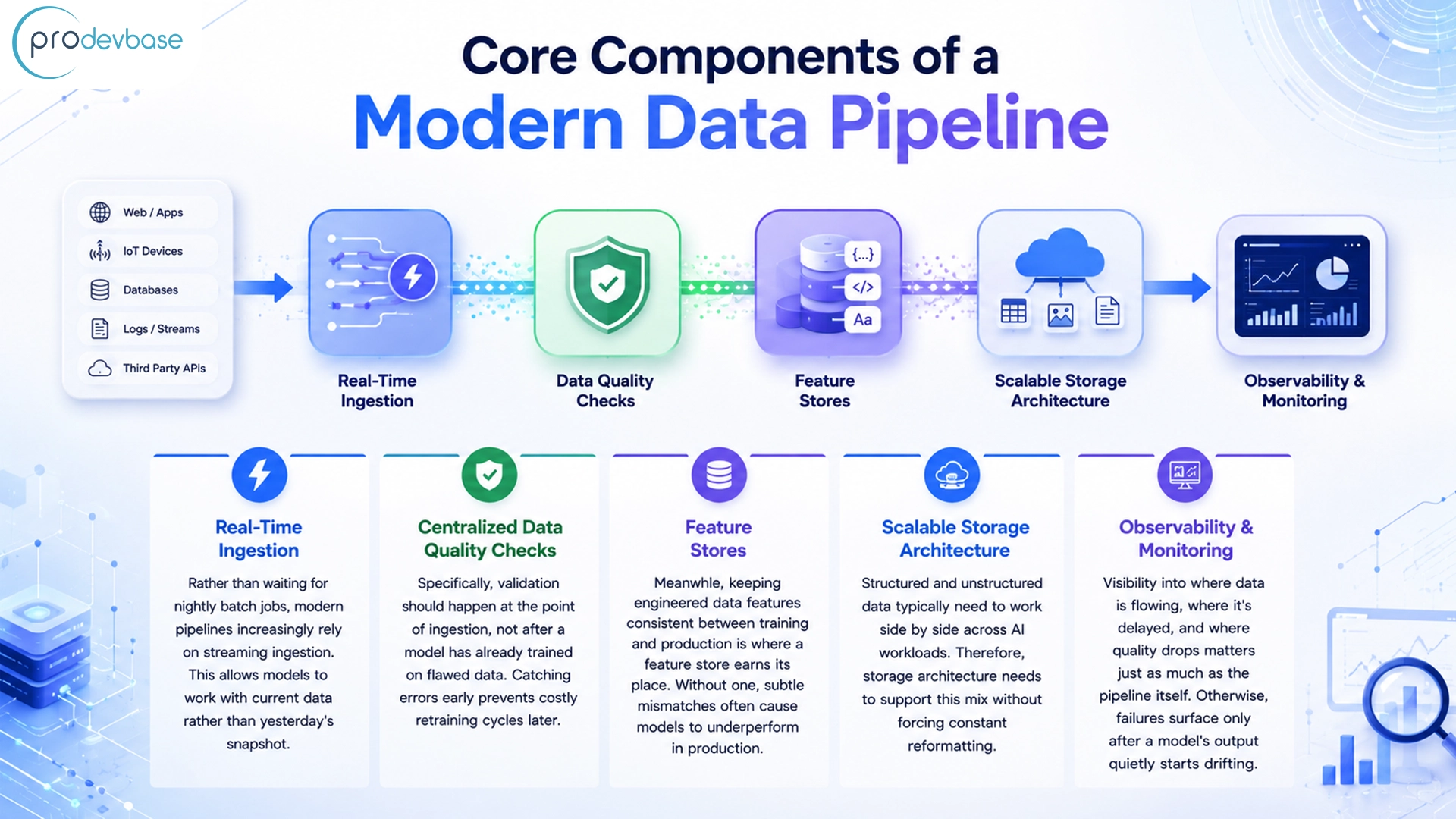
Real-Time Ingestion. Rather than waiting for nightly batch jobs, modern pipelines increasingly rely on streaming ingestion. This allows models to work with current data rather than yesterday’s snapshot.
Centralized Data Quality Checks. Specifically, validation should happen at the point of ingestion, not after a model has already trained on flawed data. Catching errors early prevents costly retraining cycles later.
Feature Stores. Meanwhile, keeping engineered data features consistent between training and production is where a feature store earns its place. Without one, subtle mismatches between these two environments often cause models to perform well in testing yet poorly once deployed.
Scalable Storage Architecture. Structured and unstructured data typically need to work side by side across AI workloads. Therefore, storage architecture needs to support this mix without forcing constant reformatting.
Observability and Monitoring. Visibility into where data is flowing, where it’s delayed, and where quality drops matters just as much as the pipeline itself. Otherwise, failures surface only after a model’s output quietly starts drifting.
Building the Pipeline in the Right Order
Reducing rework considerably tends to come down to sequence. First, map existing data sources and identify where quality gaps already exist. Next, establish ingestion methods appropriate to each workload’s latency needs. Then, implement validation and feature consistency layers before connecting any model. After that, add monitoring so drift gets caught early rather than discovered after damage is done.
Prodevbase follows this exact sequence when building data pipelines for AI workloads, since skipping validation early often means expensive retraining later.
Common Mistakes That Undermine AI Pipelines
Several patterns repeatedly cause AI initiatives to underperform. Treating data pipeline work as a one-time setup rather than ongoing maintenance is one. Skipping data quality validation to move faster toward deployment is another. Building pipelines around a single model instead of a reusable architecture is a third. Ignoring monitoring until a model’s accuracy has already visibly declined rounds out the list.
Significant time and budget are usually already invested by the point these mistakes surface, which makes early prevention considerably more valuable than late correction.
Why This Matters More As AI Scales
Surviving a single pilot project is one thing for a fragile data pipeline. However, once multiple models depend on the same infrastructure, cracks widen quickly. Consequently, businesses that invest in pipeline architecture early tend to scale AI initiatives with far fewer disruptions later.
Prodevbase has seen this pattern hold consistently: a modern data pipeline isn’t a technical detail bolted onto AI strategy; it’s the foundation the entire strategy depends on. Businesses that get this right early tend to face far fewer surprises as workloads and model complexity increase.
Moving Forward
More than upgrading storage or adding a few automation scripts, building a modern data pipeline requires rethinking how data moves, where it’s validated, and how consistently it behaves between training and production. As AI adoption accelerates through 2026, pipeline architecture will likely separate initiatives that scale smoothly from those that stall under their own weight. Prodevbase continues helping businesses build that foundation before scale exposes the gaps.