
Generative AI in Product Design and Prototyping: A New Era for Creators

How Does Generative AI Improve Product Design? Key Benefits Explained
Product teams are changing how they build things. Generative AI in product design is one reason why. This technology helps teams sketch, test, and refine ideas faster than before. So let’s know about how does Generative AI Improve Product Design.
Traditionally, product design took weeks. Sketches came first, followed by physical models. Next, teams spent rounds on feedback that slowed progress down. Generative AI in product design and prototyping shortens this cycle. As a result, teams move from concept to working prototype in days instead of months.
What Generative AI Means for Product Design
Generative AI refers to systems that create new content based on patterns learned from data. In product design, this means generating shapes, structures, and layouts based on set goals. For instance, a designer can enter constraints like weight, material, and strength. The system then produces several design options instantly.
Because of this, engineers spend less time drafting by hand. Instead, they review AI-generated options and refine the strongest ones. Consequently, the design phase becomes a process of selection and improvement rather than creation from scratch.
Also read: The Complete AI Product Engineering Lifecycle: From MVP to Scalable AI
Faster Prototyping Through Generative AI
Prototyping used to require physical builds at every stage. Now, generative AI in product design allows virtual testing before a single part gets made. Simulations show how a design performs under stress, heat, or pressure. Therefore, flawed designs get caught early.
Additionally, 3D printing paired with AI-generated models speeds up physical testing. A team can print a prototype the same day a design gets finalized. As a result, feedback loops shrink from weeks to hours.
Reducing Design Costs and Material Waste
Traditional prototyping wastes material. Failed models get discarded, and new ones get built from scratch. However, generative AI in product design reduces this waste. Because the software tests digital versions first, fewer physical failures occur.
Furthermore, AI can suggest lighter structures that use less raw material without losing strength. This matters for industries like aerospace and automotive, where weight and cost affect performance directly. Similarly, packaging design benefits from AI models that reduce material use while keeping products protected.
Real-World Applications Across Industries
Generative AI in product design and prototyping already shapes several fields. In furniture design, AI suggests structural forms that balance comfort and material efficiency. Footwear brands use AI to generate sole patterns suited to specific movement types. Meanwhile, medical device makers use AI to prototype components that fit human anatomy precisely.
On the other hand, software product teams use generative AI to build interactive prototypes for apps and websites. Because these tools generate layouts based on user behavior data, interfaces improve before launch rather than after.
Prodevbase supports businesses looking to apply generative AI in product design workflows. Because early-stage testing matters so much, the focus stays on building prototypes that reflect real design goals rather than guesswork.
Challenges Teams Should Consider
Even so, generative AI in product design brings challenges. AI-generated designs still need human judgment. A design might meet technical requirements but miss aesthetic or brand goals. Therefore, human review remains a necessary step, not an optional one.
Also, integrating AI tools into existing design software takes planning. Teams need training to interpret AI outputs correctly. Without this, generated designs can get misapplied or misunderstood.
Data quality matters too. Since generative AI depends on prior design data, poor or limited datasets lead to weaker suggestions. Because of this, teams should feed the system accurate, relevant design history before relying on its outputs.
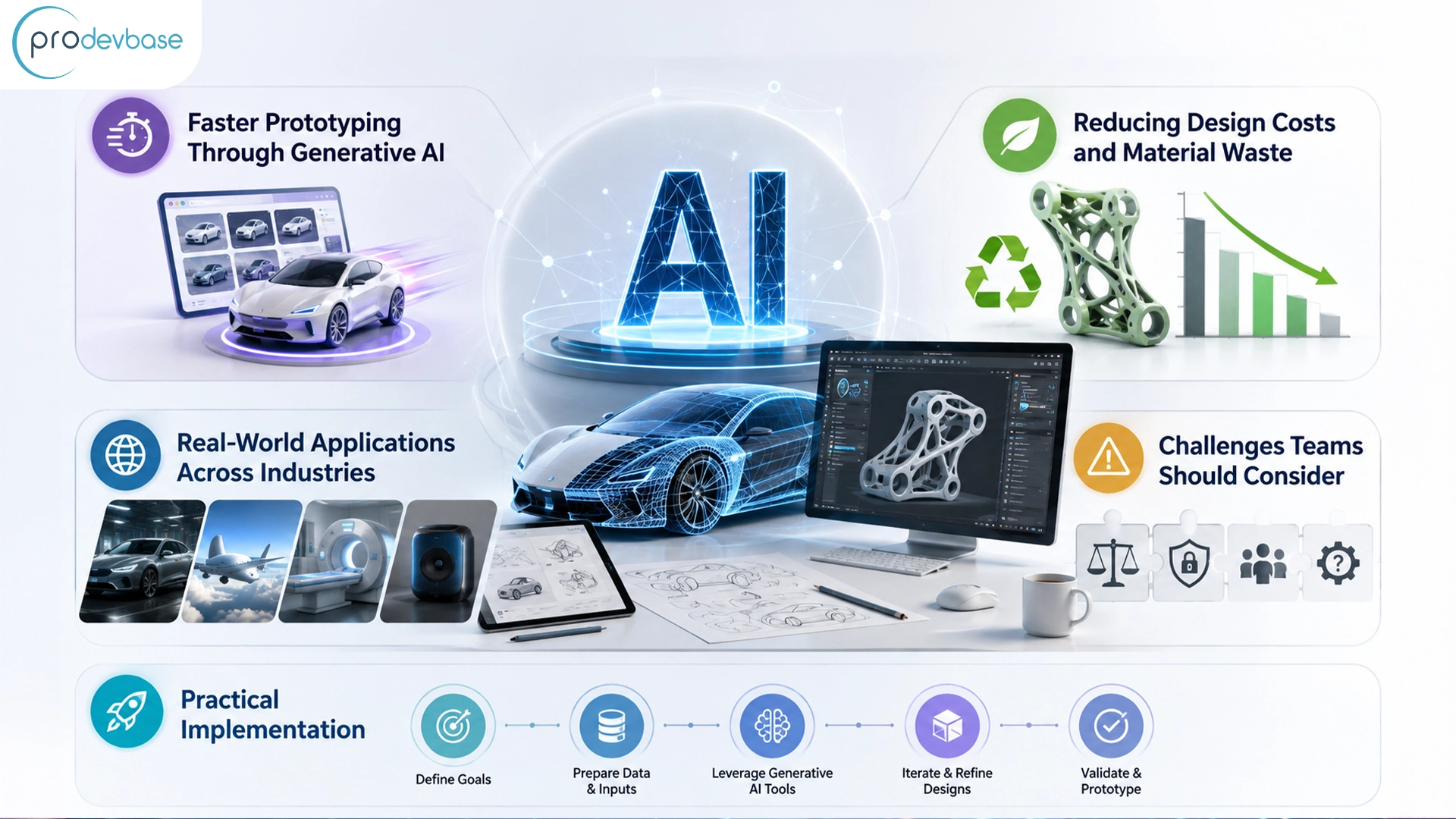
Prodevbase and Practical Implementation
Prodevbase works with product teams to introduce generative AI into design pipelines step by step. Rather than replacing designers, the approach focuses on giving teams faster tools for exploring ideas. As a result, human creativity stays central while repetitive drafting work decreases.
This method also keeps prototyping grounded in business goals. Since every product carries different constraints, generic AI templates rarely fit well. Instead, custom-tuned models produce designs aligned with specific requirements.
The Future of Generative AI in Prototyping
Looking ahead, generative AI in product design will likely merge further with virtual and augmented reality tools. Designers could walk through a digital prototype before it exists physically. Meanwhile, real-time collaboration tools will let distributed teams refine AI-generated models together.
Additionally, sustainability pressure will push generative AI further into material science. As the push to cut waste grows, AI-guided design will play a bigger role in choosing efficient structures and materials.
Final Thoughts
Generative AI in product design and prototyping changes how ideas move from sketch to shelf. Because testing happens digitally first, costly errors decrease. Consequently, teams build stronger products in less time.
Prodevbase continues to help businesses put generative AI into practice within design and prototyping stages. As adoption grows, this technology will likely become a standard part of how new products get built, tested, and launched.