
From MVP to Scale: The AI Product Engineering Lifecycle
The Complete AI Product Engineering Lifecycle: From MVP to Scalable AI
Building an AI product is exciting. However, turning that excitement into a working, scalable product is a completely different story. Indeed, many teams jump straight into complex models. As a result, they often skip the steps that actually make a product succeed.
This is exactly where AI Product Engineering comes in. In short, it is the structured process of designing, building, testing, and scaling AI-powered products. It combines software engineering best practices with machine learning to create reliable, scalable AI solutions. Businesses looking to build intelligent applications can explore our AI engineering services to accelerate development and deployment. So let’s have a look at AI Product Engineering Lifecycle.
What Is AI Product Engineering?
First, it helps to understand the term itself. AI product engineering covers the full journey of an AI product, including idea validation, data pipelines, model development, deployment, and long-term scaling.
In other words, it is a lifecycle, not a one-time project. Consequently, every stage feeds into the next. Therefore, understanding this early can save months of rework later on.
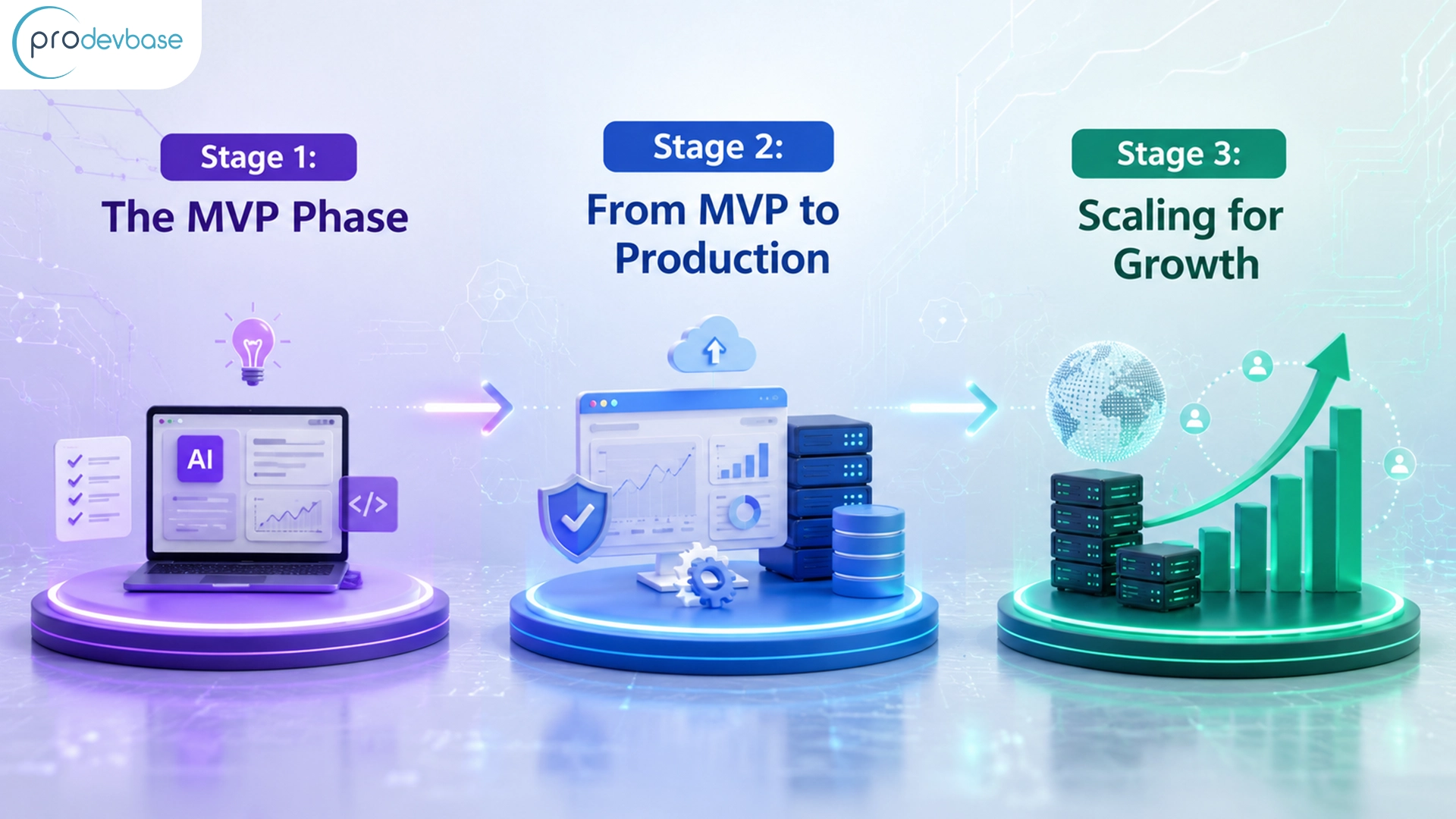
AI Product Engineering Stage 1: The MVP Phase
To begin with, every great AI product starts small. Indeed, the first goal is not perfection. Instead, it is validation.
Generally speaking, AI products carry more uncertainty than traditional software. For instance, you may not know if your data is reliable enough. Similarly, you may not know if users will trust an AI-driven feature. Because of this, an MVP helps confirm three things: whether the AI solves a real problem, whether the data holds up, and whether users actually adopt it.
Typically, a strong MVP includes a clear problem statement, a small clean dataset, a simple prototype, and a basic interface for early testers. Notably, the model does not need to be perfect yet. Instead, it just needs to prove the concept.
Stage 2: From MVP to Production
Once the MVP proves its value, the next challenge begins. Specifically, teams must turn a fragile prototype into something reliable. Admittedly, this step is often underestimated. However, it remains one of the most important stages in the lifecycle.
During this phase, engineers usually focus on improving model accuracy, building proper data pipelines, adding monitoring, and strengthening security. Meanwhile, product teams start planning for edge cases, such as unexpected input or sudden traffic spikes. As a result, this stage blends engineering rigor with product thinking, ultimately producing a stable product customers can depend on daily.
Stage 3: Scaling for Growth
Without a doubt, scaling is where many AI products struggle most. In fact, a model that works well for a hundred users may break entirely at ten thousand.
As usage grows, infrastructure demands grow alongside it. Consequently, teams must consider compute costs, latency, and uptime. Otherwise, the user experience suffers. For example, a slow chatbot frustrates users quickly, while a well-optimized system responds almost instantly. Additionally, teams often adopt caching, model distillation, or smarter batching to keep costs manageable.
Similarly, data management becomes critical at scale. Continuous monitoring, retraining pipelines, and clear versioning help maintain model quality. In addition, proper governance ensures compliance as regulations evolve. Ultimately, scaling is not just about traffic; it is about preserving trust and reliability.
Also read: AI Data Engineering vs AI Product Engineering: Which Is Right for Your Business?
Common Pitfalls in AI Product Engineering
Even strong teams make mistakes. However, most pitfalls fall into familiar patterns: skipping the MVP stage, ignoring data quality, underestimating infrastructure costs, or failing to monitor models after launch. Because of these mistakes, many promising AI ideas fail before reaching real users.
How ProDevBase Helps Businesses Build AI Products
This is exactly where Prodevbase becomes valuable. Specifically, we help businesses move through every stage of the AI product engineering lifecycle with confidence, from early validation to full-scale deployment. As a result, businesses avoid common pitfalls and reach the market faster.
For instance, a startup might need help validating an AI feature quickly, while an established company might need support scaling safely. Either way, a structured engineering approach makes the difference between success and stalled progress.
Final Thoughts
Altogether, the journey from MVP to scale is rarely simple. However, it becomes far more manageable with the right approach: validate first, stabilize next, then scale with strong infrastructure and data practices. Consequently, businesses that follow this path consistently outperform those that skip steps.
If your business needs expert support at any stage, Prodevbase offers dedicated AI Product Engineering services designed to help you grow with confidence.
Follow us on our LinkedIn Platform