
AI Product Engineering for SaaS Startups: Build Smarter Products | Prodevbase
AI Product Engineering for SaaS Startups: A Practical Guide
Every SaaS roadmap now has an AI feature penciled in somewhere. Yet penciling it in and actually shipping something reliable are two different challenges entirely. Between choosing a model, wiring up data pipelines, and keeping a shifting roadmap on track, engineering teams often discover that “adding AI” is far harder than the pitch deck made it sound. So let’s know about AI Product Engineering for SaaS Startups.
This is where AI product engineering enters the picture. Essentially, it is the discipline of turning artificial intelligence from a buzzword into a working, reliable feature inside a software product. Below, this guide breaks down what that discipline actually involves, why it matters right now, and how a SaaS startup can approach it without losing months to trial and error.
What Is AI Product Engineering
At its core, AI product engineering combines software engineering, data science, and product design into a single workflow. Rather than treating artificial intelligence as a separate experiment, this approach embeds it directly into the product lifecycle, starting from planning and continuing through deployment.
Specifically, it covers three layers. First, the infrastructure layer handles data collection, storage, and pipelines. Second, the intelligence layer covers model selection, fine-tuning, and prompt design. Third, the experience layer focuses on how end users actually interact with AI features inside the interface. Together, these layers determine whether an AI feature feels magical or frustrating.
Why SaaS Startups Need AI Product Engineering Now
Competition in the SaaS space has intensified sharply. Consequently, adding a basic chatbot or a generic automation feature no longer impresses buyers. Instead, decision-makers now expect intelligence that solves a specific, measurable problem.
Additionally, funding conversations have shifted. Investors frequently ask how artificial intelligence is embedded into the core product rather than bolted on as an afterthought. Therefore, founders who treat AI engineering as a strategic pillar, not a side project, tend to raise faster and retain customers longer.
Furthermore, customer expectations have evolved alongside consumer AI tools. Users who interact daily with intelligent assistants elsewhere naturally expect similar responsiveness from business software. Hence, ignoring this shift risks losing relevance within a short window.
Core Components of AI Product Engineering
Data Infrastructure
First and foremost, clean, well-structured data forms the foundation of any AI feature. Without it, even the strongest model produces unreliable output. Accordingly, early-stage teams should prioritize data pipelines, labeling systems, and storage architecture before touching a single model.
Model Selection and Integration
Next, choosing between a proprietary model, an open-source model, or a fine-tuned variant depends heavily on cost, latency, and accuracy requirements. Meanwhile, integration work, meaning the process of connecting the model to existing APIs and databases, often consumes far more engineering time than the model selection itself.
Product-Led AI Design
Equally important, an AI feature must feel native to the product rather than tacked on. Otherwise, adoption suffers regardless of how sophisticated the underlying technology happens to be. Thus, interface design and user flow deserve as much attention as backend architecture.
Testing and Feedback Loops
Finally, AI systems behave probabilistically rather than deterministically. As a result, continuous testing, monitoring, and feedback loops become non-negotiable. Otherwise, small errors compound into larger trust issues among end users over time.
Common Challenges Startups Face
Admittedly, the path toward AI product engineering rarely runs smoothly. For instance, hiring engineers who understand both machine learning and traditional software architecture remains difficult, especially for early-stage teams operating with lean budgets.
Similarly, technical debt accumulates quickly when AI features are rushed to market. Consequently, what began as a quick prototype often becomes a maintenance burden within a handful of product cycles.
Moreover, cost management poses another hurdle. Model inference charges, storage fees, and compute costs can escalate unpredictably. Therefore, budgeting for AI features requires forecasting beyond typical software development estimates.
A Practical Roadmap for AI Product Engineering
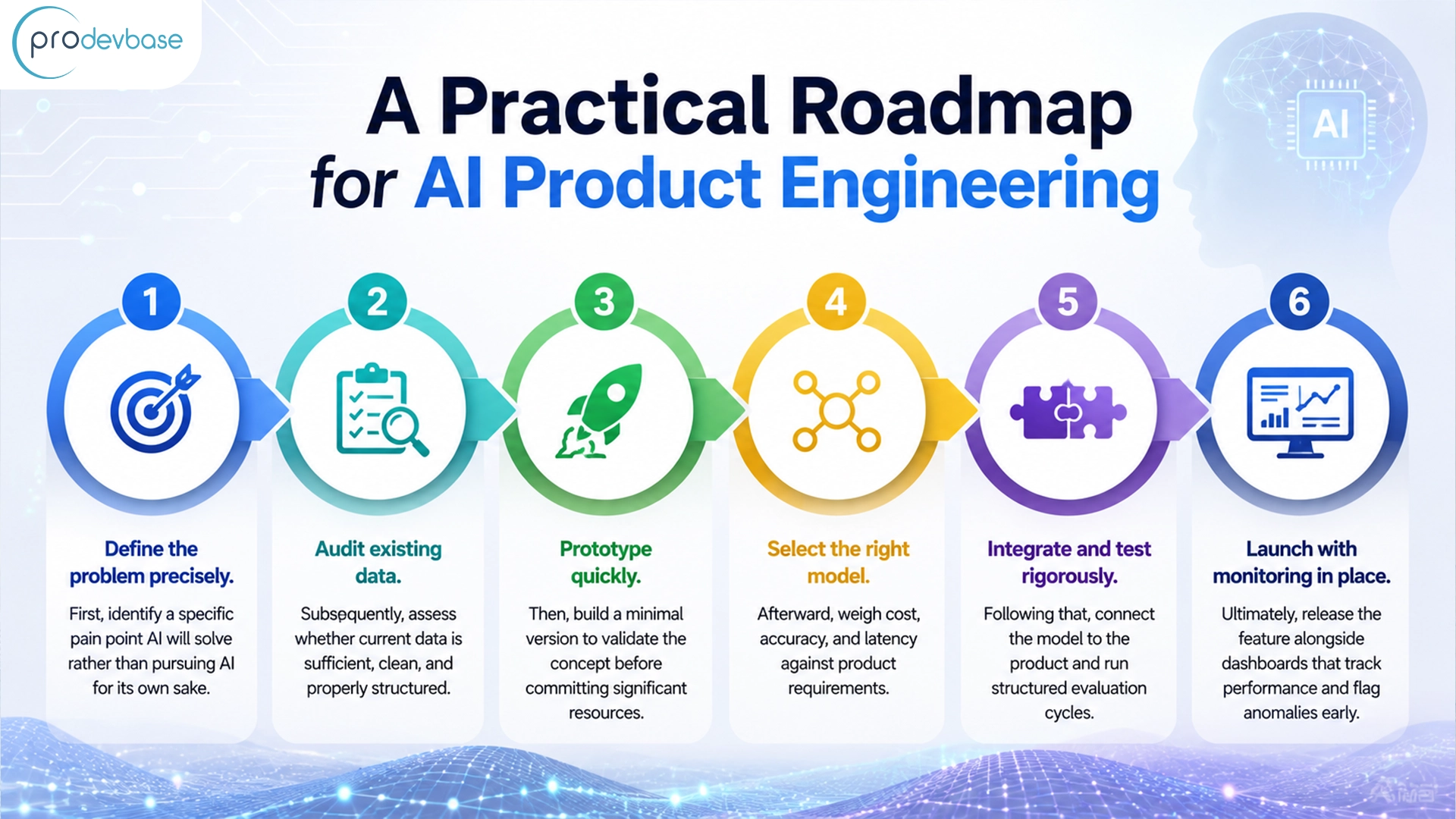
To simplify execution, the process can be broken into sequential stages:
- Define the problem precisely. First, identify a specific pain point AI will solve rather than pursuing AI for its own sake.
- Audit existing data. Subsequently, assess whether current data is sufficient, clean, and properly structured.
- Prototype quickly. Then, build a minimal version to validate the concept before committing significant resources.
- Select the right model. Afterward, weigh cost, accuracy, and latency against product requirements.
- Integrate and test rigorously. Following that, connect the model to the product and run structured evaluation cycles.
- Launch with monitoring in place. Ultimately, release the feature alongside dashboards that track performance and flag anomalies early.
Following this sequence reduces wasted engineering effort and shortens time to a stable release.
How Prodevbase Helps Startups Build AI Products
Given the complexity outlined above, partnering with a specialized engineering team often accelerates progress considerably. Prodevbase focuses specifically on AI product engineering for early and growth-stage SaaS ventures, handling everything from data architecture through model integration and interface design.
Rather than offering generic development services, Prodevbase builds AI features tailored to the exact workflow a founder is trying to automate or enhance. Consequently, startups working with Prodevbase typically move from concept to a working AI feature without the usual detours into unnecessary technical debt.
Measuring Success After Launch
Once an AI feature goes live, measurement becomes essential. Specifically, engineering teams should track accuracy, latency, adoption rate, and user satisfaction side by side. Otherwise, it becomes difficult to distinguish a genuinely valuable feature from one that merely looks impressive in a demo.
Additionally, feedback loops should feed directly back into model refinement. Over time, this iterative cycle compounds, turning a modest first release into a durable competitive advantage.
Final Thoughts
Ultimately, AI product engineering is not a one-time project but an ongoing discipline. Startups that treat it this way, building solid data foundations, choosing models deliberately, and testing continuously, tend to outperform competitors chasing quick wins.
For founders who prefer to skip months of trial and error, Prodevbase offers a structured path toward building AI features that actually work in production. Given the pace of change across the SaaS landscape, starting this process sooner rather than later remains a sound strategic choice, and Prodevbase stands ready to support that journey from the prototype through full-scale deployment.