
AI-Powered Quality Inspection: How Computer Vision Detects Product Defects
How Does AI Detect Product Defects? Why AI-Powered Quality Inspection Matters Today
The Limits of Manual Checks
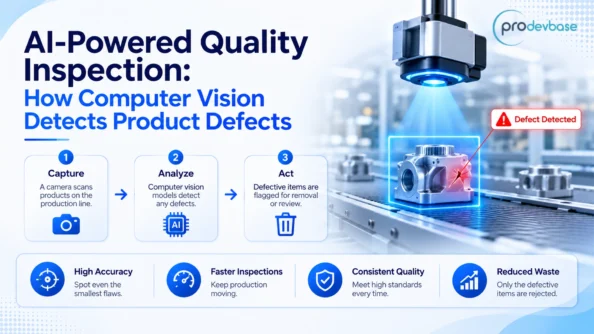
The use of AI in quality inspection is altering the way factories detect flaws. Cameras take pictures of each product as it moves along the production line. Computer vision models then examine the images within milliseconds. Because of this, defects appear before the products leave the factory. So here let’s know How Does AI Detect Product Defects.
Factories have been using manual inspections for decades. But people’s eyes get weary after long shifts, so small scratches, cracks, and changes in color go undetected. Moreover, two inspectors might give the same item different evaluations.
Computer vision deals with these problems by applying the same standard to all items, every day and every night. It is for this reason that quality teams achieve consistent and measurable results.
Also read: How to Automate Invoice Processing With AI and Eliminate Manual Data Entry
How Computer Vision Detects Defects
Deep learning models base their learning on labeled images. Initially, the system learns what a perfect product should look like. Then, it examines the visual characteristics of each kind of defect. Lastly, it compares the live images with this knowledge and immediately identifies any discrepancies.
The model is still continuing to learn. Each new image contributes to the data used for training, so the accuracy increases as production goes on.
Types of Defects the Technology Finds
Faults on the surface such as scratches, dents, and stains are easy to identify. In the same way, the models are able to detect missing parts, incorrect labels, and components that are crooked. Moreover, they can pick out hairline cracks and defects in the welding that people usually fail to see. For example, a trained model can inspect a circuit board and locate a small solder gap in less than a second.
Key Benefits of AI-Powered Quality Inspection
- Greater Accuracy – With greater accuracy, the models consistently detect minor flaws. This means that fewer defective items get to the buyers.
- Faster Inspection – Inspection runs more quickly since cameras check the products at the speed of the production line. As a result, bottlenecks vanish.
- Reduced Costs – Reduced costs result from automated checks, which in turn reduce the need for rework, returns, and warranty claims. Consequently, the profit margins rise.
- Less Waste – With less waste, teams identify defective batches early, so they don’t end up using up extra material. The same applies to the scrap rate.
- Full Traceability – There is full traceability since the system saves each image with a timestamp. This makes audits and root-cause investigations easy.
- Easy Scalability – It is easy to scale up. Teams can easily add cameras and product lines, and there’s no longer a need for large inspection teams.
Real-World Use Cases Across Industries
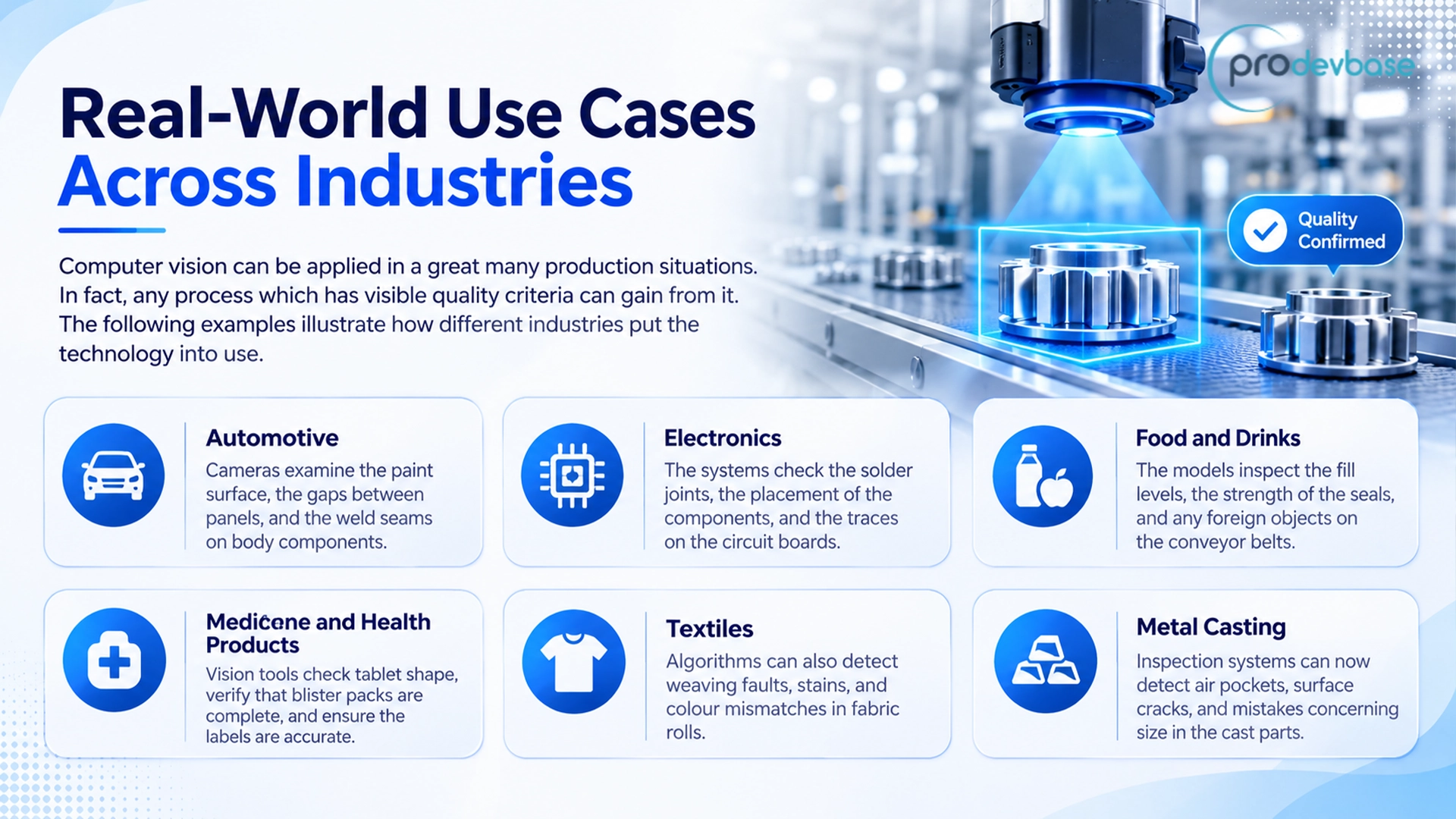
Computer vision can be applied in a great many production situations. In fact, any process which has visible quality criteria can gain from it. The following examples illustrate how different industries put the technology into use.
- Automotive – Cameras examine the paint surface, the gaps between panels, and the weld seams on body components.
- Electronics – The systems check the solder joints, the placement of the components, and the traces on the circuit boards.
- Food and Drinks – The models inspect the fill levels, the strength of the seals, and any foreign objects on the conveyor belts.
- Medicine and Health Products – Vision tools check tablet shape, verify that blister packs are complete, and ensure that the labels are accurate.
- Textiles – Algorithms can also detect weaving faults, stains, and colour mismatches in fabric rolls.
- Metal Casting – Inspection systems can now detect air pockets, surface cracks, and mistakes concerning size in the cast parts.
Implementation Process: From Idea to Live Inspection
Success is based on having a well-defined and organised rollout. A competent technology partner helps to reduce the learning curve. Prodevbase provides businesses with practical AI services and direct engineering support at every stage.
Step 1: Define Goals – We should define our goals by making a list of the types of defects. We should also specify the desired accuracy and the speed of the line. Setting clear goals will keep the project focused.
Step 2: Gather Images – Take photographs of both good and defective products using the actual lighting found in the factory. Having a variety of samples increases the strength of the model.
Step 3: Label the Data – Mark the defects using boxes or masks. The accuracy of the labels has a direct effect on the quality of the model.
Step 4: Train and Validate – Construct the model and test it on images that it has not seen before. Then make the necessary adjustments to the settings until the results match the target.
Step 5: Put It Into Use – Install the cameras, the lighting, and the edge devices. Then connect the alerts to the current control system.
Step 6: Monitor and Retrain – Track the performance after the system has launched. Also refeed the new defect examples into the training process in order to maintain a high level of accuracy.
Tools and Technologies Behind Visual Inspection
Having the right toolkit will speed up development and make deployment easier as well. Furthermore, the selection of hardware has as great an effect on image quality as the software does. The categories below make up a typical technology stack.
- Deep Learning Frameworks – The main deep learning frameworks are TensorFlow and PyTorch, which form the foundation for training detection and sorting models.
- Vision Libraries and Models – OpenCV is responsible for image processing, while YOLO and Detectron2 provide fast object detection.
- Imaging Hardware – Industrial cameras, controlled lighting, and NVIDIA Jetson edge devices ensure that the images are clear and that real-time processing takes place.
- Deployment and Monitoring – Docker, ONNX, MLflow, and Kubernetes package the models, track the tests, and ensure that the systems remain stable.
Lighting deserves special consideration since a badly lit scene may conceal a defect which even the best model cannot correct. For this reason, teams must check the camera angles and light levels before settling on the design.
Ready to Reduce Defects?
Prodevbase creates custom computer vision systems to suit existing production lines. Why not book a free consultation now and find out how automated inspection can reduce waste and safeguard brand quality?
Conclusion
Factories can detect defects more quickly and with greater consistency through the use of AI-powered quality inspection. In other words, computer vision takes the place of human eyes by providing never-fatigued accuracy. As a result, companies achieve reduced costs, less waste, and satisfied customers.
Prodevbase provides AI services that are customized to meet business requirements. They cover the entire process from data preparation to full deployment. Get in touch with them today and start your journey towards smarter, defect-free production.