
AI Data Engineering: The Foundation of Reliable, High-Performance AI
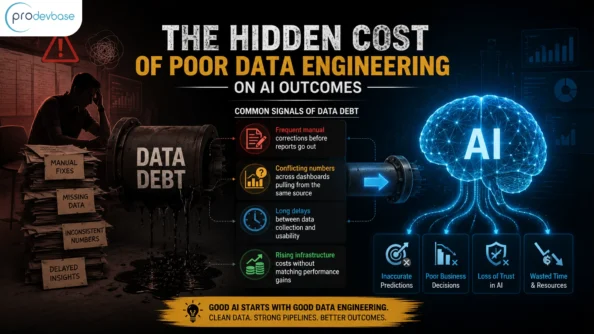
The Hidden Cost of Poor Data Engineering on AI Outcomes
A model is only as good as what it’s fed. Simple enough to say. But teams keep pouring months into tuning algorithms while the data underneath sits riddled with gaps, duplicates, and mismatched formats. When results come back wrong, the algorithm takes the blame. The pipeline rarely does. And it’s usually the real source of the problem. So let’s know about how does AI Data Engineering Improve AI Outcomes.
Why the Foundation Outweighs the Model
Ask a data scientist what killed their last project. Rarely does the answer sound like “the neural network wasn’t sophisticated enough.” It’s usually something duller: missing fields, inconsistent timestamps, three systems reporting three different versions of the same customer record. A model trained on that mess doesn’t fail loudly. It fails quietly, spitting out numbers that look plausible right up until someone checks them against reality.
What Weak Pipelines Actually Cost
The price shows up in places nobody budgets for. Analysts lose Friday afternoons reconciling spreadsheets instead of building anything new. Leadership starts asking why the “AI initiative” hasn’t moved the needle. Nobody realizes the model has already been retrained six times on the same flawed dataset. Trust goes first. Budget cuts follow soon after.
Take a retail chain forecasting holiday demand off incomplete transaction logs. It might overstock one region and run dry in another. Not because the forecasting logic was wrong, but because half the sales data never made it into the training set. A hospital predicting readmission risk from inconsistent patient records faces something worse than a bad forecast. Nobody blames the spreadsheet in either case. They blame the AI.
Where AI Data Engineering Earns Its Keep
Here’s the part that rarely gets attention until something breaks: AI Data Engineering is the discipline of building pipelines that catch these problems before a model ever touches the data. Validation checks, lineage tracking, schema enforcement, none of it glamorous. But it’s the difference between a model that works in a demo and one that survives contact with real, messy, constantly changing data.
Done properly, it saves time nobody notices being saved. Standardized formats across teams mean an analyst in finance and an analyst in operations aren’t arguing over whose numbers are correct. Silent failures, the kind where a model keeps running but quietly drifts off course, get caught early instead of six months into production. Is that glamorous work? Not really. Does it matter more than the model architecture itself? Often, yes.
Signs the Debt Is Already Piling Up
A few patterns tend to show up before things go visibly wrong:
- Reports need manual fixing every time, right before they go out the door
- Two dashboards pulling from the same source somehow disagree
- Data takes days to become usable after it’s collected
- Infrastructure spend keeps climbing without any real gain in output
None of these fix themselves. Left alone, they compound. The eventual repair bill dwarfs what early intervention would have cost.
How Does AI Data Engineering Improve AI Outcomes and How Prodevbase Approaches
Prodevbase builds pipelines around one assumption: data will be messy, because it always is. Rather than patching problems after deployment, engineers design validation and monitoring directly into the pipeline from day one. Anomalies get flagged before they ever reach a production model. Teams working with Prodevbase tend to see fewer failed rollouts and a shorter gap between “we built this” and “this actually works.”
Lineage tracking gets the same attention. When something breaks three layers downstream, tracing it back to the source turns a week-long investigation into an afternoon. That’s not a small thing when a launch date is on the line.
Also read: AI Data Engineering vs AI Product Engineering: Which Is Right for Your Business?
The Bottom Line
No algorithm fixes bad data by being clever. Companies that treat pipeline work as an afterthought tend to relearn that lesson the expensive way, usually right after a launch goes sideways. Getting AI Data Engineering right from the start doesn’t guarantee success. Skipping it nearly guarantees the opposite.
The hidden cost here isn’t abstract. It’s wasted engineering hours, eroded trust in leadership meetings, and projects that quietly stall out. Prodevbase exists to catch that cost before it shows up on a balance sheet.