
AI Data Engineering vs AI Product Engineering: Which Is Right for Your Business?
AI Data Engineering vs AI Product Engineering: What Sets Them Apart
AI Data Engineering vs AI Product Engineering is a comparison that keeps surfacing as artificial intelligence moves from experimentation into daily operations. Both fields sound similar on paper. However, they solve very different problems inside an AI system.
Data engineering handles the raw material. Product engineering shapes what people actually use. Understanding this split helps teams avoid costly missteps early in an AI initiative.
This breakdown of AI Data Engineering vs AI Product Engineering shows how each discipline earns its place inside a working AI pipeline and how the two connect in practice.
What Is AI Data Engineering?
AI Data Engineering focuses on building the infrastructure that feeds machine learning models. This includes data collection, cleaning, labeling, storage, and pipeline automation. Without this layer, no AI model can perform reliably.
Consequently, data engineers spend most of their time on ingestion pipelines, schema design, and data validation. They also manage feature stores and maintain compliance with privacy regulations. In short, this discipline is the plumbing behind every AI-powered feature, much like how data engineering is the practice of designing systems that collect and prepare raw data at scale.
For instance, a recommendation engine needs clean purchase histories, timestamps, and interaction logs before any model can train properly. Similarly, a fraud detection system depends on structured transaction data flowing in near real time. Without accurate pipelines, even the best algorithms fail to deliver useful results.
What Is AI Product Engineering?
AI Product Engineering, on the other hand, focuses on turning trained models into usable features, applications, or platforms. This involves interface design, API integration, model deployment, and user experience testing. Data feeds the model; product engineering delivers the outcome to end users.
Product engineers work closely with designers and stakeholders. Meanwhile, they translate model outputs into dashboards, chat interfaces, or automated workflows. As a result, this layer determines whether an AI capability actually gets adopted.
For example, a well-trained churn prediction model means little without a dashboard that surfaces the right accounts to a sales team at the right time. Likewise, a language model only creates value once it sits inside a chatbot, plugin, or application people can reach.
Also read: Why Do Businesses Need AI Product Engineering? Benefits Explained
Key Differences Between AI Data Engineering and AI Product Engineering
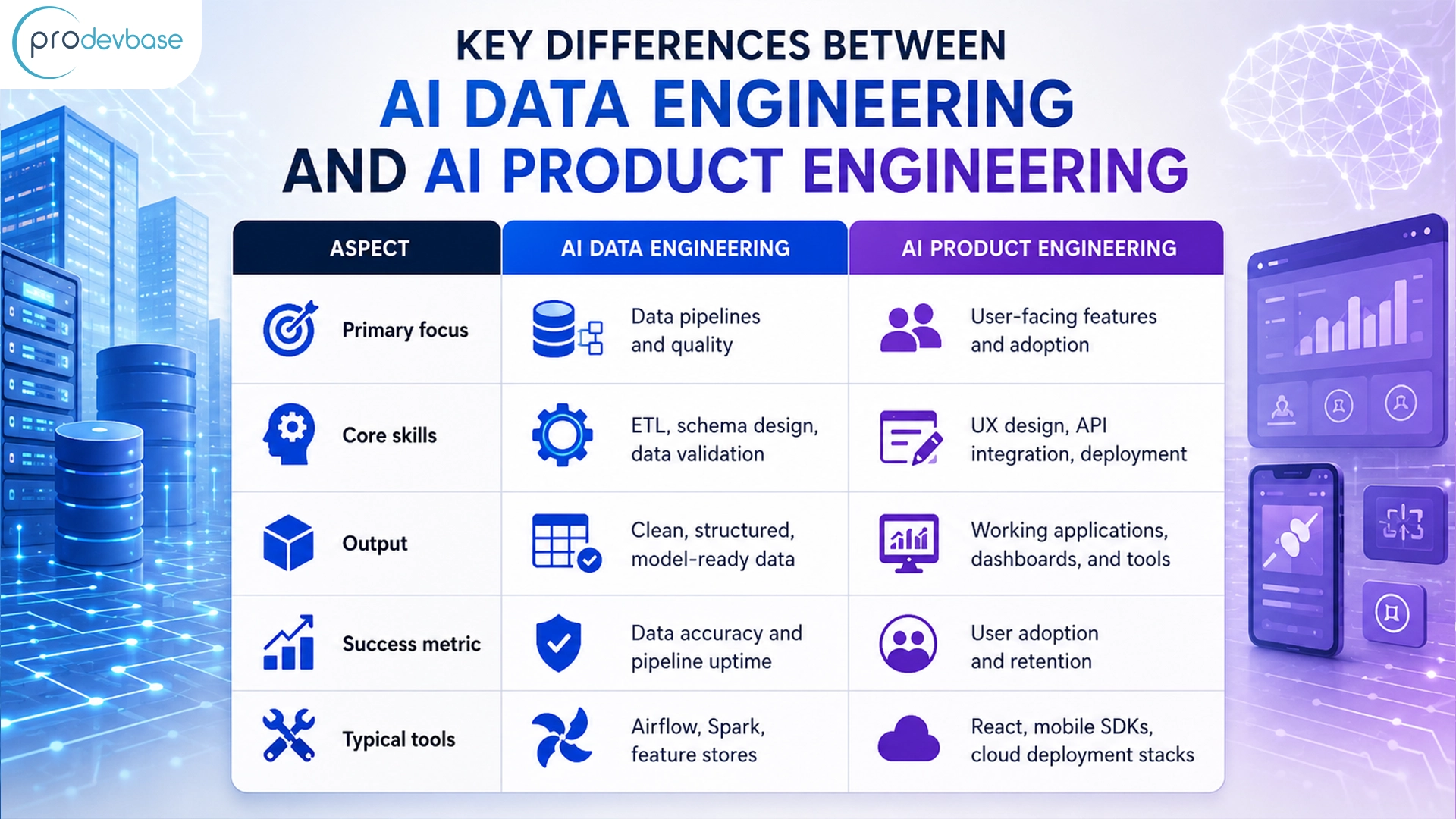
The comparison of AI Data Engineering vs AI Product Engineering becomes clearer once the core functions sit side by side.
| Aspect | AI Data Engineering | AI Product Engineering |
|---|---|---|
| Primary focus | Data pipelines and quality | User-facing features and adoption |
| Core skills | ETL, schema design, data validation | UX design, API integration, deployment |
| Output | Clean, structured, model-ready data | Working applications, dashboards, and tools |
| Success metric | Data accuracy and pipeline uptime | User adoption and retention |
| Typical tools | Airflow, Spark, feature stores | React, mobile SDKs, cloud deployment stacks |
The table above shows a clear pattern. Data engineering builds inward, toward accuracy. Product engineering builds outward, toward usability. Therefore, neither one can replace the other inside a complete AI system.
How the Two Disciplines Work Together
Although these fields differ, they rarely operate in isolation. Data engineering supplies clean, structured inputs. Product engineering then transforms model predictions into interactions that solve real problems, an approach closely aligned with what practitioners call MLOPs, the practice of connecting data pipelines with deployed applications.
For instance, Prodevbase often pairs both teams on a single roadmap so pipelines and interfaces evolve together. Otherwise, gaps appear between a technically accurate model and a feature nobody wants to use.
Furthermore, feedback loops move in both directions. Usage data flows back into pipelines, which then retrain models. Meanwhile, engineering priorities shift based on what people click, ignore, or abandon.
Which One Comes First in an AI Roadmap?
Sequencing AI Data Engineering vs AI Product Engineering correctly can save months of rework later. Typically, data engineering starts first. Clean, reliable pipelines must exist before any model gets trained with confidence.
Otherwise, product teams end up building interfaces around unstable or incomplete outputs. That said, some projects begin with a product hypothesis instead. In that case, a rough prototype validates demand before heavier data infrastructure gets built.
Eventually, though, both tracks need to mature together for a system to scale.
Choosing the Right Approach for a Project
Selecting between the two disciplines is not really a choice; both are usually required. However, priority order depends on project stage, available data, and business goals.
Early-stage AI concepts often need product engineering first to test market appetite. Meanwhile, mature systems handling large data volumes need data engineering to keep pipelines stable and models accurate over time.
Prodevbase evaluates project maturity before recommending which discipline to prioritize. As a result, teams avoid overinvesting in infrastructure nobody uses or shipping features on top of unreliable data.
FAQ’s About AI Data Engineering vs AI Product Engineering
- Is AI Data Engineering more important than AI Product Engineering?
Neither discipline outweighs the other. Data engineering ensures models receive reliable inputs, while product engineering ensures those models reach real users effectively.
- Can one team handle both disciplines?
Small teams sometimes combine both roles early on. However, as systems scale, dedicated specialists in each area typically improve speed and quality. Prodevbase structures teams this way once a project reaches production scale.
- How long does it take to build both layers?
Timelines vary depending on data volume, model complexity, and product scope. Generally, data infrastructure takes longer to stabilize than the first working interface does.
Conclusion
AI Data Engineering vs. AI Product Engineering is ultimately not a rivalry between two departments. Instead, it is a partnership where one discipline builds the foundation and the other builds the experience.
Teams that treat these as connected functions, rather than separate silos, tend to ship AI features that actually work in production. Prodevbase continues to combine both disciplines within a single delivery model, so pipelines and products move forward together instead of in isolation.