
How Can AI Improve Healthcare Operations? Transforming the Future of Care
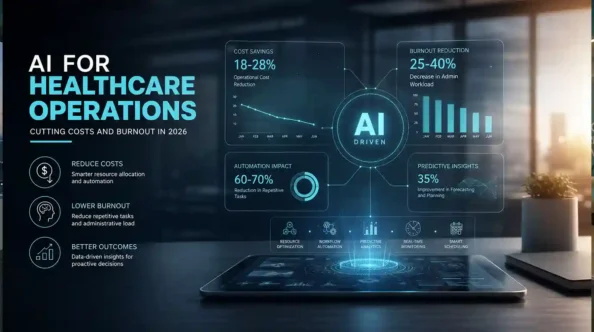
How Can AI Improve Healthcare Operations and Reduce Costs?
Resilient Data Layers for Autonomous AI
Prodevbase builds the foundational data architecture that autonomous AI systems require. Specifically, our engineering team constructs low-latency pipelines and specialized data environments. These advanced environments rapidly transform messy corporate data into structured, context-rich assets. Ultimately, enterprise AI applications fail without premium backend infrastructure. We design and deliver that technical foundation. A strong data foundation is also key to successful Intelligent Automation, helping businesses automate processes faster and make smarter decisions. So let’s know about How Can AI Improve Healthcare Operations?.
AI for Healthcare Operations: Cutting Costs and Burnout in 2026
Hospitals are facing an overwhelming administrative burden. This is not an exaggeration. Administrative work now eats up roughly a quarter of every dollar spent on healthcare in the United States. Because administration comprises around 25% of total healthcare costs, according to Jennifer Holloman, director of health IT policy at the American Hospital Association, it has naturally become a primary target for automation.
This is exactly where AI for healthcare operations comes into play. It is not about replacing doctors or nurses. Instead, it focuses on removing the paperwork, scheduling chaos, and billing delays that slow down medical teams.
Accordingly, this guide outlines what AI for healthcare operations means, where the technology is making the biggest difference in 2026, and how to begin implementation without disrupting patient care.
What Does AI for Healthcare Operations Actually Mean?
AI for healthcare operations refers to using artificial intelligence to run the business side of a hospital, clinic, or medical practice. Specifically, this includes managing scheduling, billing, staffing, supply tracking, and patient communication.
It is entirely different from clinical AI. In contrast to clinical AI, which helps doctors diagnose disease or read scans, operational AI helps the building run smoothly so doctors have time to do their core work in the first place.
Healthcare margins are exceptionally razor thin right now. For instance, hospital operating margins sat at just 1.5% at the end of 2025, according to data from Strata Decision Technology. This single number explains why so many hospital leaders are turning to automation. Consequently, there is very little room left to absorb rising costs any other way.
Furthermore, a critical workforce problem is driving this shift. Billing and coding staff, along with patient access teams, are retiring faster than organizations can replace them. Moreover, these roles have always been hard to fill, in part because the pay does not always match the required technical skill.
Why 2026 Is Different From Previous Years
Artificial intelligence in hospitals is not a brand-new concept. Decision support tools have actually existed since the 1980s. However, the modern shift is completely defined by its unprecedented scale.
Recent adoption numbers strongly back up this reality. A 2025 survey from the American Hospital Association and the Assistant Secretary for Technology Policy found that billing and scheduling are now the two fastest-growing AI use cases in healthcare. This tracks with what is happening on the ground. Hospitals are no longer asking whether to automate billing and scheduling. Instead, they are determining how fast they can roll it out.
Also read: How AI Agents Reduce Business Costs Without Sacrificing Growth
Most administrative AI tools today fall into a few clear categories:
- Generative tools that draft billing summaries, prior authorizations, and appeals.
- Automated coding software that reads clinical documentation and assigns billing codes.
- Scheduling algorithms that match staffing levels to predicted patient demand.
Each tool targets a specific operational bottleneck, rather than the whole organization at once. Consequently, adoption has accelerated because hospitals can start small and prove value quickly.
Where AI Is Making the Biggest Operational Impact
1. Automated Medical Coding
Coding has always been one of the slowest, most error-prone parts of running a healthcare practice. A single missed or mismatched code can delay reimbursement by weeks.
AI coding tools now read data directly from the electronic health record and assign diagnostic or procedural codes automatically. This significantly speeds up claims submission, which consequently means faster reimbursement. Crucially, this is not a fully hands-off process. When a tool generates a code that does not meet a set confidence threshold, it gets flagged for a human coder to review by hand. That human checkpoint matters because it keeps accuracy high while still removing the bulk of repetitive coding work.
2. Prior Authorization Support
Prior authorization remains one of the most tedious tasks in healthcare operations. It is slow, payer-specific, and often gets bounced back over a single missing form.
AI tools are now reading patient records alongside payer requirements to determine, in advance, whether a procedure or medication is likely to need prior authorization. From there, the system can draft the documentation a payer will need to see medical necessity clearly established. This matters even more given the push toward electronic prior authorization from the Centers for Medicare & Medicaid Services. Therefore, healthcare leaders stress that a clinician still needs to be in the loop, especially on appeals, since an undue administrative burden falls on hospitals and patients alike if authorizations get mishandled.
3. Clinical Documentation Support
Doctors did not go to medical school to type administrative notes. Yet documentation remains one of the top reasons physicians burn out and eventually leave the profession.
Ambient AI scribes listen to patient visits and generate structured clinical notes automatically, cutting down significantly on the time physicians spend writing after each appointment. The effect compounds. When a clinical note is complete and well-structured from the start, coders have what they need to bill accurately the first time. As a result, this narrows the documentation gaps that lead to downcoding and denied claims.
4. Smarter Staffing and Scheduling
Hospitals run on constantly shifting demand. Some days the emergency room is quiet, while other days it is completely overwhelmed. Predicting that swing has always been part art and part guesswork.
AI tools are now helping organizations forecast patient demand and recommend staffing levels that actually match it, rather than relying on static shift templates built around averages. Consequently, the result is fewer days where units are dangerously understaffed, and fewer days where staff are paid to sit idle.
5. Agentic AI for Care Coordination
The newest shift in 2026 involves AI agents that do not just answer questions but carry out multi-step tasks independently. One real example is a cancer-screening assistant built by Color Health in partnership with Google. This tool automates the early steps of breast cancer risk assessment, gathering eligibility information and routing complicated cases to a clinician for review.
A second type of agent now used in claims appeals reads denial letters, figures out what documentation is missing, and assembles the corrected paperwork for a nurse to approve. Ultimately, this is a meaningfully different category from older single-task automation because the agent coordinates several steps end-to-end, with a person checking the output before anything is finalized.
What Is Slowing Adoption Down?
Not every hospital is moving at the same speed, and that gap is worth understanding before beginning a deployment rollout.
Data quality remains the biggest blocker. Health system leaders consistently point to infrastructure and data governance, rather than the AI tools themselves, as the hardest part of scaling AI responsibly. According to Craig Joseph, Chief Medical Officer at Nordic Global Consulting, more than half of health IT leaders cite infrastructure and governance, not the AI itself, as their biggest barrier to adoption. If patient records are scattered across five disconnected systems, no AI tool fixes that constraint on its own.
Risk awareness matters just as much. Holloman draws a clear distinction between administrative use cases and anything that touches a clinical decision. This highlights why organizations need to know exactly where that line sits before automating a workflow.
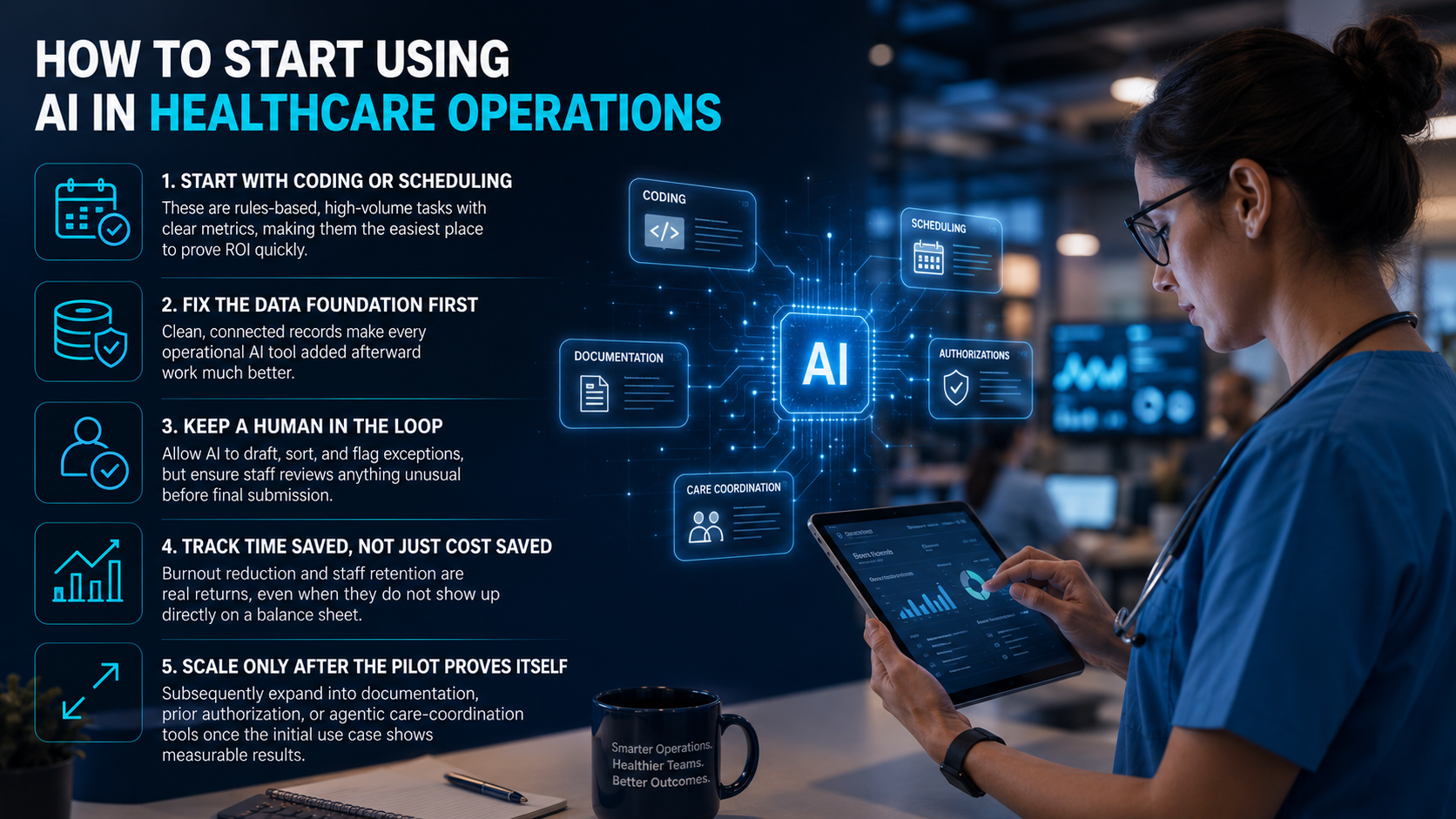
How Can AI Improve Healthcare Operations and How to Start Using AI
Overhauling an entire infrastructure at once is rarely necessary. Most successful rollouts follow a similar, structured pattern:
- Start with coding or scheduling: These are rules-based, high-volume tasks with clear metrics, making them the easiest place to prove ROI quickly.
- Fix the data foundation first: Clean, connected records make every operational AI tool added afterward work much better.
- Keep a human in the loop: Allow AI to draft, sort, and flag exceptions, but ensure staff reviews anything unusual before final submission.
- Track time saved, not just cost saved: Burnout reduction and staff retention are real returns, even when they do not show up directly on a balance sheet.
- Scale only after the pilot proves itself: Subsequently expand into documentation, prior authorization, or agentic care-coordination tools once the initial use case shows measurable results.
Conclusion
Implementing AI for healthcare operations is no longer an experiment running quietly in a single department. Automated coding, prior authorization, documentation, scheduling, and agentic care coordination are becoming the backbone of how modern hospitals function under tight margins and persistent staffing shortages.
The organizations seeing the biggest gains are not the ones chasing every new flash tool on the market. Instead, they are the ones treating automation as core infrastructure, starting with the highest-friction task, keeping a person in the loop, and building outward from there.
If a medical team is still buried in manual coding, scheduling conflicts, or prior authorization backlogs, the technology to fix those bottlenecks is already proven and running in hospitals right now. The only real question left is when to begin execution.