
How Can Agentic AI Architecture Transform Enterprise Operations?
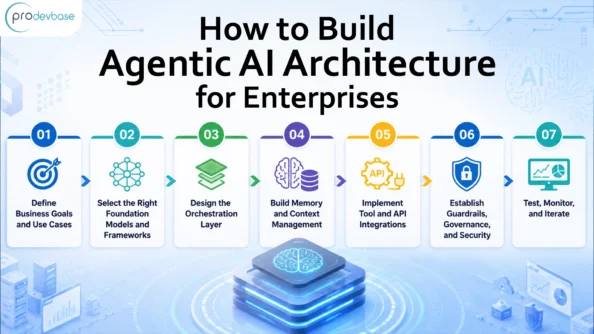
How to Build Agentic AI Architecture for Enterprises
Enterprise leaders are moving beyond simple chatbots and static automation scripts. Consequently, interest in agentic AI architecture has grown rapidly. This is because it allows software systems to plan, reason, and act with minimal human intervention. This guide breaks down what agentic AI architecture actually means. It also explains why it matters for large-scale business systems, and how technical teams can build one from the ground up. So let’s know about How Can Agentic AI Architecture for Enterprises?
What Is Agentic AI Architecture and How Can Agentic AI Architecture for Enterprises??
Agentic AI architecture is a system design. It gives artificial intelligence agents the ability to perceive information, reason about goals, and take autonomous action across connected tools and data sources. Unlike traditional rule-based automation, an agentic system does not simply follow a fixed script. Instead, it evaluates context, chooses among available actions, and adjusts its behavior based on outcomes.
In practice, this means an enterprise agent can read a customer support ticket and check inventory data through an API. It can then draft a response and escalate the case if needed. All of this happens without a human writing explicit instructions for each step. Because of that flexibility, enterprises across finance, healthcare, logistics, and retail sectors are exploring agentic AI. Their goal is to reduce manual workload while improving decision speed.
Core Components of an Enterprise-Ready Agentic AI System
Before diving into implementation, it helps to understand the building blocks. These are the pieces that make agentic AI architecture work at scale.
1. Foundation Model Layer
This layer includes the large language model or models that power reasoning and language understanding. Typically, enterprises choose between proprietary models, open-source alternatives, or a hybrid setup. This choice depends on cost, latency, and compliance requirements.
2. Orchestration Engine
The orchestration engine coordinates how agents plan tasks, call tools, and hand off work between sub-agents. Without this layer, a system cannot manage complex, multi-step workflows reliably.
3. Memory and Context Store
Persistent memory allows an agent to recall past interactions and retrieve relevant documents. It also helps maintain context across sessions. As a result, responses stay consistent and grounded rather than repetitive or disconnected.
4. Tool and API Integration Layer
Agents need access to external systems — CRMs, databases, ticketing platforms, payment gateways. This access lets them take real action rather than just generate text.
5. Governance and Guardrail Layer
Since autonomous decision-making carries risk, enterprise deployments need monitoring and permission controls. They also need fallback mechanisms to keep agent behavior within approved boundaries.
Also read: How Does Generative AI Improve Product Design? Key Benefits Explained
Step-by-Step Framework for Building Agentic AI Architecture
Building a production-ready agentic AI system involves careful planning. It should never mean jumping straight into code. Below is a practical framework enterprise teams can follow.
Step 1: Define Business Goals and Use Cases
First, teams should identify a narrow, high-value problem. It helps to avoid attempting to automate an entire department at once. For instance, automating invoice reconciliation or first-line customer triage tends to deliver measurable results faster than broad, undefined goals.
Step 2: Select the Right Foundation Models and Frameworks
Next, engineering teams evaluate which foundation models fit the required reasoning complexity, latency, and budget. Enterprise teams frequently use open frameworks such as LangGraph, AutoGen, or CrewAI to structure agent behavior. Custom-built orchestration still remains common in regulated industries.
Step 3: Design the Orchestration Layer
Afterward, architects map out how tasks flow between planner agents, worker agents, and evaluator agents. A well-designed orchestration layer prevents infinite loops and redundant tool calls. It also stops conflicting actions between agents working in parallel.
Step 4: Build Memory and Context Management
Subsequently, teams add a memory layer. Vector databases like Pinecone, Weaviate, or pgvector often power this layer. It lets agents retrieve historical context and company-specific knowledge accurately.
Step 5: Implement Tool and API Integrations
Once memory is in place, developers connect agents to internal systems through secure APIs. Each integration should include strict scope limits. This ensures an agent cannot perform actions beyond its intended permission level.
Step 6: Establish Guardrails, Governance, and Security
Equally important, enterprise deployments need audit logs and human-in-the-loop checkpoints for high-risk actions. Rate limiting also helps prevent runaway processes. Otherwise, autonomous agents can make costly or non-compliant decisions without oversight.
Step 7: Test, Monitor, and Iterate
Finally, before full rollout, teams should test agents against edge cases, adversarial inputs, and failure scenarios. After launch, continuous monitoring helps teams catch drift, hallucination patterns, or unexpected tool usage early.
Common Challenges in Enterprise Agentic AI Deployment
Even with a solid framework, enterprise teams often encounter obstacles. For example, legacy systems without modern APIs can slow integration efforts significantly. Similarly, data silos across departments make it difficult for agents to access unified context.
Meanwhile, compliance requirements in regulated sectors such as banking or healthcare add extra layers of review. Compliance teams must approve autonomous actions before deployment. Consequently, a phased rollout tends to reduce risk considerably. This typically starts with read-only or advisory agents before granting write access.
Why Partner With Prodevbase for Agentic AI Development
Building agentic AI architecture in-house requires specialized expertise. This spans machine learning engineering, backend infrastructure, and security compliance — skills that are not always available internally. This is where Prodevbase comes in.
Prodevbase works with enterprises to design, build, and deploy agentic AI systems tailored to specific operational needs. This ranges from customer service automation to internal workflow orchestration. Rather than offering a one-size-fits-all product, Prodevbase focuses on architecture that fits existing tech stacks, compliance requirements, and growth plans.
Additionally, Prodevbase provides ongoing support after deployment. This includes monitoring, fine-tuning, and scaling assistance as business needs evolve. For companies aiming to grow through intelligent automation, partnering with an experienced development team offers a practical path forward. This avoids absorbing the full technical burden internally.
Final Thoughts
Agentic AI architecture represents a meaningful shift in how enterprise software operates. It moves systems from static automation toward reasoning, planning, and acting independently. However, success depends heavily on thoughtful design: clear use cases, reliable orchestration, strong governance, and continuous monitoring.
Ultimately, enterprises that approach agentic AI with a structured, phased strategy tend to see stronger, safer, and sustainable outcomes. This holds true rather than rushing toward full autonomy.
Frequently Asked Questions
What is the difference between agentic AI and traditional automation?
Traditional automation follows fixed rules. Agentic AI reasons about context and adapts its actions dynamically based on goals and available tools.
Is agentic AI architecture safe for regulated industries?
Yes, provided teams build proper guardrails, audit trails, and human-in-the-loop checkpoints into the system from the start.
How long does it take to build an enterprise agentic AI system?
Timelines vary based on complexity. A focused pilot use case can typically launch within a few months when an experienced development team such as Prodevbase supports the effort.