
Building a Private Enterprise AI Assistant with Generative AI and AI Data Engineering
How to Develop a Private Enterprise AI Assistant Using Company Data
Why Companies Need a Private Enterprise AI Assistant
A private enterprise AI assistant takes the disparate bits of company knowledge and turns them into quick, reliable answers. This guide looks at how to build one safely and how to keep it accurate. So let’s know about how to build an AI Assistant Using Company Data.
Staff waste hours looking for policies, tickets, and reports. As a result, projects get bogged down, and people get increasingly frustrated. A private enterprise AI assistant addresses this issue as it can answer queries against internal documents in seconds. Public chatbots simply can’t deal with confidential files in any secure manner. Businesses therefore need an assistant that operates in a secure environment. That way, the sensitive data is kept out of the public model training.
Generative AI provides the linguistic ability, and AI data engineering provides the clean, well-structured data. That’s what creates a reliable digital colleague. In fact, the quality of the data is what determines the quality of each answer. This guide covers the architecture, the use cases, the steps, and the tools. It also shows how Prodevbase goes about enterprise AI projects. Once the guide has been read, a team will be in a position to plan a pilot with confidence.
What Makes an Enterprise AI Assistant Private
A private assistant keeps data within its own internal boundaries. For example, the model runs in a private cloud or on-premises. Likewise, access is governed by the existing company permission model. Prompts and responses are never used to train any public models.
Compliance teams are therefore very comfortable with the deployment. In addition, the audit logs will record who asked what so the reviewers can track each answer. Data is also encrypted at rest and in transit.
How Generative AI and AI Data Engineering Work Together
Large language models can understand and generate text. They don’t, however, have any knowledge of internal facts. Retrieval-augmented generation (RAG) is the solution to that. The system first performs a search of the approved documents. The model then produces a response based on the retrieved passages.
As the answer references sources, reviewers can check it straight away. Meanwhile, the knowledge base is kept up to date via the data pipelines. In short, it’s all engineering feeding the model and the model serving the user.
Why Clean Data Decides the Outcome
Bad data leads to bad answers. For instance, duplicates and out-of-date policies are a complete mess when it comes to retrieval. Similarly, scanned documents with no text are a complete black hole for information. So data engineers go through the data and clean it up, label it, and structure it before any model ever sees it. Once that solid foundation is in place, the assistant can build trust very rapidly.
Core Components of a Private Enterprise AI Assistant
Each assistant is built on six building blocks. If one of those blocks fails, then the quality of the answer drops. For that reason, teams should plan all six of them together.
- Data connectors – Pull content from SharePoint, Confluence, CRMs, ticketing systems, and databases.
- Ingestion pipelines – Clean, split, and tag documents so that retrieval remains accurate and relevant.
- Vector database – Stores the embeddings so that searching based on meaning is possible.
- Language model – Produces clear, natural answers from the passages it has retrieved.
- Access control layer – Applies role-based permissions so employees only see the content they are authorized to see.
- Monitoring dashboard – Tracks accuracy, speed, cost, and user feedback over time.
Practical Use Cases for a Private Enterprise AI Assistant
The value of an assistant is in its ability to solve day-to-day problems. For instance, support, HR, and finance teams spend hours looking for answers. A good assistant removes that friction and enables skilled staff to do the work that requires a human touch.
- HR helpdesk – An employee asks about the leave rules and is given an answer that contains a link to the policy.
- Customer support – The agents have suggested replies pulled from previous tickets and the product manuals.
- Sales enablement – The reps pull the case studies and the pricing rules during the live call.
- Legal review – Lawyers can go through thousands of contracts and find the relevant clause in seconds.
- IT service desk – The assistant deals with access requests by simply reading the runbooks.
- Finance reporting – Analysts query the report summaries in plain language and get the sourced figures.
Step-by-Step Process to Build a Private Enterprise AI Assistant
Step 1 – Define the goals and scope. Start with one department and a tangible outcome (e.g., faster response time). A focused scope will keep the first release under control.
Step 2 – Audit and collect the data. List all the sources, owners, formats, and sensitivity levels. Also remove the old files as early as possible, as old files will lead to wrong answers.
Step 3 – Build the data pipelines. Extract, clean, deduplicate, and chunk the documents. Afterward, generate the embeddings and load those into the vector store. Set up regular refreshes so that the new files get picked up automatically.
Step 4 – Select and deploy the model. Teams can go with a commercially available model that is hosted privately or an open-source one. Fine-tuning is optional, as retrieval often provides sufficient accuracy. Teams should also compare the latency and cost prior to making a selection.
Step 5 – Add security and governance. Enable single sign-on, encryption, audit logs, and masking of personally identifiable information. Likewise, establish clear retention rules and appoint an owner for each data source.
Step 6 – Test, launch and improve. Run a pilot with real users. Then go through the feedback, assess the quality of the answers, and tweak the prompts and data accordingly. Once the results are stable, roll it out to the other departments.
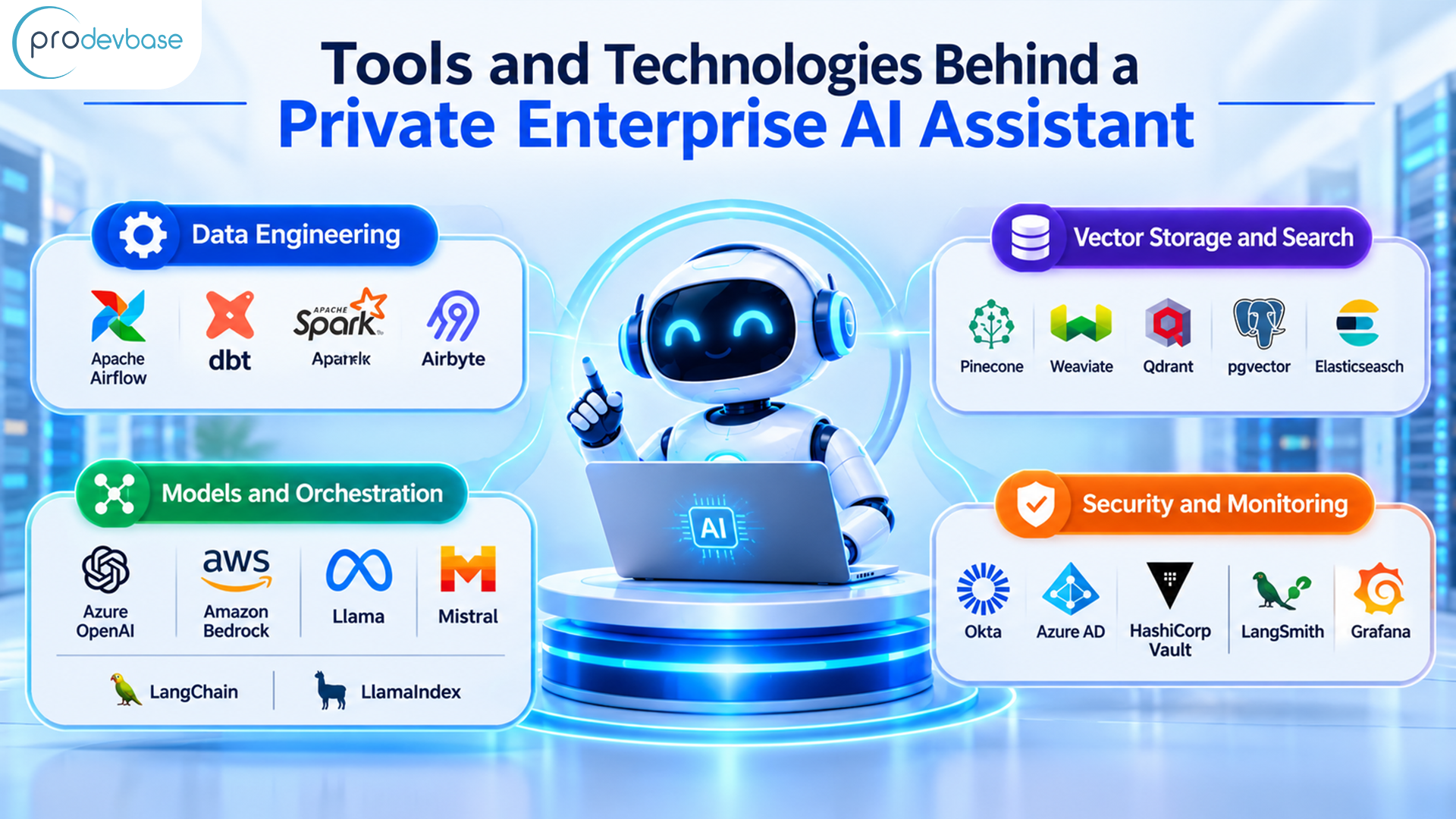
Tools and Technologies Behind a Private Enterprise AI Assistant
The right stack will obviously be dictated by the existing infrastructure and the compliance requirements. That said, there are a few categories that appear in nearly all projects. Each of those categories is solving a different problem, so they should be evaluated on their own merits.
- Data engineering – Apache Airflow, dbt, Spark, and Airbyte for extraction, transformation, and scheduling.
- Vector storage and search – Pinecone, Weaviate, Qdrant, pgvector, and Elasticsearch all provide fast vector search.
- Models and orchestration – Azure OpenAI, Amazon Bedrock, Llama, and Mistral provide the language capability, with LangChain and LlamaIndex providing the orchestration.
- Security and monitoring – Okta, Azure AD, HashiCorp Vault, LangSmith and Grafana.
Tool selection should be driven by the existing infrastructure. For example, a Microsoft shop is likely to go with Azure, while another may be inclined towards an open-source stack. Prodevbase helps teams evaluate the options and avoid vendor lock-in. In addition, the team builds pipelines that are designed to scale as the data grows. As a result, the assistant remains both accurate and cost-effective.
Ready to build a secure assistant for the business?
Book a free consultation today and turn internal knowledge into a trusted AI tool.
Conclusion
A private enterprise AI assistant is a very useful tool that turns internal knowledge into something genuinely useful. It will only work, though, if clean data, good security, and proper testing are in place. So start small, measure the results, and then scale up. Prodevbase provides AI services (including generative AI development and AI data engineering) to meet business needs. Get in touch with our team to discuss a secure pilot.