
Building Smarter Factories: Overcoming the Biggest Manufacturing Challenges
Custom AI and ML Development for Manufacturing: Use Cases, Benefits, and Implementation
What if a machine could report its own problems days before it fails? That is the idea behind Custom AI and ML development for manufacturing: models trained on a plant’s own equipment and data, so warnings arrive while there is still time to act.
Off-the-shelf software treats all plants alike, but plants differ. Therefore, this post covers the use cases that work, the benefits worth expecting, and the steps for starting a project.
What Custom AI and ML Development for Manufacturing Involves
A custom model trains on one facility’s own data. That includes its machines, its sensors, and its defect history. For example, a vibration pattern that signals trouble on a 20-year-old lathe may be normal on a new one. Only a model built around the actual equipment can tell the difference.
The raw material comes from familiar places. Sensors log temperature, pressure, and vibration. Cameras capture parts as they pass. Meanwhile, MES, ERP, and SCADA systems record orders, stoppages, and quality checks. A custom build ties these sources together. As a result, patterns surface that the human eye would miss.
The technique also changes with the problem. Time-series forecasting suits demand and energy loads. Anomaly detection suits equipment health. Computer vision handles inspection. Reinforcement learning occasionally appears in process control, although it is the rarest of the four.
Why Packaged Tools Often Miss the Mark
Ready-made platforms install quickly, and the demos look great. However, the trouble starts afterward. Those products learn from generic datasets. Consequently, odd machinery, product variants, and older controllers throw them off.
Integration is another snag. A single site may run PLCs from three different decades, and no standard connector handles that mix cleanly. Data policies add a further hurdle. Cloud-only products, for instance, sometimes fail security or contract requirements.
That is why manufacturers with specialized lines look for a build partner. Prodevbase develops custom AI and ML solutions for businesses that need models fitted to their own equipment and data instead of a generic package.
Use Cases That Deliver on the Factory Floor
Predictive Maintenance
Unplanned downtime ranks among the priciest problems in production. Predictive models watch vibration, motor current, and temperature drift. They catch early signs of wear. As a result, repairs move into planned stops. Bearings, pumps, motors, and CNC spindles are typical candidates.
Visual Quality Inspection
People get tired. Judgment shifts between the first hour of a shift and the eighth. Vision models, on the other hand, hold one fixed standard at line speed. They spot scratches, cracks, skewed labels, and weld flaws.
Custom training matters here because lighting, surface finish, and defect types differ by product. Edge deployment helps as well. A camera-side model can trigger a reject before the part moves on.
Demand Forecasting and Production Planning
Overproduction locks up cash. Underproduction delays orders. Forecasting models blend order history, seasonality, and supplier lead times. Planners then build schedules on evidence instead of instinct. Likewise, inventory models can set safety stock item by item rather than by broad category.
Process Parameter Optimization
Yield often hinges on small shifts in temperature, pressure, speed, or material mix. Machine learning can map how those variables interact. On an injection molding line, for example, a model might suggest setpoint tweaks that cut scrap. Engineers usually test the suggestions by hand at first. Once results hold up, the team can automate a portion of the adjustments.
Energy Management
Power is a heavy line item in metals, chemicals, and plastics. Models forecast load and spot idle machines that still draw current. They also push energy-hungry jobs into cheaper tariff windows. Cost savings and sustainability targets then move together.
Worker Safety Monitoring
Vision systems can flag missing helmets, entry into restricted zones, or a forklift closing in on a walkway. Alerts reach supervisors within seconds. Still, privacy rules and worker consultation need attention early, not after rollout.
Have a Specific Line or Machine in Mind?
Each plant starts with one problem worth solving. Prodevbase can review the equipment, data, and goals behind that problem, then outline a scoped pilot with clear success metrics. Book a consultation with Prodevbase and turn a single pain point into a working model.
Benefits of Custom AI and ML Development for Manufacturing
Well-scoped projects tend to pay off in a handful of places:
- Fewer surprise breakdowns, because the model predicts failures
- Lower scrap and rework, because defects surface near the source
- Steadier quality from shift to shift
- Planning based on plant data rather than gut feel
- Energy waste that becomes visible and measurable
- No forced replacement of working equipment
There is a long-term upside too. A custom model belongs to the business that funded it. It sharpens as fresh data arrives. In addition, a competitor cannot simply buy the same thing off a shelf.
How to Implement Custom AI and ML in a Plant
Small, staged projects fail less often than sweeping ones. Therefore, the order below works well.
1. Pick One Narrow Problem
First, choose a single pain point tied to a number, such as “cut unplanned stoppages on Line 3.” A goal like “add AI to operations” is too vague to test. A narrow target, however, guides every later choice.
2. Audit the Data
Next, take stock of what already exists. Check sensor feeds, maintenance logs, and inspection images. Look for gaps, mismatched timestamps, and missing labels. In fact, this step often shows that data collection needs an upgrade before modeling begins.
3. Build the Data Pipeline
Then connect machines and systems, commonly through OPC UA or MQTT. Clean the records, align the timestamps, and store everything securely. A solid pipeline heads off the headaches that appear later.
4. Prototype and Validate
After that, data scientists train candidate models. They test each one against past events, such as failures that already happened. Plant engineers should review the output. Floor experience catches errors that accuracy scores hide.
5. Pilot on One Line
Before a wider rollout, run the model live on a single line. Then compare results with the baseline. Prodevbase follows this pilot-first approach. As a result, value gets proven on a small scale before a plant commits to a larger investment.
6. Deploy and Integrate
Afterward, decide where the model runs. Edge hardware fits fast jobs like inline inspection. On-premise or cloud servers fit heavier analytics. Either way, output has to reach operators through dashboards, alerts, or the MES they already use. A model nobody sees does nothing.
7. Monitor and Retrain
Finally, keep watching performance. Tooling wears, suppliers change, and products evolve. Together, these shifts slowly erode accuracy. The industry calls this model drift. Scheduled retraining and basic MLOps practices keep it in check.
Common Challenges and Fixes
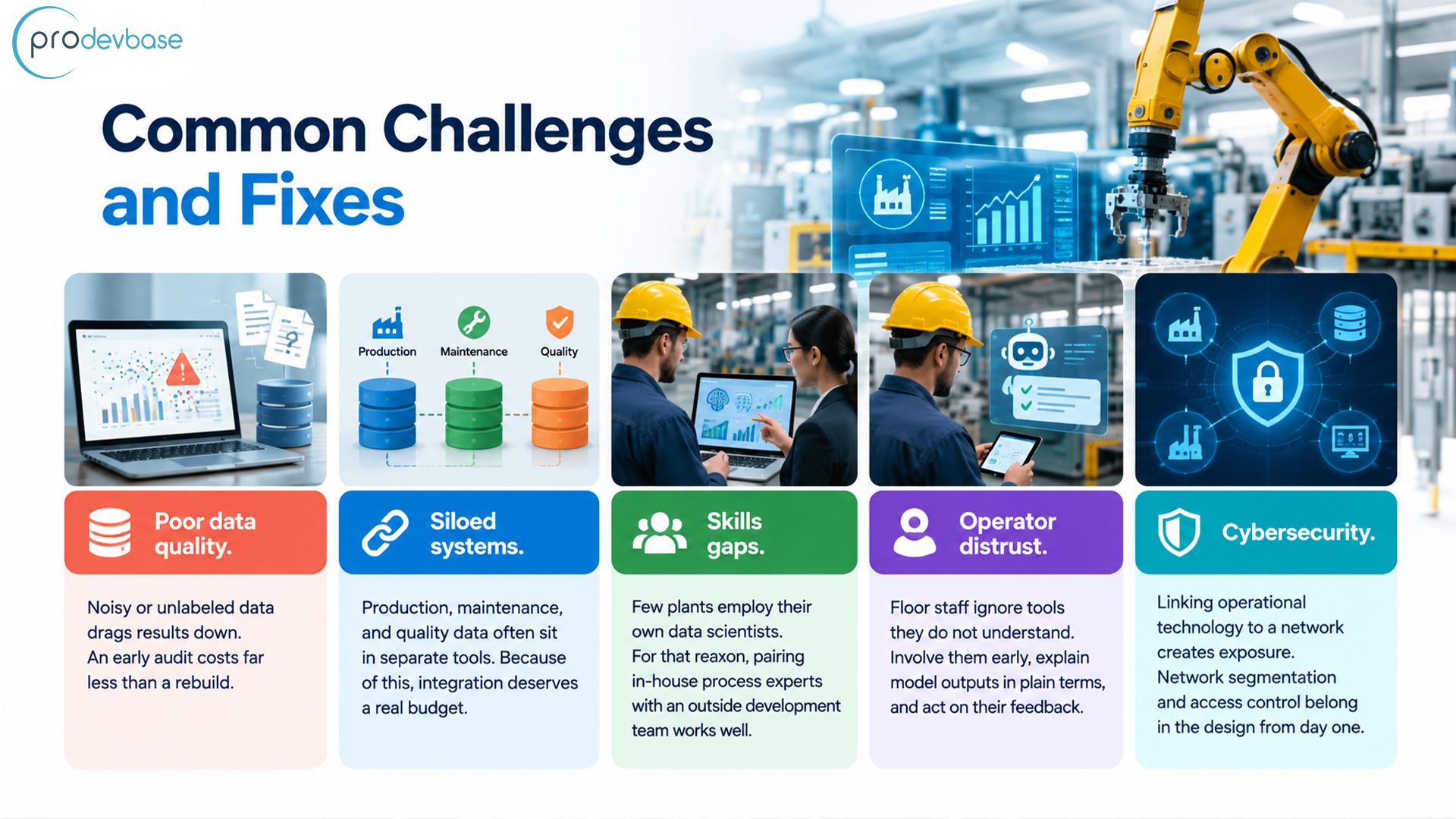
Poor data quality. Noisy or unlabeled data drags results down. An early audit costs far less than a rebuild.
Siloed systems. Production, maintenance, and quality data often sit in separate tools. Because of this, integration deserves a real budget.
Skills gaps. Few plants employ their own data scientists. For that reason, pairing in-house process experts with an outside development team works well.
Operator distrust. Floor staff ignore tools they do not understand. Involve them early, explain model outputs in plain terms, and act on their feedback.
Cybersecurity. Linking operational technology to a network creates exposure. Network segmentation and access control belong in the design from day one.
Also read: How Do Custom AI and ML Development Services Drive Growth?
Choosing a Development Partner
Technical skill counts, but manufacturing context counts too. A capable partner has worked with industrial data, edge deployment, and legacy equipment. Just as important, the team explains trade-offs plainly and commits to measurable outcomes.
Prodevbase pairs machine learning engineers with people who understand production environments. Consequently, models reach the floor instead of stalling as a proof of concept.
Final Thoughts
Manufacturing rewards precision. Custom AI and ML development for manufacturing applies that precision to maintenance, quality, planning, and energy use. The strongest projects start small, prove value on one line, and then expand.
Ready to Build a Model Around Real Machines and Real Data?
A scoped pilot is the fastest way to see what custom AI and ML can do on a factory floor. Prodevbase works with manufacturers to plan, build, and deploy models that fit existing equipment. Contact Prodevbase today to discuss a pilot built around the plant’s own goals.