
7 Common AI Product Development Pitfalls and How to Avoid Them

AI Product Development Pitfalls: Why AI Projects Fail
Building an AI product sounds exciting at first. However, the journey from idea to a working, reliable product is rarely smooth. Many businesses face AI product development pitfalls that can delay projects, increase costs, and reduce the chances of successful AI adoption. Partnering with experienced teams for AI Product Engineering Services helps organizations build scalable and reliable solutions.
Below, common pitfalls in AI product engineering are explored in detail. Additionally, practical ways to avoid them are shared, since prevention is always easier than a costly rebuild later. Prodevbase has seen these patterns repeat across industries, and therefore, this guide draws from real, hands-on engineering experience.
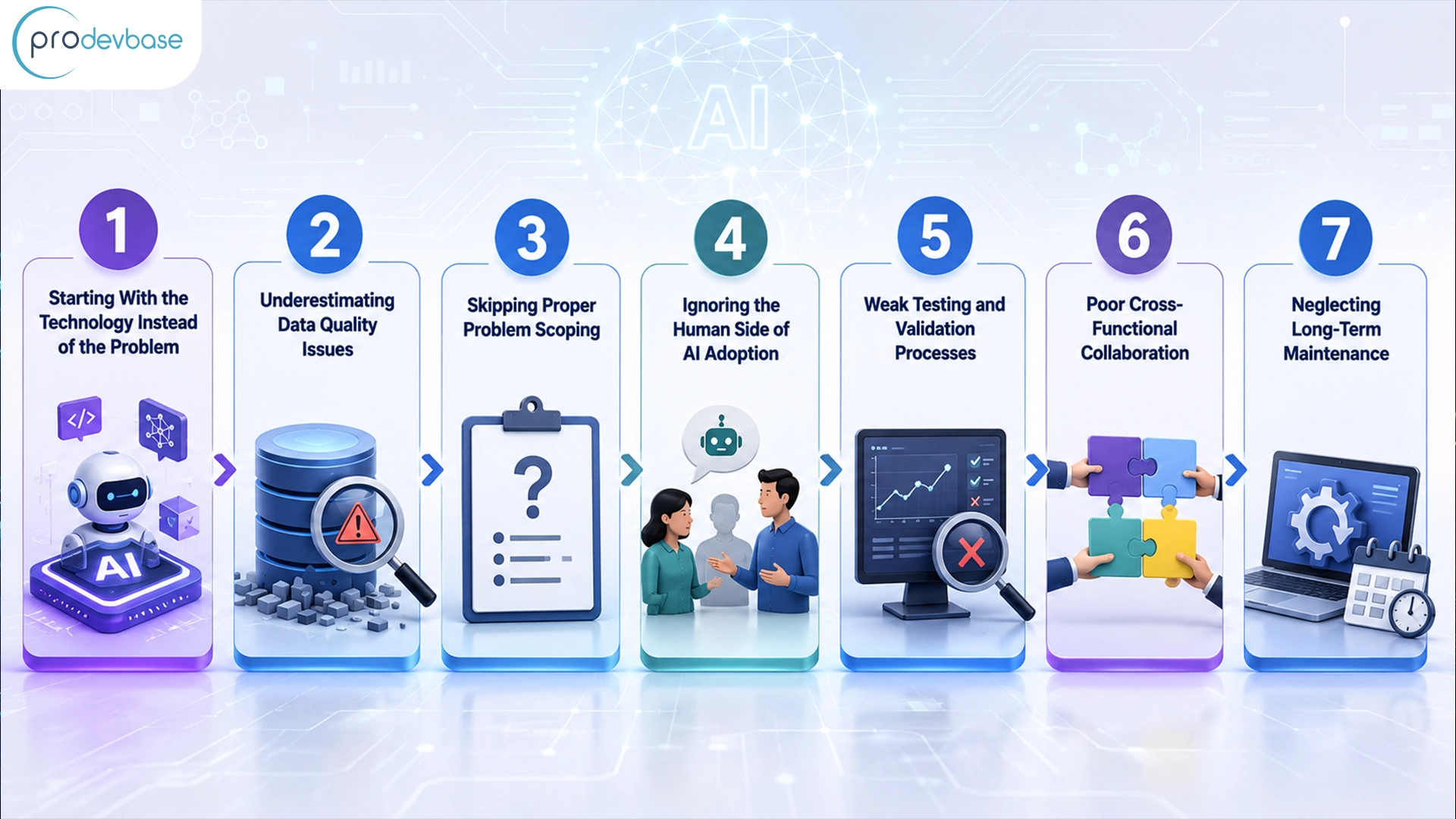
1. Starting With the Technology Instead of the Problem
To begin with, one of the biggest mistakes is choosing a model or framework before clearly defining the problem. As a result, teams end up with technically impressive systems that solve the wrong issue.
Consequently, this leads to wasted budgets and frustrated stakeholders. Instead, it helps to start with a clear business outcome. Then, teams can select the right AI approach to match that outcome. Prodevbase always begins engagements by mapping the desired outcome first, since this single step prevents a large share of downstream rework.
2. Data Quality Challenges in AI Product Development
Meanwhile, data quality is often treated as an afterthought. Nevertheless, poor data is one of the most frequent reasons AI products fail to perform in production.
For instance, incomplete records, inconsistent formatting, and biased samples can quietly damage model accuracy. Therefore, a thorough data audit should happen before any serious development begins. Similarly, ongoing data validation should continue throughout the product lifecycle, not just at the start.
3. Skipping Proper Problem Scoping
On the other hand, some teams try to solve too much at once. As a result, the scope keeps expanding, and the product never reaches a stable release.
In contrast, a narrower, well-defined scope tends to produce faster wins. Once that scope proves successful, teams can add additional features gradually. This phased approach reduces risk and, in addition, builds confidence among stakeholders early on.
4. Ignoring the Human Side of AI Adoption
Furthermore, technology alone does not guarantee adoption. Indeed, end users often resist tools they do not trust or understand.
To address this, clear communication about how the AI system works is essential. Moreover, training sessions and simple explanations of decision-making logic can build trust over time. Without this, even a technically sound product can sit unused.
5. Weak Testing and Validation Processes
In addition, testing AI systems is fundamentally different from testing traditional software. Nevertheless, some teams apply the same shallow testing methods to both.
As a result, edge cases go unnoticed until they surface in production. Instead, engineering teams should build rigorous validation, including stress testing on diverse data samples, into the process from day one. Prodevbase treats validation as a continuous cycle rather than a one-time checklist, which helps catch issues before they reach end users.
6. Poor Cross-Functional Collaboration
Similarly, AI product development requires close collaboration between data scientists, engineers, designers, and business stakeholders. However, silos frequently form, and communication breaks down.
Consequently, misaligned expectations creep in, and timelines slip. On the contrary, when teams collaborate closely and share regular updates, alignment improves significantly. As a result, the final product reflects both technical soundness and real business value.
7. Neglecting Long-Term Maintenance
Finally, a common pitfall is treating deployment as the finish line. In reality, AI models require ongoing monitoring, retraining, and fine-tuning as data patterns shift over time.
Otherwise, model performance can quietly degrade, a phenomenon often called model drift. Therefore, teams should build a maintenance plan into the roadmap from the very beginning, not add it as an afterthought once problems appear.
Also Read: Generative AI for Marketing Content: Scale Without Losing Brand Voice
AI Product Development Best Practices for Success
In short, avoiding AI Product Development Pitfalls requires more than writing algorithms. Successful AI products need careful planning, quality data, cross-functional teamwork, and a long-term mindset.
Prodevbase specializes in AI Product Engineering Services that help businesses navigate exactly these challenges. From problem scoping to deployment and long-term support, Prodevbase brings structured, experience-driven engineering to every stage of the process. Ultimately, that combination of strategy and execution is what separates AI products that thrive from those that quietly fade away.
Businesses looking to grow through reliable, well-engineered AI solutions can turn to Prodevbase for support at any stage of the journey.