
Can AI predict inventory shortages before they happen?
AI Solutions for Specific Business Problems: Stopping Stockouts Early
Why Inventory Shortages Keep Happening
Stockouts can reduce revenue, damage customer trust, and disrupt business operations. AI inventory forecasting helps businesses identify potential inventory shortages before they happen. By combining sales history, demand patterns, supplier performance, and market trends with advanced AI solutions for businesses, companies can detect stock risks early, improve inventory planning, and avoid costly disruptions.
Traditional planning is all about spreadsheets and fixed reorder points. However, demand can change in a flash and supplier delays can pop up at any time. Therefore, static rules simply don’t work when things change suddenly. Similarly, manual reviews are not going to be able to keep track of thousands of SKUs. That’s why the question now is: can AI be used to forecast stock risk using live data?
AI looks at the sales history, seasonality, supplier performance, and market signals all together. Then it produces a risk score for each product. As a result, the teams know which products they need to be looking at today. Besides, the models also get better as fresh data comes in.
How can AI predict inventory shortages early?
Firstly, the system pulls data from the ERP, the warehouse, and the sales platforms. Next, the algorithms look for patterns in demand and lead times. After that, the model goes on to forecast stock levels for the coming weeks. Finally, alerts get to the planners when the projected stock level falls below the safe level. Thus, we’re in a position where we can see a shortage before the shelf is actually empty.
Additionally, the model monitors external signals. For example, changes in the weather, holiday calendars, and port delays all have an impact on supply. Likewise, sudden spikes in online searches are a good indicator of rising demand. Because the system connects to stock levels, it can spot risk much earlier than a manual review could. So can AI predict a stock shortage? Yes, it can. It can do so by spotting the link between the various signals that a human would simply miss.
Where Traditional Methods Fall Short
Fixed safety stock is context blind. For example, a promotion, a weather event, or a port delay can all cause demand to change overnight. The same is true of human planners who can’t possibly be monitoring all the signals at any one time. AI, on the other hand, can process huge volumes of data in minutes. Consequently, accuracy goes up, and the amount of manual work goes down.
Also read: How to Implement AI for Revenue Leakage Detection
Key Benefits of AI-Powered Inventory Prediction
- Fewer stockouts – AI inventory forecasting identifies potential shortages early, giving teams time to reorder products before stock runs out.
- Lower carrying costs – Accurate predictions help businesses avoid excess inventory and use their working capital more efficiently.
- Better demand accuracy – AI models analyze seasonal patterns, market trends, and promotions to improve demand predictions.
- Faster decisions – Automated insights reduce manual spreadsheet work and help teams make quicker inventory decisions.
- Stronger supplier planning – Supplier performance and delivery lead times help businesses identify potential delays and plan purchases effectively.
- Happier customers – Consistent product availability improves customer satisfaction, builds trust, and encourages repeat purchases.
Real-World Use Cases for AI Inventory Forecasting
Indeed, predictive inventory tools work across all industries. Likewise, the same fundamental principle can be applied to any supply chain. The following are just a few examples of how businesses use this in practice today.
- Retail – A fashion chain will forecast size-level shortages prior to the start of a seasonal sale.
- Manufacturing – The factory will flag component gaps early on, which stops the line from stopping.
- Healthcare – A hospital forecasts medical supply demand during flu season.
- E-commerce – An online store will adjust its reorder quantities during the festival traffic spikes.
- Food and Grocery – A distributor tracks shelf life and demand in order to reduce spoilage and gaps.
- Automotive Parts – A dealer network will be forecasting spare part demand by region and model.
How to Implement AI Inventory Prediction
Step 1 – Define the problem: Firstly, work out which products or locations are the worst short on stock.
Step 2 – Audit the data sources: Next, look at the sales records, supplier data, and warehouse logs for quality and gaps.
Step 3 – Clean and integrate the data: Then merge all the sources into one reliable pipeline.
Step 4 – Build and train the models: Afterward, having established the historical demand and lead time patterns, go on to build the forecasting models.
Step 5 – Test and validate: Subsequently, compare the predictions against the actual results and tune the model as appropriate.
Step 6 – Deploy and monitor: Finally, link the alerts to the planning dashboards and keep a continuous eye on the accuracy.
Tools and Technologies for Predictive Inventory Management
Several tech layers are involved in enabling accurate prediction, and each one has a distinct role. Together, they form a robust forecasting system.
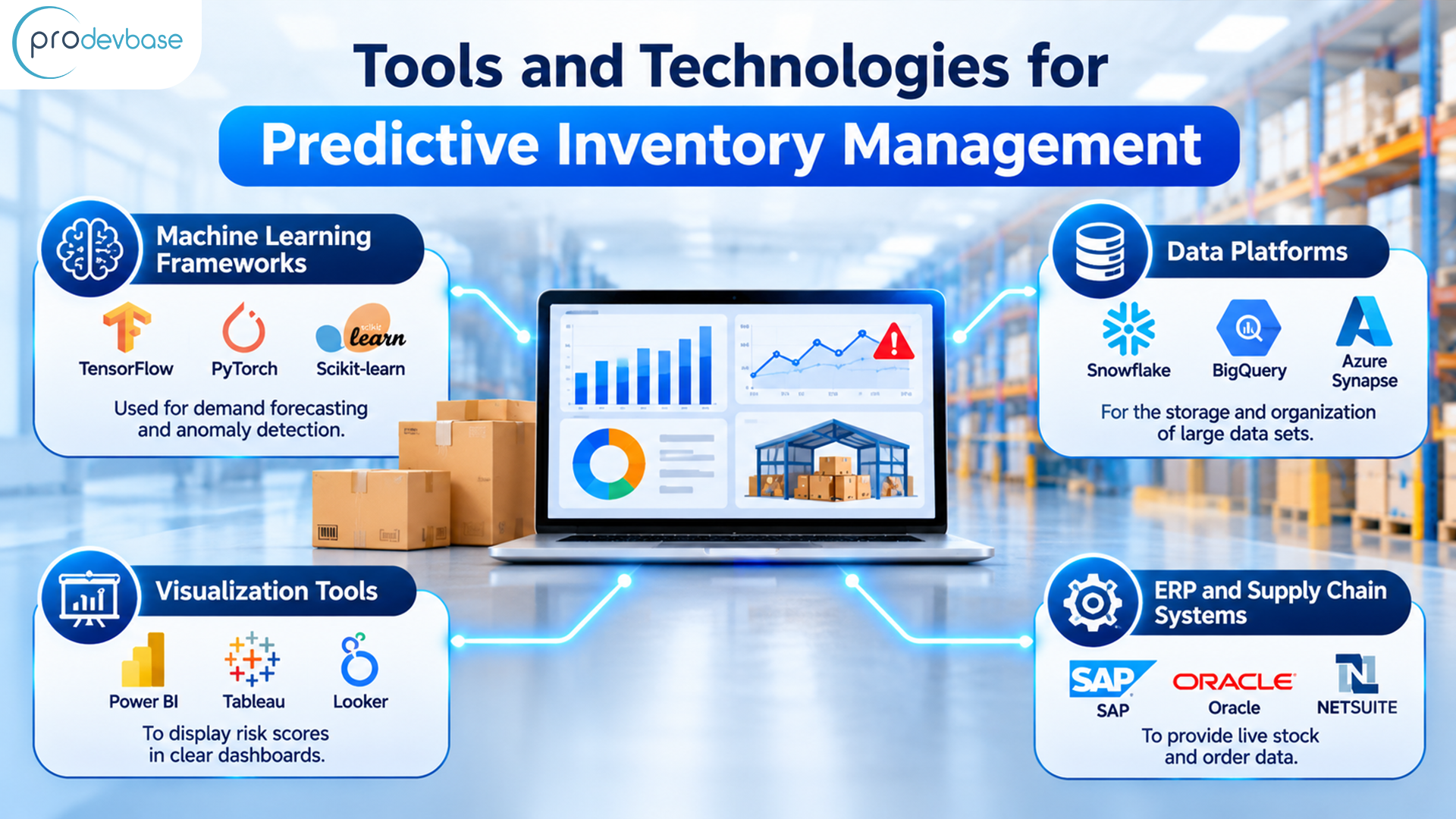
- Machine learning frameworks – TensorFlow, PyTorch and Scikit-learn are used for demand forecasting and anomaly detection.
- Data platforms – Snowflake, BigQuery and Azure Synapse for the storage and organization of large data sets.
- Visualization tools – Power BI, Tableau and Looker all have risk scores displayed in clear dashboards.
- ERP and supply chain systems – SAP, Oracle and NetSuite provide live stock and order data.
However, tools in themselves don’t solve the problem. It’s all down to clean data, clear objectives and proper integration. That’s why numerous organizations end up working with an experienced AI team. For example, Prodevbase builds bespoke forecasting models that plug straight into existing inventory systems. As a result, the business gets the right forecast without having to reinvent the wheel.
FAQs: Can AI accurately predict inventory shortages?
Can AI accurately predict inventory shortages?
Yes, though accuracy is dependent on data quality, model choice, and update frequency. Generally, a well-trained model will beat a fixed reorder rule. Additionally, accuracy will improve as fresh data comes in, so the results get better over time.
How far in advance can AI predict inventory shortages?
Normally, the models will flag risk quite a few weeks in advance. However, the length of the window will of course vary depending on the supplier lead times and the nature of the demand. For example, fast-moving items have a much shorter window than slow-moving items.
What data does AI forecasting require?
Firstly, the system needs sales history, current stock levels, supplier lead times, and promotion calendars. Seasonality and external signals (e.g., weather) are also useful. Therefore, clean and consistent records are of course key.
Is AI inventory forecasting appropriate for SMEs?
Absolutely. Cloud-based tools have massively reduced the cost of setup. Moreover, a small business can start with its best-selling products and grow from there. As a result, the investment remains very manageable whilst the benefits increase.
Ready to Prevent Stockouts?
Stock gaps do not have to disrupt operations. Prodevbase provides AI services that turn raw inventory data into early, actionable warnings. Contact the team today to book a consultation and explore a forecasting solution.
Conclusion
AI can predict inventory shortages before they happen. Moreover, it does so with speed and accuracy that manual methods cannot match. Businesses that adopt predictive forecasting reduce stockouts, cut costs, and protect customer relationships. Additionally, early action keeps supply chains stable during uncertain periods. Prodevbase offers AI services and forecasting solutions tailored to unique business needs. Start the conversation today, and move from reactive planning to confident, data-driven inventory control.