
From AI Spending to Real ROI: The Strategy Financial Firms Need

How AI Strategy Turns AI Investments Into Real Business Value for Financial Firms
Financial institutions have poured billions into artificial intelligence over the past few years. Chatbots, fraud detection engines, credit scoring models, algorithmic trading tools: the list keeps growing. Yet despite this spending spree, a large share of these projects never make it past the pilot stage. Why does this keep happening so let’s have a deep look into AI Strategy for Financial Services.
The Gap Between AI Spending and AI Value
Banks, insurers, and wealth management firms tend to approach AI the same way they approach any new software purchase. They identify a vendor, buy the tool, deploy it, and hope for results. Consequently, the technology arrives before the thinking does. Teams end up with a powerful model that has no clear owner. It also lacks a defined success metric and a plan to integrate with existing workflows.
As a result, the tool sits underused. Meanwhile, leadership starts questioning whether AI was worth the investment in the first place.
This is precisely where AI strategy and advisory work becomes essential. Rather than starting with the technology, a proper strategy starts with the business problem. That could mean fraud losses, slow underwriting cycles, compliance bottlenecks, or customer churn. From there, the work moves backward to figure out which AI capability actually solves it.
Why Financial Services Face Unique Challenges
Unlike retail or manufacturing, financial services operate under heavy regulatory scrutiny. Data privacy rules, anti-money-laundering requirements, and fair-lending laws all shape what an AI system is allowed to do. Therefore, an AI strategy built for a financial institution cannot simply mirror one built for an e-commerce brand.
For instance, a credit risk model has to be explainable to regulators. Accuracy alone isn’t enough. Similarly, a customer service chatbot handling account information has to meet strict data-handling standards. Without a strategy that accounts for these constraints from day one, projects often stall in legal review. In some cases, they get rejected entirely after months of development.
This is exactly the kind of friction a dedicated AI advisory partner helps financial firms navigate early. Prodevbase works specifically in this space, helping firms avoid wasting resources on approaches that were never going to clear compliance.
AI Strategy for Financial Services: What a Sound AI Strategy Actually Looks Like
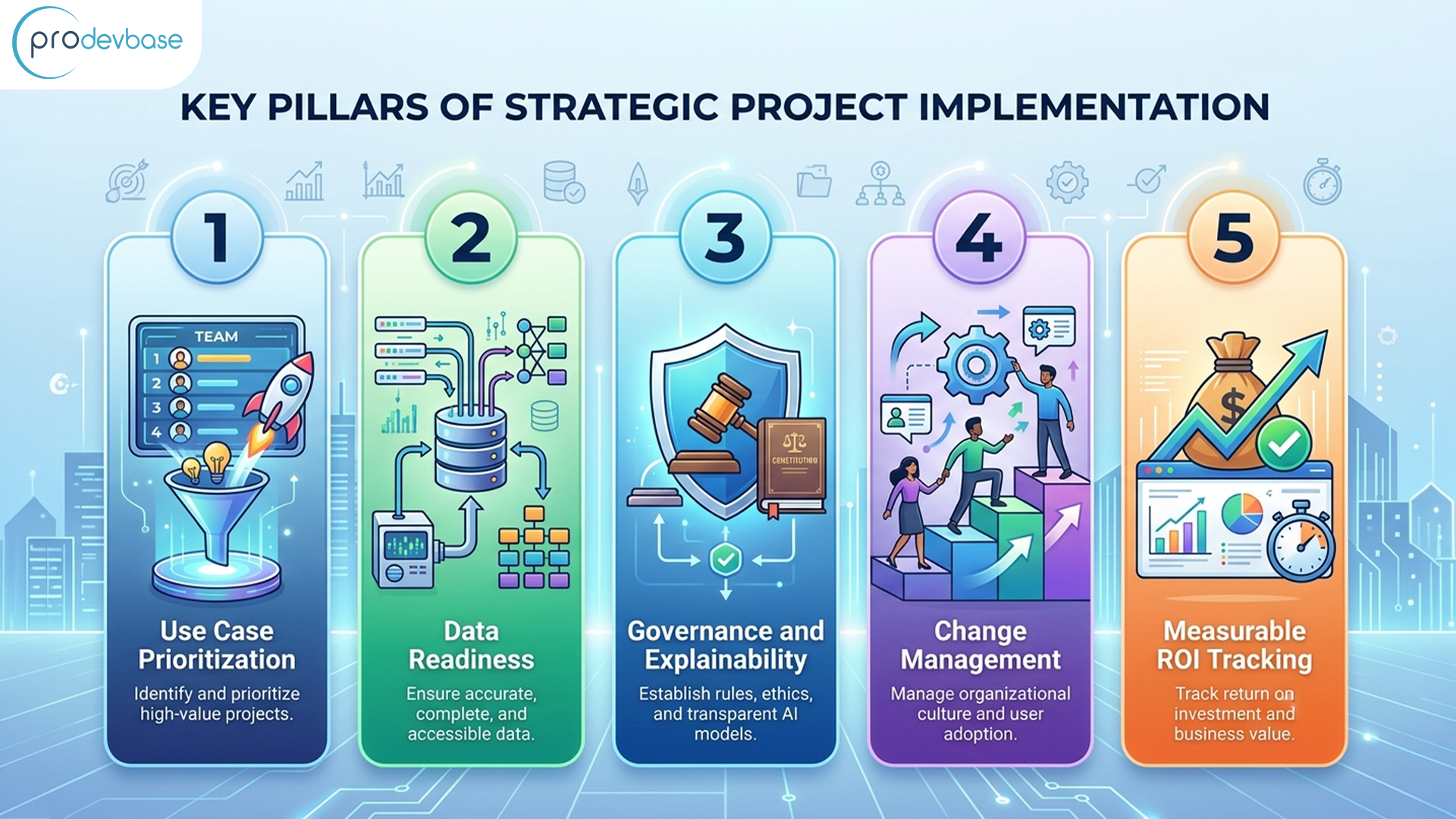
A workable AI strategy for a financial business tends to rest on a handful of pillars.
1. Use Case Prioritization
Not every AI idea deserves funding. A structured strategy ranks opportunities by feasibility, regulatory risk, and financial impact. As a result, effort goes toward initiatives with the clearest path to measurable return. This matters more than chasing whichever idea generated the loudest buzz in a leadership meeting.
2. Data Readiness
AI models are only as capable as the data feeding them. Legacy banking systems, disconnected databases, and inconsistent record-keeping are common obstacles. Consequently, a strategy phase has to include an honest audit of data quality before any model gets built. Otherwise, the output simply reflects the mess underneath.
3. Governance and Explainability
Given the regulatory weight on financial decisions, governance cannot be an afterthought. Model decisions need documentation, audit trails, and a clear chain of accountability. Otherwise, even a technically sound model becomes a liability. This happens the moment a regulator asks how a decision was made.
4. Change Management
Even the most accurate fraud detection system fails under one condition. If the fraud team doesn’t trust it or know how to act on its alerts, the tool becomes useless. Thus, strategy work has to include training and clear communication. A realistic adoption timeline matters just as much as the launch date itself.
5. Measurable ROI Tracking
Finally, every initiative needs a defined metric. That could be a reduced loss ratio, faster loan processing time, or lower customer acquisition cost. Without one, there is no way to prove the investment actually paid off. This step is often skipped. It is usually the reason leadership loses confidence in AI initiatives altogether.
Turning Strategy Into Execution
Strategy documents alone don’t move a business forward. Translating a roadmap into working systems takes close collaboration. Technical teams, compliance officers, and frontline staff all need to be involved. This handoff is where a large number of AI initiatives quietly fall apart. The plan looks solid on paper, but nobody owns the execution.
Prodevbase helps financial businesses bridge that exact gap between planning and deployment. Rather than handing over a slide deck and stepping away, the approach involves staying engaged through implementation. That way, the strategy actually reflects what gets built.
A Realistic Path Forward
AI adoption in financial services isn’t slowing down. If anything, competitive pressure is accelerating it. That said, speed without direction tends to produce expensive dead ends rather than real value.
A financial firm that pauses to build a genuine strategy first tends to move faster later on. This means addressing regulatory constraints, data readiness, and adoption planning upfront. Firms that skip this step often end up further behind than the ones that took the time.
Ultimately, the difference between an AI investment that pays off and one that gets shelved comes down to strategy. Firms that treat AI advisory as a foundational step, not an optional add-on, are the ones seeing measurable returns.
Prodevbase continues to support financial institutions through this exact process. That means identifying where AI genuinely fits, building governance around it, and staying involved until the value shows up on the balance sheet, not just in a pilot report.