
How to Develop an AI-Powered Recommendation System for E-commerce
AI Solutions for Specific Business Problems: Why Online Stores Need Smarter Product Discovery
In any one online store, there are thousands of products. So it takes a good deal of time and patience to find the right one. That is why AI-powered recommendation systems in e-commerce have become a fundamental business tool. In practice, the system examines shopper behaviour and then suggests appropriate products in real time. As a result, the stores achieve greater engagement and higher sales. So let’s know about AI Solutions for Specific Business Problems.
Conventional merchandising rules cannot keep up with changes in what shoppers intend to do. For instance, a fixed best-seller list shows the same products to every visitor. On the other hand, machine learning adjusts for each individual visitor. Moreover, it learns from clicks, searches, carts, and purchases. As a result, each session offers an opportunity to provide a personal experience.
Yet, creating such a system requires a well-thought-out plan. The business should first set definite goals that can be measured. Then, the business has to select the appropriate data and models. After that, the system has to be tested and improved continuously. This guide sets out the entire process, step by step.
How Recommendation Engines Work
A recommendation engine is able to predict the products that a shopper is likely to want next. It usually makes use of three different methods. The first is collaborative filtering, which compares shoppers who have similar behaviour. The second is content-based filtering, which matches the attributes of products to a shopper’s past interests. Finally, hybrid models combine both of these methods in order to achieve greater accuracy.
Moreover, modern engines apply deep learning to images, text, and sequences of actions. For example, a model will find that shoppers who look at running shoes tend to search for socks afterwards. On this basis, the engine can make the appropriate suggestion at the right time.
The Business Problem Behind Poor Product Discovery
Low conversion rates are usually due to poor discovery. When customers can’t quickly find relevant items, they leave. Likewise, irrelevant suggestions damage trust in the shop. Moreover, abandoned carts increase when customers get no useful advice.
Personalization is now essential since it has a direct effect on bounce rates, small basket sizes, and low rates of repeat purchases. In fact, relevant suggestions keep shoppers engaged for a longer period. Engaged shoppers end up making purchases.
Also read: How to Protect Sensitive Business Data When Using Generative AI
Key Benefits of an AI Recommendation System
- Higher conversion rates follow since relevant suggestions reduce the distance between browsing and buying.
- The average order value is higher because the smart cross-sell and upsell suggestions add useful products to the cart.
- Better customer retention follows because shoppers are given a reason to come back based on personal experiences.
- Cart abandonment drops since timely reminders and alternatives have brought hesitant buyers back.
- Inventory movement improves since slow-moving products are now visible to the appropriate audience.
- Customer insights that are actionable show what behavior patterns indicate trends, which in turn inform decisions about pricing, stocking, and campaigns.
Practical Use Cases for E-commerce Recommendations
Recommendation models appear at a number of points throughout the shopping journey. Likewise, each of those touchpoints addresses a specific business issue. The examples below illustrate the clear value that the technology provides.
- A fashion store displays jackets that are currently trending to a customer who has previously looked at outerwear when they return to the homepage.
- Next to a newly released phone, an electronics retailer shows suggestions for products such as chargers and cases.
- A grocery platform offers pasta sauce when the customer’s cart includes spaghetti.
- The beauty brand sends out an email and a push message to alert customers that a serum they prefer is running out of stock.
- The ranking of search results: a home décor store ranks sofas according to customers’ preferences for style rather than on popularity alone.
- After the customer has received the book, the bookstore suggests the following title in the series.
How to Develop an AI-Powered Recommendation System: Step-by-Step Process
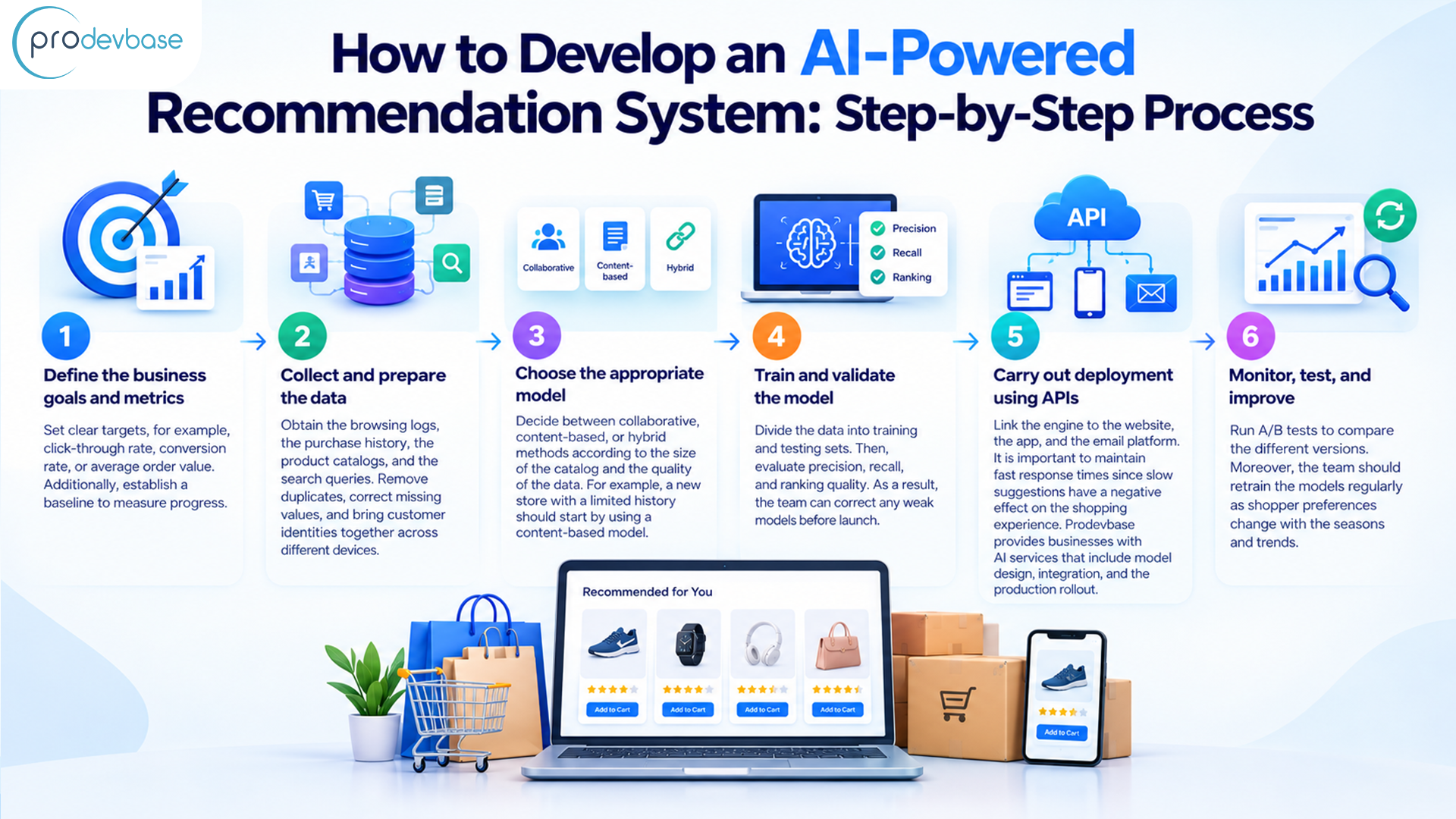
In the first step, define the business goals and metrics by setting clear targets, for example, click-through rate, conversion rate, or average order value. Additionally, a baseline must be established so that progress can be measured.
- Define the business goals and metrics – Set clear targets, for example, click-through rate, conversion rate, or average order value. Additionally, the business must establish a baseline to measure progress.
- Collect and prepare the data – Obtain the browsing logs, the purchase history, the product catalogs, and the search queries. Then remove any duplicates, correct the missing values, and bring the customer identities together across different devices.
- Choose the appropriate model – Decide between collaborative, content-based, or hybrid methods according to the size of the catalog and the quality of the data. For example, a new store with a limited history should start by using a content-based model.
- Train and validate the model – Divide the data into training and testing sets. Then, evaluate precision, recall, and ranking quality. As a result, the team can correct any weak models before launch.
- Carry out deployment using APIs – Link the engine to the website, the app, and the email platform. It is important to maintain fast response times since slow suggestions have a negative effect on the shopping experience. Prodevbase provides businesses with AI services that include model design, integration, and the production rollout.
- Monitor, test, and improve – Run A/B tests to compare the different versions. Moreover, the team should retrain the models regularly as shopper preferences change with the seasons and trends.
Tools and Technologies for Building Recommendation Engines
Using the correct technology stack cuts down on development time and increases reliability. As a result, teams ought to select tools that are appropriate for both the size of the project and the skill level of the workforce. The categories listed below serve as a good starting point.
- TensorFlow, PyTorch, and Scikit-learn provide support for model training and experimentation.
- Library recommendations such as LightFM, Surprise, and TensorFlow Recommenders make it easy to implement collaborative and hybrid methods.
- Platforms for data and streaming, such as Apache Spark, Kafka, and BigQuery, are capable of managing large numbers of events and real-time pipelines.
- Managed options are available from Cloud AI services such as Amazon Personalize, Google Cloud Recommendations AI, and Azure AI in order to speed up launches.
Privacy should also receive careful consideration since consent management, data minimisation, and secure storage serve to protect both shoppers and the brand’s reputation. Similarly, explainable models enable the teams to understand the reason why a product has been suggested. Thus, trust increases on both the business and the customer side.
Ready to Customize the Shopping Experience?
The online competition favours those shops which understand their customers. Prodevbase assists retail brands in converting raw data into profitable recommendations. Get in touch with the team now to arrange a custom AI roadmap.
Conclusion
A recommendation system that uses AI addresses a definite problem, namely the need for shoppers to have access to appropriate options quickly. It also increases revenue, boosts customer loyalty, and improves operational efficiency. Businesses can set up a dependable system by sticking to a systematic approach and then enhancing it over time. Prodevbase provides AI development, data engineering, and personalisation solutions that are adapted to the requirements of businesses. Why not start discussing it now and create a smarter store that shoppers will enjoy?