
How AI Is Reshaping Financial Operations and Customer Experience
Generative AI in Finance: Use Cases, Benefits and How Financial Businesses Can Implement It
Money has always run on information. Whoever processes it fastest and most accurately tends to make the better call. That’s basically why generative AI caught on so fast in finance. After all, data, risk, and speed all run through this industry at once, and the technology happens to be built for exactly that.
Old-school automation followed rules somebody wrote down and never revisited. Generative AI, however, works differently. It drafts reports, writes customer emails, runs through “what if” scenarios, and can even produce working code on request. Since one missed pattern in a spreadsheet can cost a firm millions, this kind of capability isn’t just convenient. In fact, it’s fast becoming table stakes.
This piece covers where the technology is actually being used in finance today, what’s changing for the people working with it, and, ultimately, a realistic way for financial businesses to bring it in without making a mess of it.
Why Finance Picked This Up So Fast
Banks and investment firms sit on piles of messy data. For instance, earnings call transcripts, regulatory filings, loan paperwork, and customer complaints buried five replies deep in an email thread all pile up fast. Naturally, older software chokes on that kind of text.
Generative AI, on the other hand, gets through thousands of pages in about the time it would take a person to skim a dozen. So the job changes. Instead of digging through documents looking for one clause, an analyst now reviews what got flagged and makes the actual decision. In other words, the tedious part gets handled by the machine, while the judgment stays with the person.
Also read: How Healthcare Organizations Can Build Responsible Generative AI Solutions
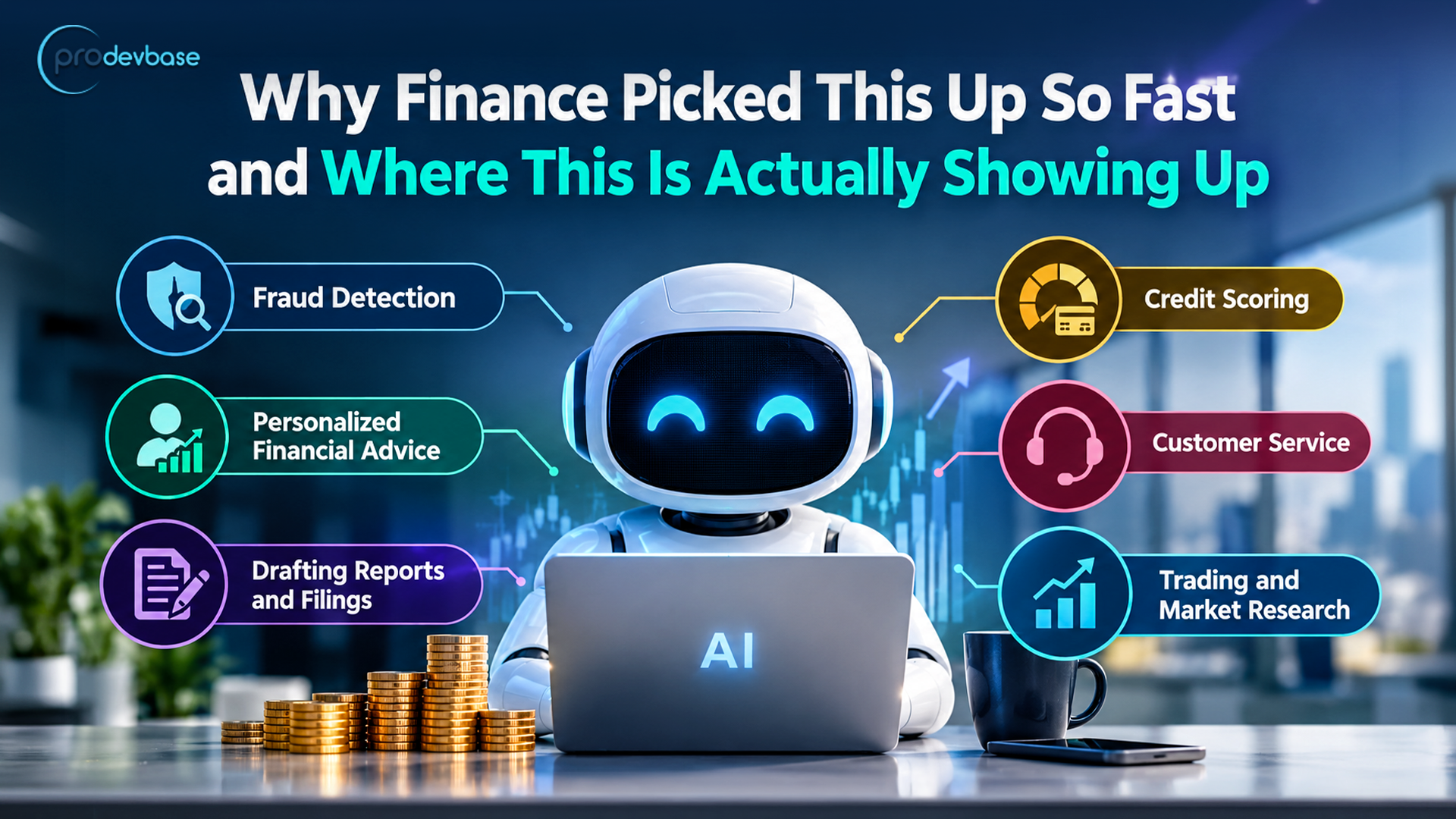
Where This Is Actually Showing Up
Fraud Detection
To begin with, fraud tactics shift fast, faster than anyone can realistically write a rule for. Generative models simulate thousands of transaction scenarios at once and catch things that don’t match any known pattern, simply because the fraud is new and no rule exists for it yet. As a result, the model adjusts on its own instead of waiting for someone to notice and update a list somewhere.
Personalized Financial Advice
Admittedly, robo-advisors aren’t new, but what they can explain is. Rather than slapping a “moderate risk” label on a portfolio and calling it done, these tools now walk through why a specific mix actually fits someone’s situation, in plain language, with no finance degree required.
Drafting Reports and Filings
Similarly, quarterly reports and compliance filings eat hours nobody’s excited to spend. Here, generative AI pulls from live data and puts together a first draft, so a reviewer edits instead of staring at a blank page. That’s real time saved, especially when several filings land the same week.
Credit Scoring
By comparison, traditional credit models look at a fairly narrow slice: income, credit history, and debt ratio. Generative AI opens that up by also factoring in spending habits, cash flow, and seasonal income swings. That’s particularly useful for people whose paychecks aren’t the same every month. In turn, underwriting moves faster without getting sloppy.
Customer Service
Meanwhile, chatbots used to be genuinely annoying: rigid, scripted, and thrown off the moment a question was phrased slightly wrong. Fortunately, that’s mostly fixed now. Generative models handle odd phrasing fine, walk someone through loan terms step by step, and know when to bring in an actual person instead of looping the same three canned answers.
Trading and Market Research
Likewise, traders use this to condense sentiment from news, earnings calls, and macro data into something readable in seconds instead of hours. Again, it’s not replacing a trader’s judgment. Rather, it makes sure the research is sitting there, ready, by the time the decision actually has to get made.
What Financial Businesses Are Getting Out of It
First and foremost, speed shows up. Work that took a team hours now takes a fraction of that, so people spend more time acting on information and less time digging for it.
Additionally, costs drop. Data entry, first-pass compliance checks, and drafting are all examples of work that no longer needs someone doing it by hand.
Moreover, risk models get sharper. Since a model tracks more variables at once than a person reasonably can, the result typically means fewer blind spots in the final assessment.
Customers, too, notice the difference. Fast, specific answers build trust, especially with people who expect service to feel immediate rather than waiting two business days for an email back.
On top of that, compliance gets a little less nerve-wracking. Gaps get flagged as they show up instead of surfacing six months later during an audit nobody wanted to sit through.
Altogether, that’s a fairly compelling case for why adoption keeps climbing instead of leveling off.
Ready to Explore Generative AI for Finance?
Generative AI can help financial businesses streamline operations, improve customer experiences, and work more effectively with complex data. Prodevbase helps turn these possibilities into practical solutions built around specific business needs, existing infrastructure, and compliance requirements.
Talk to Prodevbase about building a Generative AI solution for your financial business.
The Part Worth Taking Seriously
That said, none of this is risk-free. Since financial data is sensitive by nature, privacy concerns are real and aren’t going anywhere. Furthermore, regulators are still figuring out how to handle this technology, which means the rules keep shifting while businesses try to build on solid ground.
Then there’s hallucination. Generative models can sound completely sure of themselves while being flat wrong. Most industries can shrug that off; finance, however, really can’t. Because a wrong number in a report or a misread clause in a filing can trigger real financial damage, human review has to stay in the loop. That part isn’t optional.
In short, the technology itself isn’t the risky part. Skipping the oversight is.
A Realistic Way to Roll This Out
First, pick one use case instead of trying to overhaul everything at once. Automating internal report drafts or upgrading a customer service bot both work well as a starting point. Afterward, get that running smoothly before touching a second project.
Next, check the data before touching the model. Since generative AI is only as good as what feeds it, financial businesses need clean data and a clear read on which regulations apply, for example, GDPR, SOC 2, or PCI DSS, depending on where they operate.
Also worth doing: find a partner who’s actually done this before. Because building it in-house means hiring specialized talent that’s expensive and hard to hold onto, working with an experienced provider usually pays off. Prodevbase, for one, works with financial businesses to build generative AI systems around their specific operations, covering everything from data architecture through model integration, so internal teams aren’t stuck figuring out the technical side solo.
After that, run a pilot and track what actually matters: accuracy, time saved, and customer satisfaction. Consequently, those numbers, not a gut feeling three weeks in, should decide the next move.
Finally, once the pilot proves itself, scale it slowly. Even then, anything touching compliance or customer money still needs a human checkpoint built in.
Where Prodevbase Comes In
Overall, rolling out generative AI inside a regulated industry like finance isn’t something to wing. It takes real technical depth, a genuine understanding of compliance requirements, and experience with systems that hold up once they’re live, not just in a demo. Prodevbase brings that combination to financial businesses trying to move past experimentation into something that actually runs day to day, built around the infrastructure that’s already there instead of tearing it out and starting over.
Final Thoughts
To sum up, generative AI isn’t going anywhere in finance. It’s already changing how decisions get made, how risk gets measured, and how customers get served. The businesses pulling ahead aren’t necessarily the ones with the biggest budgets. Rather, they’re the ones that picked a clear starting point, took compliance seriously from day one, and found the right partner to build with.
For financial businesses ready to take that step, Prodevbase brings the technical know-how to turn generative AI from a talking point into something that actually works and holds up.
Turn Generative AI Into Business Impact
Ready to move beyond experimentation and explore what Generative AI can do for your financial business? Prodevbase helps financial businesses design, integrate, and scale Generative AI solutions built around their operations and goals.
Connect with Prodevbase to explore your Generative AI opportunity.