
From Data Chaos to Smart Operations: Building a Reliable Foundation for AI in Manufacturing

AI Data Engineering for Manufacturing: Building the Data Foundation for Smarter Operations
A bottling plant runs a predictive maintenance pilot. In the demo, the model flags a failing motor two days ahead, and everyone claps. But a week after go-live, the alerts turn noisy, and nobody can say why. The culprit was tiny. The sensors logged local time, the maintenance system logged UTC, and one breakdown showed up with two timestamps hours apart. So let’s have a look at AI Data Engineering for Manufacturing.
The model was fine. The data wasn’t. That gap is what AI data engineering for manufacturing deals with, so this post walks through what the work involves, why plant data is so stubborn, and how a factory can build a base that models can trust.
What AI Data Engineering Involves on a Plant Floor
Put simply, it’s the job of collecting, cleaning, labeling, and delivering data so machine learning can use it. In a factory, that data comes from PLCs, sensors, SCADA, MES, quality systems, and ERP.
Reporting is a different animal. A dashboard can refresh every fifteen minutes, and nobody complains. A model that watches bearing vibration can’t wait that long. It also needs readings that stay consistent from week to week. Say a firmware update quietly changes a sensor’s units. A dashboard shows an odd chart, and an operator shrugs. A model, on the other hand, learns the wrong lesson and keeps going.
Why Factory Data Is So Messy
Old and new machines share the same floor. A press from the 1990s might only speak Modbus, while a newer CNC exposes OPC UA. Sensors send readings several times a second, yet lab results arrive once per batch. As a result, the timing never lines up.
Then there’s the org chart. Operational technology (OT) teams keep machines running, whereas IT teams handle networks and databases. They use different tools for the same thing.
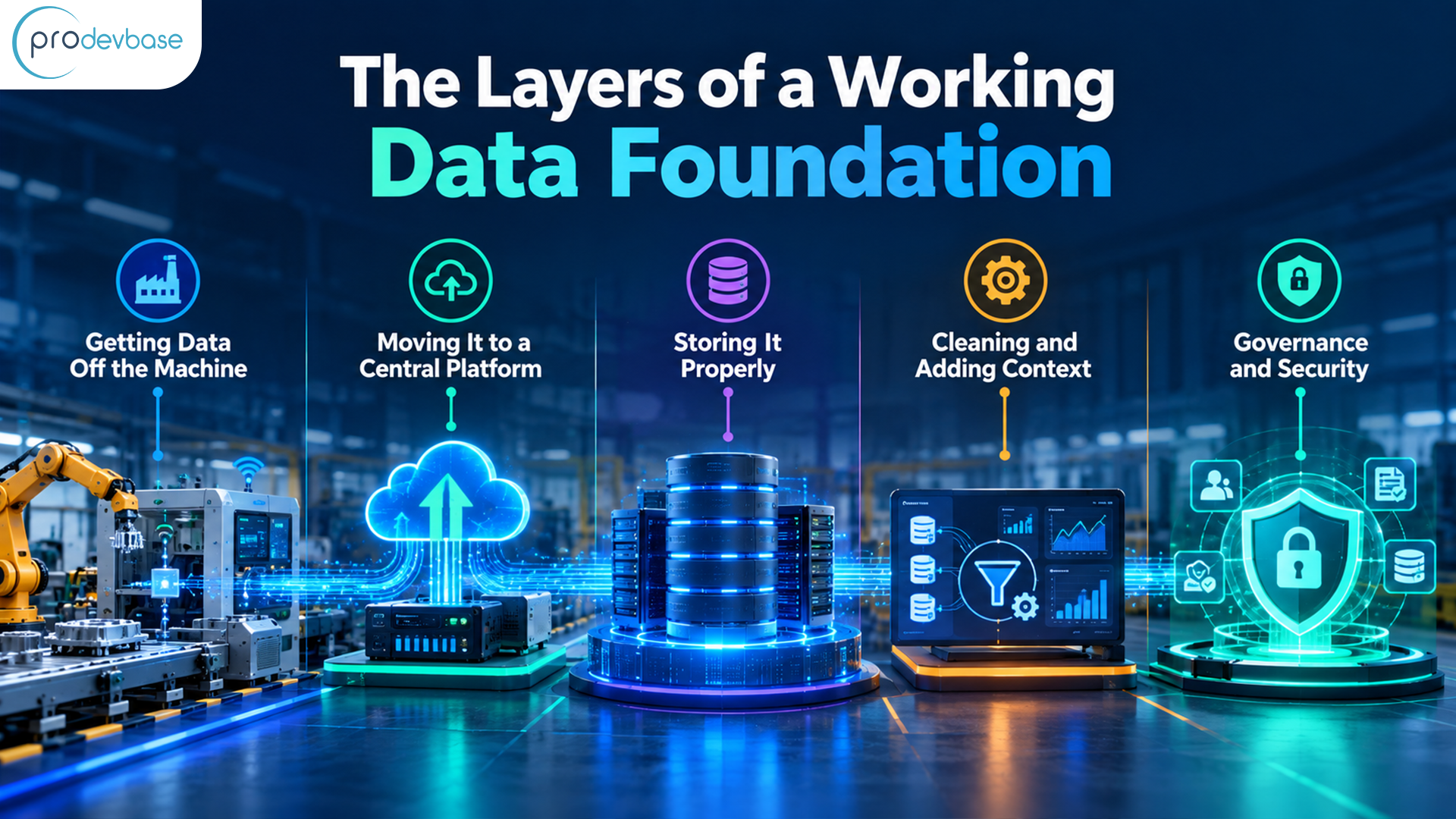
The Layers of a Working Data Foundation
Getting Data Off the Machine
Edge gateways sit right next to the equipment. They pull readings from PLCs and sensors through OPC UA, MQTT, or older protocols. When the network drops, they hold the data and send it later, so gaps stay small. They can also strip out noise early, which trims bandwidth costs.
Moving It to a Central Platform
Streaming tools like Apache Kafka carry continuous sensor feeds. Meanwhile, scheduled batch jobs pull records from MES and ERP. Both routes matter. A vibration spike alone says little, but placed beside a maintenance log entry, it starts to explain something.
Storing It Properly
Time-series databases and historians fit sensor streams well. A data lake or lakehouse then holds raw and curated data side by side. Splitting it into a raw zone, a cleaned zone, and a business-ready zone takes effort up front. Still, it pays off the first time a number looks wrong, because an engineer can trace it back one step at a time.
Cleaning the Data and Adding Context
Automated checks should catch flatlined sensors, impossible values, and duplicate records before a model ever sees them. Context is the other half of the job. Each reading gets linked to an asset, a product, a batch, and a shift. An asset model or a unified namespace makes that repeatable, so the next project doesn’t begin from scratch.
Governance and Security
Each dataset needs a named owner. Access rules and lineage tracking keep things orderly after that. Security counts too, because linking plant networks to cloud services opens new doors for attackers. The IEC 62443 series is the standard reference for that risk.
Curious About the Condition of the Plant’s Data?
Prodevbase runs data readiness reviews for manufacturers. The review shows what’s usable, what’s broken, and what deserves attention first. Get in touch with Prodevbase to set up a conversation.
Also read: AI Data Engineering in Finance: Powering Smarter Financial Decisions
What Changes Once the Foundation Is Ready
After the pipelines settle down, AI projects stop feeling like experiments.
Predictive maintenance is the obvious case. Models need vibration, temperature, and motor current readings that match repair records. Once they do, failure patterns become learnable.
Quality inspection follows the same logic. Computer vision works better when each image carries a batch number and the process settings behind it. Defects can then be traced to a cause instead of being flagged and forgotten.
Energy tracking works similarly. Meter readings only mean something beside the production schedule. With that pairing, idle-time waste and odd load spikes stand out fast.
Planning improves as well. When demand signals, machine availability, and material data live in one place, planners can react within hours, not days.
Mistakes That Keep Repeating
Well-funded projects still trip over the same things:
- Picking a model before looking at the data
- Leaving plant engineers out of design talks
- Building a separate pipeline for each use case
- Dropping data quality monitoring after launch
- Connecting all machines at once
That last one hurts the worst. Small, focused rollouts usually win, since problems surface while they’re still cheap to fix.
A Practical Order of Operations
- Begin with one use case that has a clear payoff, like cutting unplanned downtime on a single line.
- Audit the data sources. Check what exists, how clean it is, and who owns it.
- Build a minimal pipeline from the edge to storage, then test it on live production data.
- Add quality checks and context. After that, reuse the same patterns on the next line or plant.
This order delivers a working result early. It also builds goodwill with plant teams, who tend to back projects that fix daily frustrations.
Where Prodevbase Fits
Prodevbase provides AI data engineering services for manufacturers that need a dependable base under their models. The team designs edge-to-cloud pipelines, builds lakehouse architectures, and sets up automated quality monitoring. Plant engineers stay involved throughout, so the pipelines match how machines actually run rather than how the diagrams say they run.
Closing Thoughts
Smarter operations rarely start with a clever algorithm. They start with clean, connected, well-labeled data. AI data engineering for manufacturing produces exactly that, and plants that build it first tend to see quicker results and fewer nasty surprises once the demo is over.
Ready to turn machine data into a working advantage? Contact Prodevbase and start building a data foundation for steadier operations.