
AI Workflow Automation for Small Business: Work Smarter, Reduce Costs, and Grow Faste
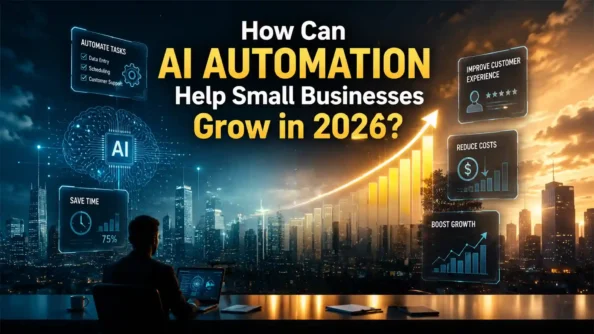
How Can AI Automation Help Small Businesses?
AI Is Changing How Small Businesses Work
Small businesses are constantly looking for ways to improve productivity, reduce expenses, and deliver better customer experiences. But with limited teams and growing responsibilities, managing daily operations can become overwhelming. So let’s have look at How Can AI Automation Help Small Businesses?
From responding to customer inquiries and managing invoices to tracking sales and handling repetitive administrative work, many business owners spend valuable time on tasks that do not directly contribute to growth.
This is where AI workflow automation for small business is creating a major shift.
Unlike traditional automation tools that only follow fixed instructions, AI-powered workflow automation can understand information, make decisions, and complete tasks with less human involvement.
Today, small businesses are using AI automation solutions to streamline operations, improve efficiency, and compete with larger organizations without increasing costs.
What Is AI Workflow Automation?
AI workflow automation is the process of using artificial intelligence to automate business tasks, connect different systems, and improve everyday workflows.
Traditional automation works based on predefined rules. For example:
“When an email arrives → send a reply.”
AI workflow automation goes further by understanding context.
An AI-powered system can:
- Analyze customer requests
- Identify important information
- Recommend actions
- Update business systems
- Complete multi-step workflows
- Learn from previous interactions
This helps businesses move from simple automation to smarter, more flexible operations.
Why Small Businesses Need AI Automation
For many small businesses, growth comes with new challenges.
As the customer base increases, companies often face:
- More customer support requests
- Increasing paperwork
- Slow approval processes
- Manual reporting tasks
- Employee workload pressure
- Higher operational costs
Hiring more employees is not always the best solution.
Instead, AI for small business automation helps existing teams work more efficiently by handling repetitive tasks and allowing employees to focus on activities that require creativity and decision-making.
The goal is not replacing people. The goal is helping people work better.
Key AI Workflow Automation Use Cases for Small Businesses
1. AI Customer Support Automation
Customer expectations have changed. People want quick answers and smooth communication.
However, small businesses may not have enough resources to provide 24/7 customer support.
With AI customer support automation, businesses can use intelligent assistants to handle common customer requests.
AI can help with:
- Answering frequently asked questions
- Providing product details
- Tracking customer requests
- Scheduling appointments
- Routing complex issues to the right employee
This reduces response time while allowing support teams to focus on important customer conversations.
2. AI Sales and Lead Management Automation
Generating leads is only the first step. Managing and converting those leads requires consistent follow-up.
Many businesses lose opportunities because leads are not contacted at the right time.
AI sales automation helps businesses:
- Capture leads automatically
- Analyze customer behavior
- Prioritize high-value prospects
- Send personalized follow-ups
- Update CRM systems
Sales teams can spend less time managing data and more time building relationships.
3. AI Marketing Workflow Automation
Marketing requires regular effort, but creating campaigns manually can consume a lot of time.
AI-powered marketing automation helps small businesses manage:
- Email campaigns
- Customer segmentation
- Content planning
- Customer engagement
- Campaign performance tracking
AI can identify customer preferences and help businesses deliver more relevant messages.
This improves engagement and creates better marketing outcomes.
4. AI Automation for Finance and Accounting
Financial tasks are essential but often repetitive.
Small businesses spend many hours managing:
- Invoices
- Payments
- Expense tracking
- Financial reports
- Data entry
With business process automation using AI, these activities can be completed faster and with fewer errors.
AI-powered systems can:
- Extract invoice information
- Categorize expenses
- Detect unusual transactions
- Generate reports
This gives business owners better visibility into their finances.
5. AI Employee and HR Workflow Automation
Managing employee-related tasks manually can slow down operations.
AI automation can simplify:
- Employee onboarding
- Document processing
- Internal requests
- Leave management
- HR communication
By automating administrative work, companies can create smoother employee experiences.
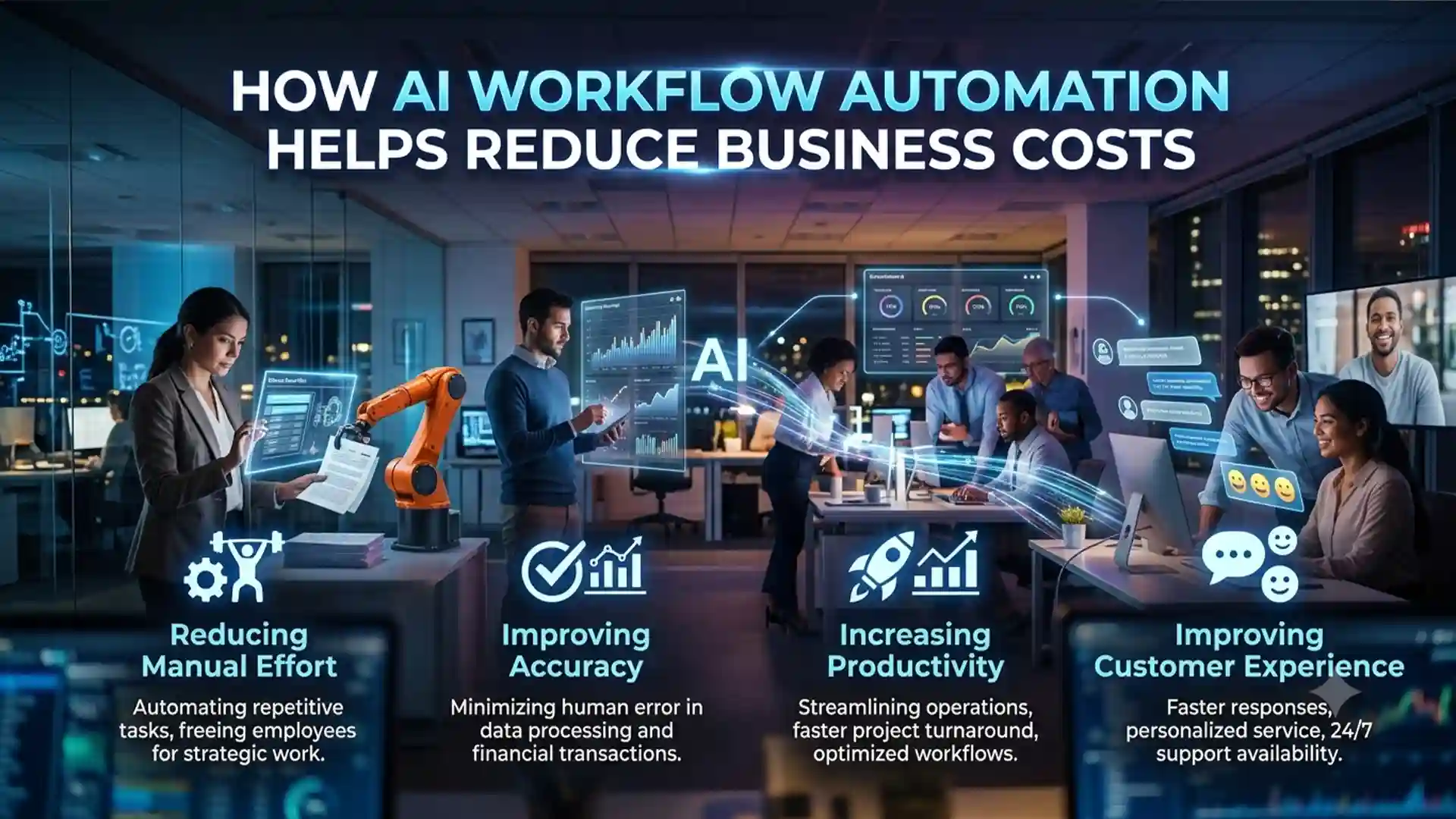
How AI Workflow Automation Helps Reduce Business Costs
One of the biggest advantages of AI automation for businesses is cost optimization.
AI helps reduce costs by:
Reducing Manual Effort
Employees spend less time on repetitive work and more time on business growth activities.
Improving Accuracy
Automation reduces mistakes caused by manual data entry and repetitive processes.
Increasing Productivity
Teams can complete more work without increasing operational expenses.
Improving Customer Experience
Faster responses and personalized service improve customer satisfaction and retention.
AI Workflow Automation vs Traditional Automation
Traditional automation is useful for simple repetitive processes, but it has limitations.
| Traditional Automation | AI Workflow Automation |
|---|---|
| Works on fixed rules | Understands context |
| Handles repetitive tasks | Handles complex workflows |
| Needs manual updates | Learns from data |
| Limited decisions | Provides intelligent recommendations |
This makes AI workflow automation a better choice for businesses that want long-term scalability.
How to Start AI Automation in Your Small Business
Successful automation does not mean automating everything immediately.
Start with areas where automation creates the biggest impact.
Identify Time-Consuming Tasks
Look for activities that take hours every week.
Examples:
- Customer emails
- Reports
- Data management
- Scheduling
Choose the Right AI Solution
Select tools that match your business goals and existing systems.
Start Small and Scale
Begin with one workflow, measure results, and expand gradually.
Also read: The Best Intelligent Automation Strategies in 2026?
Focus on Business Outcomes
The purpose of AI is not technology adoption.
The purpose is:
- Saving time
- Reducing costs
- Improving customer experience
- Growing faster
The Future of AI Automation for Small Businesses
AI is no longer limited to large enterprises.
Small businesses are now adopting AI-powered business automation to compete in a faster digital environment.
Future AI systems will help companies:
- Manage complete workflows
- Make faster decisions
- Predict customer needs
- Improve operational efficiency
Businesses that adopt AI early will have a stronger advantage as automation becomes a standard part of daily operations.
How ProDevBase Helps Small Businesses With AI Automation
At ProDevBase, we help businesses transform manual processes into intelligent workflows.
Our AI automation solutions help organizations:
- Automate repetitive business tasks
- Improve workflow efficiency
- Reduce operational costs
- Enhance customer engagement
- Build scalable digital operations
From AI strategy to implementation, we design solutions that fit your business needs.