
Integrate AI Agents Into Existing Business Applications: A Practical Guide
AI Agent Integration for Businesses: Make Your Existing Software Work Smarter
Why Teams Integrate AI Agents Into Business Software
Businesses that are able to integrate AI agents into their existing software will get faster workflows without having to do a complete rebuild. The agent will plan the task, use the tools, and act to achieve the goal. That’s the difference between an agent and a simple chatbot, really. It goes from conception to completion. That’s why agentic AI is such a good fit for CRMs, ERPs, and support platforms. So let’s have a look about AI Agent Integration for Businesses.
For instance, an agent could read a CRM record, compose a reply, and update the ticket. The net effect is that agents are spending less time on repetitive tasks. They also log each action so management can see what’s happened and why.
The market for agentic AI is continuing to grow. If you’re not in it, then you’re going to be left behind. The problem with a rush to market is that you’re going to make mistakes. You absolutely need to get it right from day one.
Why Rebuilding From Scratch Rarely Makes Sense
Legacy platforms have all sorts of data and have proven workflows. You don’t want to go out and replace them, as that’s going to take time and money. The alternative is to have agents sitting on top of the existing software via APIs and connectors. The platform itself remains as it is; the core is stable, and you’re just adding the new intelligence.
Business Benefits When Teams Integrate AI Agents
Firstly, response times go down as the agents are working 24/7. Secondly, operating costs go down as there are fewer manual steps required to complete routine tasks. Finally, customer satisfaction goes up as the service becomes faster and more consistent. The same applies to the employees, who are then free to focus on the creative and strategic work.
Also read: How to Connect Multiple Business Systems Using AI Agents
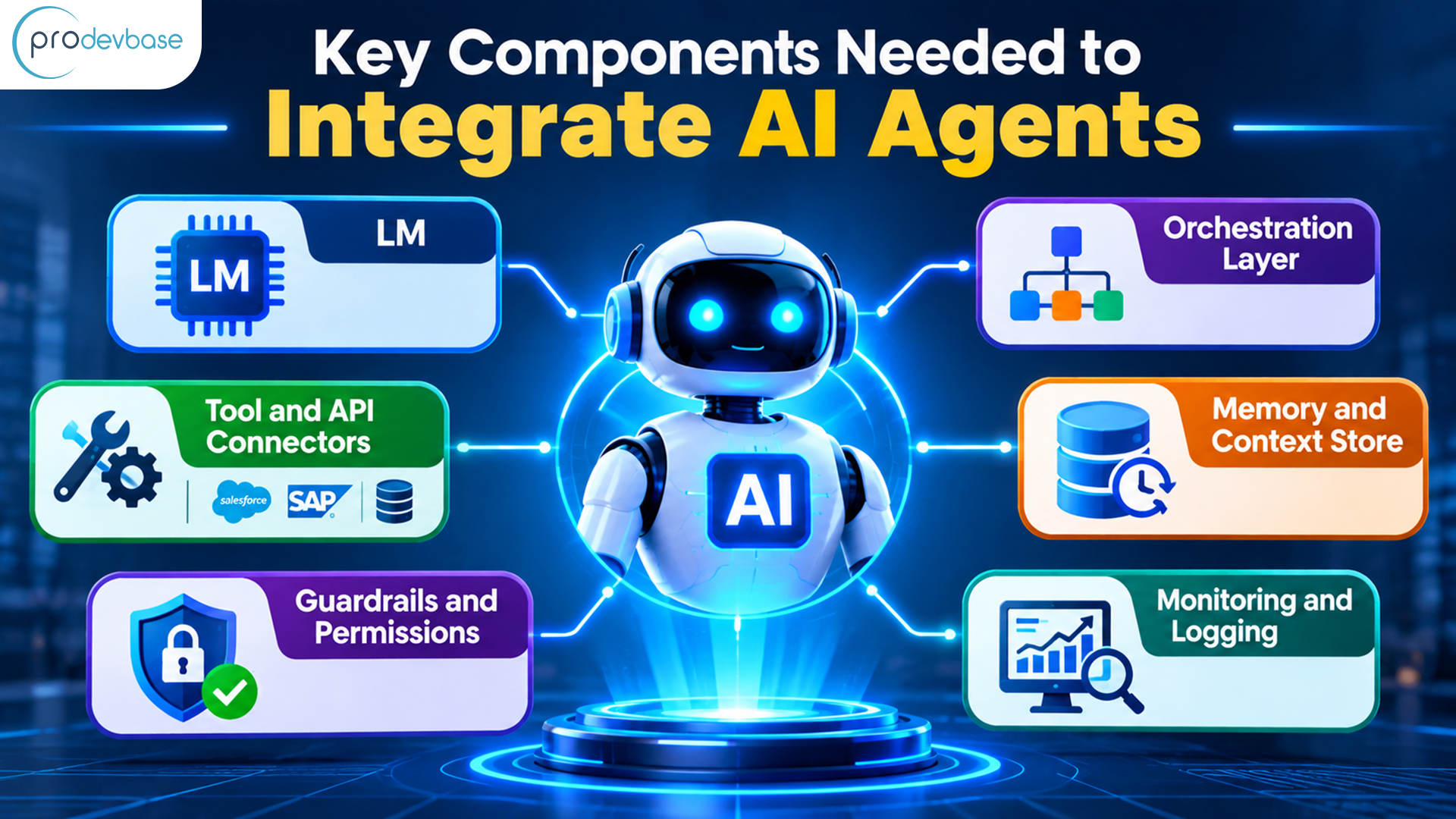
Key Components Needed to Integrate AI Agents
- LM: The model is the reasoning engine. It interprets the request and determines the next action.
- Orchestration Layer: This layer is responsible for task ordering and agent roles. Complex workflows therefore run in a predictable sequence.
- Tool and API Connectors: Connectors allow agents to reach CRMs, ERPs, and databases. You can’t have an agent acting within any existing software without them.
- Memory and Context Store: The stored context allows the agent to remember past interactions. That, in turn, means the responses remain relevant and personalized.
- Guardrails and Permissions: Access rules will limit what an agent is allowed to read and what it’s allowed to change. Similarly, approval steps will protect against certain sensitive actions.
- Monitoring and logging: Dashboards track performance, cost, and errors. Teams can therefore fix things before the customer even sees them.
Use Cases: Where to Integrate AI Agents First
AI agents are a good fit in any situation where the work follows a repeatable pattern. The best results are generally obtained when the task in question has well-defined inputs and well-defined outputs. The examples below illustrate where agents can be of value very quickly.
- Customer Support: An agent will read the ticket, look up the answer in the knowledge base, and reply. The more complex cases will be escalated to a human.
- Sales Ops: An agent scores the leads in the CRM and writes the follow-up emails. The sales reps can then focus on the actual selling.
- Finance and Invoicing: An agent will match the invoice to the purchase order and flag any mismatches. It can, for example, pick up the case of duplicate payments very early on.
- HR and Onboarding: an agent answers policy queries and books people in for their orientation. Likewise, it collects the new hire’s documentation.
- IT Service Desk: an agent resets passwords and triages incidents automatically. The technicians then deal with the more complex requests.
- Supply Chain Management: an agent monitors stock levels and will recommend reorders. It will also alert the planners to potential delays.
Steps to Integrate AI Agents Into Existing Systems
Step 1: Audit the current systems (map the applications, the data sources, and the workflows). Then go through and identify which of the tasks are the ones that are repetitive and time-consuming.
Step 2: Define a clear goal. Pick one measurable outcome (e.g., shorter ticket resolution time). Otherwise, the project is likely to drift.
Step 3: Prepare the data and APIs. Clean the data and ensure that each system has a secure API exposed. Also document the access rules.
Step 4: Build and connect the agent: pick a model, write the instructions, and then link the agent to the approved tools. Once that’s done, you then need to test the connections in a sandbox.
Step 5: Add guardrails and human review. Put guardrails in place and require approval for any high-risk actions. That way, any errors are contained.
Step 6: Launch, Measure and Improve: Release the agent out to a small group first. Then track the results and iterate on your prompts, tools, and permissions over time.
Tools and Technologies to Integrate AI Agents
The right toolset will get you there faster and safer. The market moves on all the time, but there are four categories that remain absolutely essential. So teams need to be selecting tools that fit with what they already have.
- Agent Frameworks: LangChain, LlamaIndex and Microsoft AutoGen all help you to build and orchestrate agents.
- Model providers: OpenAI, Anthropic, and Google all have capable models that you can access via simple APIs
- Integration platforms: Zapier, Make and MuleSoft all link agents to business software without the need for any heavy coding.
- Observability tools: LangSmith, Datadog and Grafana all track agent behaviour, latency and cost.
Tool selection is important, but a good strategy is even more important. A good architecture will, in fact, prevent you from having to do a lot of rework later on. That’s why Prodevbase provides support in the areas of agent design, system integration, and ongoing support.
Plan an AI Agent Rollout Today
Each project begins with a clear conversation around the goals, the systems, and the risks. From there, the team can pick the first workflow that they want to automate. That takes you from a broad idea to a working agent. Prodevbase supports the product and ops teams right through that journey.
Conclusion
To integrate AI agents into your existing business apps, you want to start small, connect via secure APIs, and keep the human in the loop. You also need to be measuring it continuously to ensure it’s actually adding value. Prodevbase provides AI services and agentic solutions to business needs. Get in touch with the team to book in a consultation and start building your smarter workflows.