
Why AI Projects Fail Before Deployment: 7 Critical Mistakes Businesses Still Make in 2026
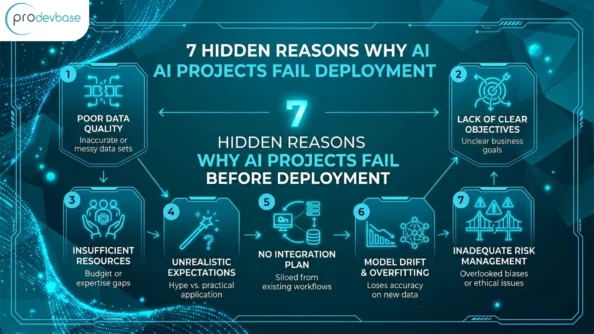
7 Hidden Reasons Why AI Projects Fail Before Deployment
A brilliant machine learning model running on a data scientist’s local laptop is a liability, not an asset. The path from a successful sandbox experiment to an enterprise production environment is where promising automation initiatives quietly die. So let’s have a look at Why AI Projects Fail Before Deployment.
When your development team spends 80% of their allocated schedule manually cleaning datasets rather than configuring the architecture, your strategy is already compromised.
Safeguarding your engineering capital requires an immediate look at the invisible operational friction points that destroy projects before launch day.
1. The Bright Shiny Object Syndrome
Organizations frequently launch initiatives because a specific technology is trending in the media, not because a concrete business bottleneck requires automation. When businesses choose the tool before defining the baseline metric, it builds an expensive solution in search of a question. Successful implementation requires an objective-driven approach where software architecture serves a clear operational goal.
2. Silent Data Friction
The engineering teams might report that you have massive amounts of enterprise information available. However, high volume does not equal high utility for machine learning models. If the data sits in isolated department silos or lacks consistent labeling, your development team will spend its entire budget preparing data rather than building core systems.
3. The Custom Build Trap
A common AI implementation mistake is trying to engineer a proprietary foundation model from scratch when a configured marketplace API would work perfectly. Teams often underestimate the long-term maintenance costs of custom neural network architecture. Unless the core value proposition depends entirely on a proprietary algorithm, building from scratch introduces massive, unnecessary risk.
4. Phantom Stakeholder Alignment
Project sponsors often sign off on budgets without understanding the operational changes required later. If the operations team, legal department, and daily end users are not involved during the design phase, they will inevitably reject the system during testing. True alignment means everyone understands exactly how the system alters their daily workflow.
5. The Proof of Concept Stagnation
Many initiatives start as successful experiments inside an isolated testing environment. Unfortunately, teams often design these experiments without considering how the system will scale across cloud networks or integrate with legacy database software. A model that performs beautifully on a local laptop can completely collapse when subjected to real-time enterprise data streams.
6. Hidden Skill Gaps
Hiring brilliant data scientists is only part of the equation. Data scientists excel at building models, but they rarely specialize in software engineering or cloud infrastructure. Without machine learning operations specialists to bridge this gap, the project will remain stuck in the development environment forever.
7. Misaligned Success Metrics
Evaluating an advanced automation system using traditional software metrics is a critical error. Traditional software is deterministic, meaning it produces the same output every time. Adaptive systems are probabilistic, meaning they operate on confidence scores and require continuous monitoring. If the leadership team expects absolute perfection on day one, they will cancel the project prematurely.
Interactive Evaluation: Assess Your Project Risk
Review these three real business scenarios to identify potential vulnerabilities in the current deployment pipeline.
Scenario A: The Executive Mandate
The leadership team requests an immediate integration of generative tools because competitors are doing it. Businesses have not identified which department will use it or how they will measure success.
- Primary Risk: Bright Shiny Object Syndrome.
- Action Step: Pause development and conduct a formal process mapping session to identify specific operational bottlenecks.
Scenario B: The Perfect Sandbox
The data science team creates an internal model with ninety-five percent accuracy using a clean, static dataset. However, the IT department has not reviewed the API connections required for live deployment.
- Primary Risk: Proof of Concept Stagnation.
- Action Step: Require a comprehensive infrastructure audit before allowing the team to write further code.
Scenario C: The Disconnected User
The development team is building an automated customer service tool. The actual customer service managers have not attended a single planning meeting because they are too busy managing current queues.
- Primary Risk: Phantom Stakeholder Alignment.
- Action Step: Halt development until a steering committee includes daily operational leaders.
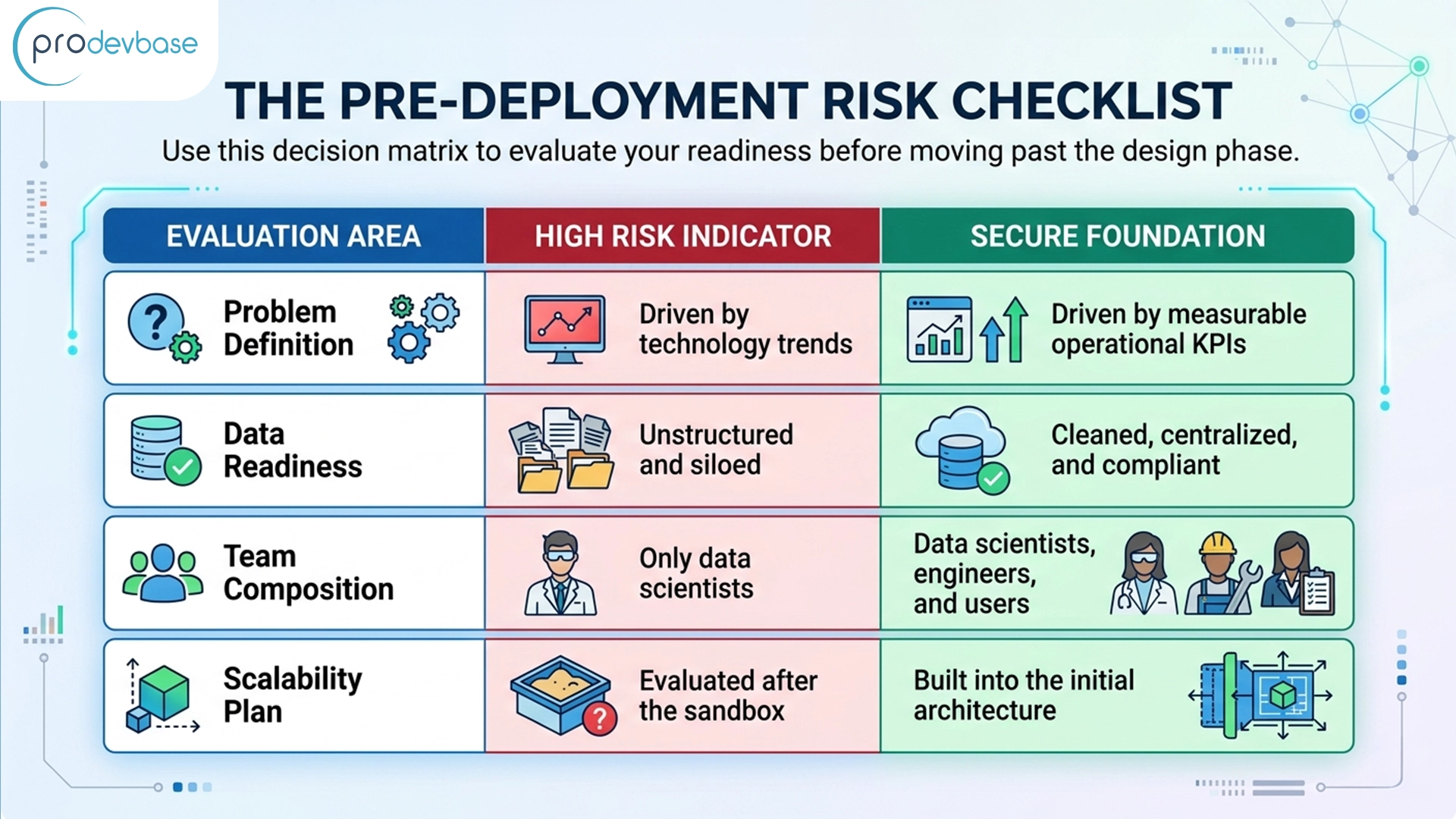
The Pre-Deployment Risk Checklist
Use this decision matrix to evaluate the readiness before moving past the design phase.
| Evaluation Area | High Risk Indicator | Secure Foundation |
|---|---|---|
| Problem Definition | Driven by technology trends | Driven by measurable operational KPIs |
| Data Readiness | Unstructured and siloed | Cleaned, centralized, and compliant |
| Team Composition | Only data scientists | Data scientists, engineers, and users |
| Scalability Plan | Evaluated after the sandbox | Built into the initial architecture |