
The Best AI Automation Use Cases in 2026 Transforming Businesses
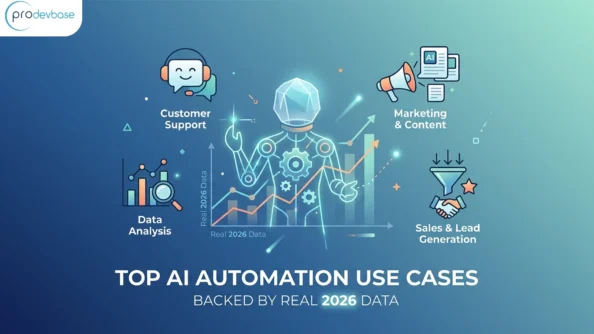
Top AI Automation Use Cases Backed by Real 2026 Data
1. Customer Service Automation
Customer service is the most mature AI automation use case today. Most contact centers already use some form of it. In fact, 88% of contact centers now report using AI in their operations, according to recent customer service research. However, only 25% have fully integrated that automation into daily workflows. So let’s have a deep look into what are the Best AI Automation Use Cases in 2026?
The gap between adoption and full integration is where the opportunity sits. AI chatbots can resolve up to 86% of routine customer questions without any human help. Agents who use AI tools alongside their own work handle close to 14% more inquiries per hour. As a result, the global AI customer service market is expected to grow from roughly 15 billion dollars in 2026 to nearly 118 billion dollars by 2034.
The lesson here is simple. Start with routine, repetitive tickets. Save your human agents for complex or emotionally sensitive cases.
2. Finance and Accounts Payable Automation
Manual invoice processing is slow and expensive. It typically costs around 15 dollars per invoice and takes roughly 12 minutes of hands-on work. AI-powered accounts payable (AP) automation changes that math entirely.
Automated systems can cut invoice processing costs by up to 80%. They also reach 99% accuracy in data capture, which removes the rework caused by typos and duplicate entries. For a company processing 500 invoices a month, that translates into tens of thousands of dollars in annual savings. On top of that, a single employee can manage over 23,000 invoices a year with automation, compared to roughly 6,000 manually.
Finance teams should treat this as a quick win. The technology is mature, the ROI is fast, and the risk is low.
3. HR and Recruiting Automation
Hiring is slow almost everywhere. The average time-to-hire in the United States sits around 42 days. AI recruiting tools are closing that gap fast by removing major structural bottlenecks.
According to recent recruitment industry data, AI can cut time-to-hire by up to 70% when applied across sourcing, screening, and interview scheduling. Resume screening time alone can drop by 75%. Cost-per-hire often falls by around 30%, with some North American companies reporting savings closer to 40%.
That said, human judgment still matters most at the final stage. Use AI to handle the high-volume, repetitive front end of hiring. Keep people in charge of the actual decision.
4. Predictive Maintenance in Manufacturing
Unplanned downtime is brutally expensive. The average large manufacturing plant loses around 253 million dollars a year because of it. AI-driven predictive maintenance directly attacks that cost.
By analyzing sensor and machine data, AI can spot early warning signs of equipment failure. Industry research shows predictive maintenance can reduce unplanned downtime by up to 50%. It can also lower overall maintenance costs by 10% to 40%. Separately, industrial field studies show that AI-driven predictive maintenance can deliver a tenfold return on investment by preventing major equipment failures.
This use case fits best in any operation with expensive machinery and costly downtime. Think factories, plants, and large-scale equipment fleets.
5. Supply Chain and Demand Forecasting
Getting demand forecasts wrong is costly in both directions. Too little inventory means stockouts. Too much means waste. AI is making forecasts much better on both fronts.
Modern AI models can reach around 87% accuracy for 30-day demand forecasts. That beats most older, manual methods by a wide margin. Companies using AI-based inventory management report a 28% drop in stockouts. Meanwhile, AI-enabled distribution operations are seeing logistics cost drops of 5% to 20% and inventory drops of 20% to 30%.
In short, this use case rewards companies with clean, centralized data. The better your inputs, the better your forecasts become.
6. Marketing Automation and Personalization
Marketing automation has moved well past simple email scheduling. AI now personalizes content, timing, and targeting at a scale no human team could manage manually.
AI-driven marketing automation delivers an average return of about 5.44 dollars for every dollar spent. Personalization tools specifically average a 2.7x return, based on recent industry data. E-commerce personalization can push ROI as high as 400%, while also cutting customer acquisition costs by up to 50%. Email flows triggered by customer behavior get far more clicks than plain, batch-sent campaigns.
The takeaway here is simple. Personalized, behavior-based marketing beats generic, one-size-fits-all marketing almost every time.
Have you missed to read: How AI Agents Reduce Business Costs Without Sacrificing Growth
How to Choose the Right AI Automation Use Case First
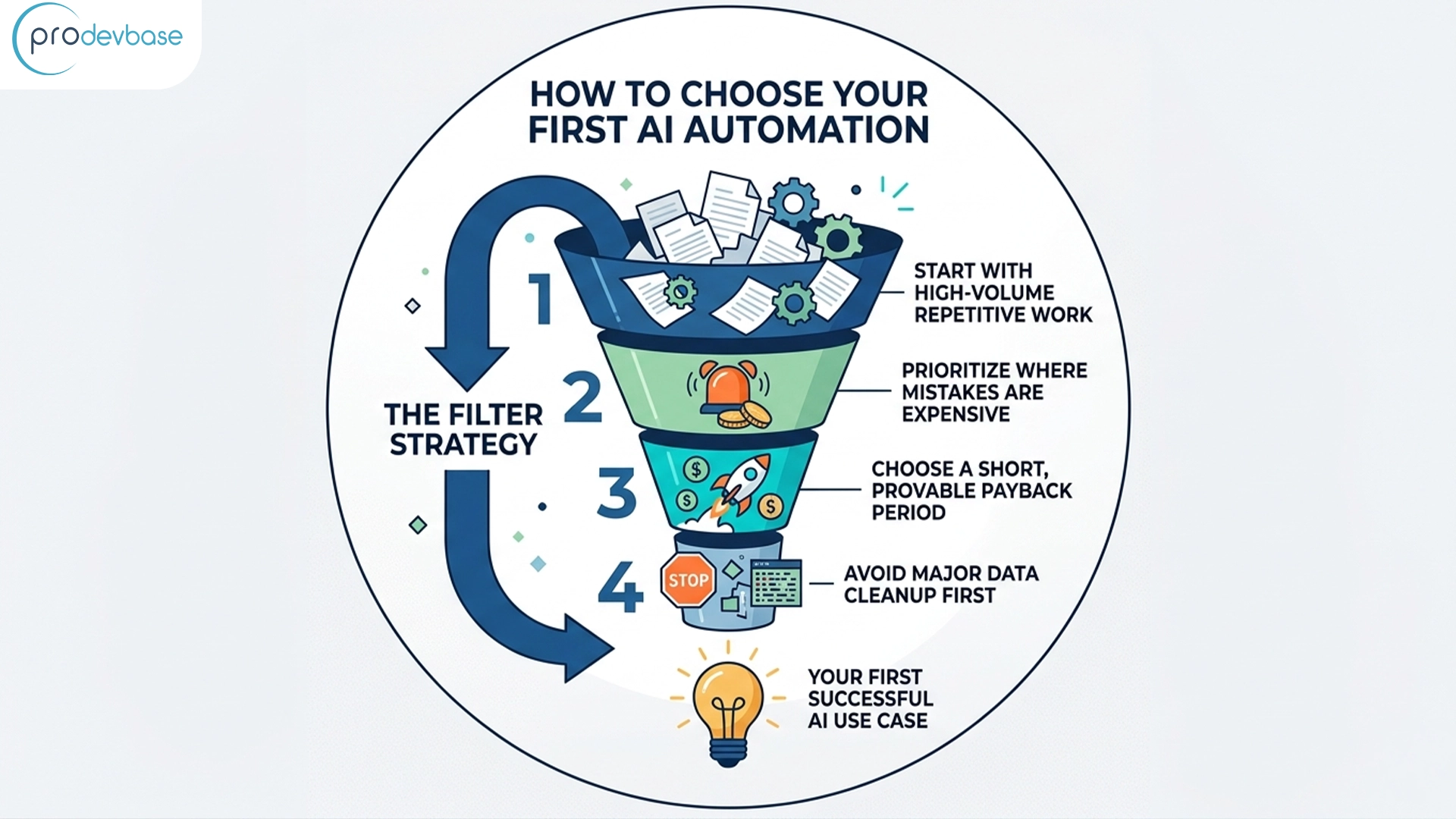
With six strong options, picking a starting point can feel like a lot. Use this simple filter strategy instead:
- Start with the function that has the most repetitive, high-volume manual work.
- Prioritize processes where mistakes are currently expensive.
- Choose a use case with a short, provable payback period.
- Avoid starting with anything that requires major data cleanup first.
Once your first project proves its value, expanding into a second function becomes a much easier internal conversation. If you want a deeper breakdown of how to prepare your business infrastructure for these changes, our AI Strategy and Advisory guide walks through how to build your long-term deployment roadmap step-by-step.
Frequently Asked Questions
Which AI automation use case has the fastest ROI?
Finance and accounts payable automation typically pays back fastest. The technology is mature, the data is highly structured, and savings are easy to measure cleanly.
Do small businesses benefit from these use cases too?
Yes. Many of the same tools now come in simpler, cheaper versions built for smaller teams, especially in customer service and digital marketing automation.
Is full automation realistic for any of these functions?
Rarely, and that is completely by design. Most successful deployments keep a human in the loop for exceptions, judgment calls, and final decisions.
How long does it take to see results from AI automation?
Many teams see measurable gains within 2 to 4 months for simpler use cases like AP automation or customer service deflection. More complex use cases, such as predictive maintenance, can take longer to fully mature.
Your Next Step: Deploying High-Impact AI Automation
The strongest AI automation use cases in 2026 share three traits. They involve repetitive work, they generate enough data to learn from, and they have a clear, measurable cost today. Customer service, finance, HR, manufacturing, supply chain, and marketing all meet that bar right now.
Pick the function where your current pain is greatest. Then use the data points above to set realistic expectations before you start.