
Intelligent Automation vs RPA: Which One Does Your Business Actually Need in 2026?
RPA vs Intelligent Automation: A Complete Comparison
What Is RPA, Exactly?
Robotic Process Automation, or RPA, is software that mimics human clicks, keystrokes, and data entry. It follows a fixed set of rules every single time. Think of it as a digital assistant that never gets bored of copying numbers from one spreadsheet into another.
RPA shines when the task is repetitive, the data is structured, and the steps never change. Common examples include:
- Moving customer records from a web form into a CRM
- Reconciling invoices against purchase orders
- Generating standard reports by pulling data from multiple systems
- Validating data fields before submission
RPA bots are fast to build and relatively cheap to deploy. However, they have one major weakness. If a system interface changes, the bot stops working. It will also fail if it encounters an exception that it was not programmed to handle.
What Is Intelligent Automation?
Intelligent Automation, often shortened to IA, takes RPA and adds a brain to it. It layers artificial intelligence, machine learning, and natural language processing on top of rule-based automation. As a result, IA systems can read unstructured documents, understand context, learn from past decisions, and handle exceptions without constant human intervention.
For example, an IA system processing insurance claims does not just move data between fields. It can read a handwritten claim form and extract the relevant details. Then, it flags suspicious patterns and routes edge cases to the right human reviewer. That level of judgment is simply out of reach for traditional RPA.
Intelligent Automation vs RPA: The Core Differences
The table below summarizes how the two technologies compare across the factors that matter most to decision-makers.
| Factor | RPA | Intelligent Automation |
|---|---|---|
| Data type | Structured only | Structured and unstructured |
| Decision-making | Rule-based, fixed | Adaptive, learns over time |
| Setup time | Days to weeks | Weeks to months |
| Cost to deploy | Lower upfront cost | Higher upfront, lower long-term |
| Handles exceptions | Poorly, needs reprogramming | Well, learns and adjusts |
| Best for | Repetitive, high-volume tasks | Complex, judgment-based processes |
| Maintenance | Breaks with layout changes | More resilient to change |
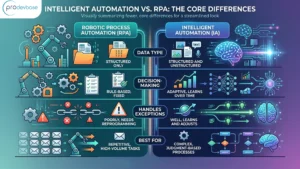
In short, RPA automates a task. Intelligent Automation automates a decision.
Real Numbers Behind the Automation Debate
The market data tells a clear story about where automation spending is heading. According to Precedence Research, the global RPA market is valued at roughly 28.31 billion US dollars in 2025. It is projected to grow to around 247.34 billion US dollars by 2035, expanding at a strong yearly growth rate.
That growth is increasingly tied to AI-powered features rather than pure rule-based scripting. This trend signals that the market itself is shifting toward the intelligent side of automation.
Industry breakdowns show why banks and insurers are leading adopters. Banks historically spend close to 270 billion US dollars annually on compliance management operations. This creates strong financial pressure to automate regulatory reporting, audit trails, and data validation. This single statistic explains why financial institutions remain one of the largest verticals for automation spending.
Geographically, North America accounted for nearly 39 percent of total RPA revenue in 2025. This was largely due to early adoption and a dense cluster of automation vendors based in the region. However, the Asia Pacific region is catching up quickly. Rising labor costs and government digitization push automation budgets higher across India, China, and South Korea.
When RPA Is the Right Choice
You should choose RPA when your process checks most of these boxes:
- The task is repetitive and follows the exact same steps every time.
- The data is clean, structured, and predictable.
- You need a quick win with a short payback period.
- The process rarely changes.
- The budget is limited and you need fast ROI.
For instance, a logistics company copying tracking numbers between legacy systems does not need artificial intelligence. It needs a reliable bot that does the same thing thousands of times a day without complaint.
When Intelligent Automation Makes More Sense
Intelligent Automation earns its higher price tag when the work involves judgment, unstructured data, or constant change. Consider IA when:
- Documents arrive in inconsistent formats, such as scanned PDFs or handwritten forms.
- The process involves exceptions that require contextual understanding.
- Customer interactions need natural language processing.
- Regulations or workflows shift frequently.
- You are automating an entire end-to-end process, not just one task.
A healthcare provider triaging patient intake forms needs more than simple data entry. It needs a system that can read free-text symptoms, prioritize urgency, and route cases correctly. That is squarely IA territory.
Can RPA and Intelligent Automation Work Together?
Yes, and in most mature organizations, they already do. RPA frequently acts as the execution layer, performing the actual clicks and data transfers. Meanwhile, AI components handle reading, reasoning, and decision-making upstream. This combined approach is often called hyperautomation, and it is quickly becoming the default operating model.
Rather than viewing Intelligent Automation vs RPA as an either-or decision, the smartest businesses treat RPA as the foundation. They layer intelligence on top only where it is genuinely needed. This keeps costs lower while still solving the harder problems that pure RPA cannot touch.
Common Mistakes Businesses Make When Choosing
Many automation projects stall or underperform because of avoidable missteps. Watch out for these five errors:
- Buying an expensive AI platform for a task that simple RPA could handle.
- Underestimating the maintenance RPA bots need when source systems change.
- Skipping a pilot phase before scaling automation company-wide.
- Ignoring change management and employee training.
- Assuming automation is a one-time project instead of an ongoing program.
Avoiding these mistakes often matters more than the specific technology you choose.
Also read: How AI Agents Reduce Business Costs and Improve Business Efficiency in 2026
Frequently Asked Questions
Is Intelligent Automation more expensive than RPA?
Generally, yes, it is more expensive upfront. IA requires AI model training, integration, and ongoing tuning. However, it delivers stronger long-term ROI for complex processes because it requires less manual rework.
Can RPA be upgraded into Intelligent Automation later?
In many cases, yes. Modern RPA platforms increasingly offer AI add-ons. Therefore, businesses can start with simple bots and expand into intelligent capabilities as needs grow.
Which industries benefit most from this comparison?
Banking, insurance, healthcare, and logistics see the clearest gains. This is because they combine high transaction volumes with frequent exceptions and strict compliance demands.
Does Intelligent Automation replace RPA entirely?
No, it does not. IA builds on RPA rather than replacing it. Most real-world deployments use RPA for the repetitive groundwork and AI for the judgment calls.
Conclusion:
The Intelligent Automation vs RPA decision is not about picking a winner. It is about matching the right tool to the right problem.
Start with RPA for quick, structured wins. Layer in Intelligent Automation when your processes demand judgment, flexibility, or unstructured data handling. Businesses that approach automation this way consistently see stronger returns than those chasing the flashiest technology on the market.
If you are unsure where your own processes fall on this spectrum, map your top five manual workflows against the comparison table above. This is a practical first step toward a clearer automation strategy.
Follow us on our LinkedIn Platform